
So, you've heard this question, maybe from a kid or maybe from that one friend who's really into their car battery. Does electricity flow from positive to negative?
It sounds like a simple yes or no, right? Like asking if water flows downhill. But here's the dirty little secret of electrical engineering: the answer is both yes and no, and it depends entirely on when you went to school and whether you're talking about history or reality.
Honestly? This is the single most confusing part of learning about electronics. I've seen grown adults, seasoned mechanics, and even some new electrical engineers get tripped up on this. Let's cut through the noise. I've been in this game for over a decade, and I still have to mentally switch gears depending on what I'm looking at. So let's settle this once and for all.
The Great Lie We All Tell: The Case for Conventional Current
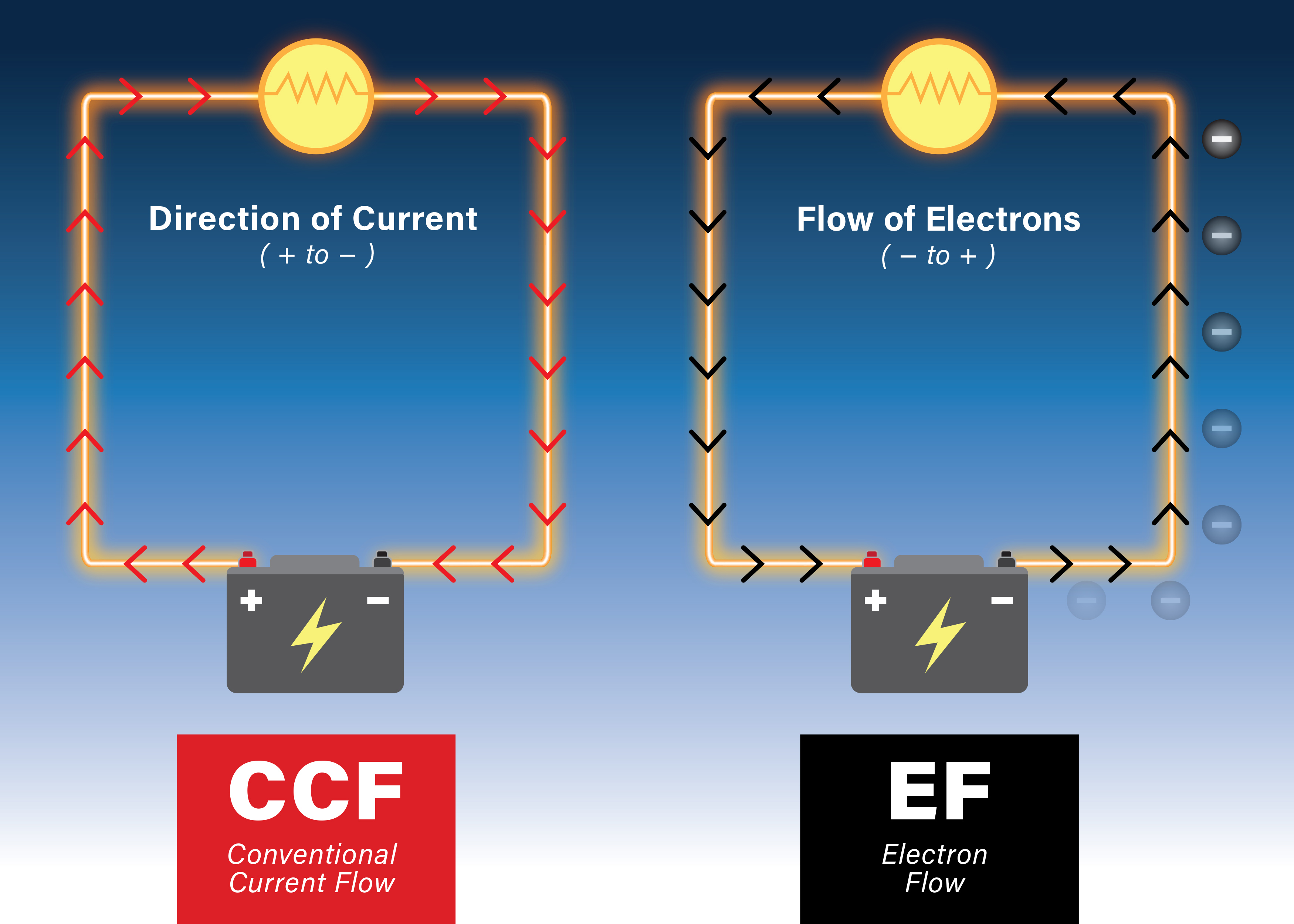
Look—if you open up any textbook that teaches circuit analysis, you will see arrows drawn on wires. These arrows point from the positive terminal of a battery, through the resistor, through the light bulb, and back to the negative terminal. This is called conventional current, and it is the standard language of electrical engineering.
Does electricity flow from positive to negative according to these textbooks? Yes. Absolutely. Without a doubt.
Why? Because we had to pick a direction before we knew what we were actually doing.
Here's the history: Benjamin Franklin was messing around with static electricity in the 1700s. He theorized that electricity was a fluid that flowed from the positive (surplus) to the negative (deficit). He guessed the direction. And here is the kicker—he was wrong. But by the time we figured out he was wrong (roughly 150 years later with the discovery of the electron), the entire engineering profession, all the math, all the textbooks, and all the circuit symbols were already built on his model.
So we kept it. It's more convenient.
#### The Practical Survival Guide
If you are designing a circuit board, analyzing a power grid, or reading a schematic for a car alarm, you must use conventional current. You don't have a choice. It is the language.
- Circuit Analysis: Kirchhoff's Voltage Law and Ohm's Law work perfectly with conventional current. - Semiconductor Physics: When you look at a diode symbol (the arrow), current flows in the direction of the arrow. This is conventional current. - Communication: If you tell a technician the current is flowing the "wrong way," you will confuse everyone.
In this context, the flow of electricity from positive to negative is not just a theory; it's the operating manual for our modern world.
The Bitter Truth: What is Actually Happening Inside the Wire
Now, let's get real. Let's zoom in. Does electricity flow from positive to negative when we look at the actual particles?
Absolutely not.
The electric current in a typical copper wire is the movement of electrons. Electrons are negatively charged. They are attracted to positive charges and repelled by negative charges. So, the actual physical particles that carry the charge move from the negative terminal to the positive terminal.
It's a big deal because it reverses everything.
Imagine a pipe filled with ping-pong balls. If you shove a new ball in one end, a ball falls out the other end almost instantly. The "signal" travels fast. But the actual ball you pushed? It moves slowly. That's the difference between electron flow and conventional current.
#### The "Hole" Concept (Get Your Mind Out of the Gutter)
This gets even weirder in semiconductors. In a P-type semiconductor, you don't have moving electrons. You have "holes"—a lack of an electron. These holes behave as if they are positive charges.
1. An electron moves to fill a hole. 2. This creates a new hole where the electron used to be. 3. The hole effectively moves in the opposite direction of the electron.
So, when we draw an arrow showing conventional current flowing from positive to negative, we are actually accurately describing the movement of these "holes" or the "energy" of the flow. The electron flow is the physical reality, but the energy transfer is modeled by the positive flow.
When Does This Actually Matter? (And When Does It Not?)
Seriously. For 90% of people, this is a philosophical debate that doesn't affect their daily life. If you are changing a light switch, the wire is either live or neutral. The physics is irrelevant.
But there are specific times when knowing the difference between conventional current and electron flow saves your bacon.
#### Troubleshooting with a Scope
If you are looking at a circuit signal on an oscilloscope, you need to understand the reference. A negative voltage spike means electrons are rushing away. If you are using conventional current logic, you might think the power is dropping, but in reality, the electrons are just moving violently in the other direction.
#### Electrochemistry and Batteries
This is where it gets hilarious. Does electricity flow from positive to negative inside a battery? No. Inside a battery (during discharge), negatively charged ions flow towards the positive electrode, and positively charged ions flow towards the negative. The electron flow is through the external circuit. The actual chemical process depends entirely on the movement of ions, not the direction of the arrow in the textbook.
Here is a critical list of real-world applications where the direction shifts:
- Cathodic Protection: This is how we stop ships from rusting. We literally force electrons into the metal. You must understand electron flow to set this up. - Vacuum Tubes: In old guitar amps, electrons boil off a hot cathode and fly to a plate (anode). They go from negative to positive. No conventional current nonsense here—it's naked electron physics. - Particle Accelerators: You are shooting electrons. You care about the negative charge. You don't pretend they are positive.
Common Questions About Does Electricity Flow from Positive to Negative
Why do we still teach conventional current if it's wrong?
Because it makes the math easier. All the standard formulas for voltage, current, and resistance were written based on conventional current. It creates a consistent framework for analyzing complex circuits. Rewriting thousands of textbooks and re-engineering all simulation software would cost billions and fix nothing.
Does the direction of current matter for a light bulb?
For a standard incandescent bulb or an AC appliance? No. The filament doesn't care which way the electron flow goes. For an LED? Yes. An LED is a diode. It only lets current flow in one direction (from the anode to the cathode, which follows conventional current). If you install an LED backwards, it just won't light up.
Is AC current moving from positive to negative?
No. Alternating Current (AC) is constantly reversing direction. It swings from positive to negative and back again. In this case, the conventional current model still holds, but the actual electron flow is wiggling back and forth. It doesn't go anywhere; it just oscillates.
If I get shocked, does it matter which way the electricity flows?
For the damage it does? No. The severity of a shock is determined by the current (amps) and the path through your body, not the direction of the charge. Your heart doesn't care if the electrons are going up or down; it cares about the disruption of electrical signals. Does electricity flow from positive to negative across your skin? Yes, according to conventional current analysis, but the pain is the same either way.
How do I remember which is which in a circuit?
I use a simple trick. Conventional current is for the "big picture" of the circuit. Electron flow is for the "physics" of the component. If you are drawing a block diagram, use conventional current. If you are building a battery from scratch or dealing with plasma, use electron flow. Just remember: Franklin guessed wrong, but we kept his guess because it was too expensive to change.
If you found this grammar guide about do and does in english useful, let others know about it. He/she/it form of do 3. Dengan memahami aturan dan contoh di atas, kamu bisa. Many english learners (and even native speakers) get confused about when to use do and when to use does. Gunakan “do, does” untuk membuat kalimat tanya dan negatif dalam bentuk present simple, atau sebagai kata kerja utama. Do and does are forms of the verb “to do.” they appear frequently in english sentences, especially when forming questions, negative statements, or emphasizing an idea. He/she/it form of do 2. Both words are forms of the verb “to do,” and they play important roles in. Pelajari 100 contoh penggunaan do dan does dalam simple present tense beserta artinya. Penggunaan kedua kata kerja ini umum digunakan pada percakapan bahasa inggris, kamu bisa menggunakan untuk menyatakan suatu aksi, pertanyaan,.
Pelajari 100 contoh penggunaan do dan does dalam simple present tense beserta artinya. We’ve put together a guide to help you use do, does, and did as action and auxiliary verbs in the simple past and present tenses. If you found this grammar guide about do and does in english useful, let others know about it. Dengan memahami aturan dan contoh di atas, kamu bisa. He/she/it form of do 2. Do and does are forms of the verb “to do.” they appear frequently in english sentences, especially when forming questions, negative statements, or emphasizing an idea. Present simple of do, used with he/she/it. He/she/it form of do 3. Many english learners (and even native speakers) get confused about when to use do and when to use does. Dilengkapi soal untuk memahami perbedaan do dan does.
If you found this grammar guide about do and does in english useful, let others know about it. Dengan memahami aturan dan contoh di atas, kamu bisa. He/she/it form of do 2. See our notes about the difference between do, does, did and done. Both words are forms of the verb “to do,” and they play important roles in. Pelajari 100 contoh penggunaan do dan does dalam simple present tense beserta artinya. We’ve put together a guide to help you use do, does, and did as action and auxiliary verbs in the simple past and present tenses. Gunakan “do, does” untuk membuat kalimat tanya dan negatif dalam bentuk present simple, atau sebagai kata kerja utama. Present simple of do, used with he/she/it. Do and does are forms of the verb “to do.” they appear frequently in english sentences, especially when forming questions, negative statements, or emphasizing an idea.
Pelajari 100 contoh penggunaan do dan does dalam simple present tense beserta artinya. Dengan memahami aturan dan contoh di atas, kamu bisa. See our notes about the difference between do, does, did and done. Dilengkapi soal untuk memahami perbedaan do dan does. Both words are forms of the verb “to do,” and they play important roles in. Many english learners (and even native speakers) get confused about when to use do and when to use does. Gunakan “do, does” untuk membuat kalimat tanya dan negatif dalam bentuk present simple, atau sebagai kata kerja utama. Present simple of do, used with he/she/it. Penggunaan kedua kata kerja ini umum digunakan pada percakapan bahasa inggris, kamu bisa menggunakan untuk menyatakan suatu aksi, pertanyaan,. We’ve put together a guide to help you use do, does, and did as action and auxiliary verbs in the simple past and present tenses.