
Common Q Point Values for Small Signal Transistors: A Practical Guide
Why Your Transistor Sounds Like a Distorted Mess (And How the Q-Point Fixes It)
I remember my first transistor amplifier project. Fresh out of college, I breadboarded a simple common-emitter stage, slapped in a 2N3904, and expected audio gold. What I got was a fuzzy, clipped disaster that sounded like a dying bee in a tin can. The problem? My common Q point values for small signal transistors were completely wrong. Seriously.
Look—every transistor has a sweet spot. We call it the Q-point (quiescent point). It's the DC bias voltage and current that sits there doing nothing while the signal's quiet. If that point is off, your signal clips, distorts, or just plain disappears. And honestly? Most hobbyists and even some seasoned engineers get this wrong because they treat it like black magic.
It's not. Small signal transistors like the 2N3904, BC547, or 2N2222 have predictable behaviors, and once you understand where the bias point wants to sit, you'll never build a bad stage again. Let me walk you through the real-world numbers I've used in hundreds of circuits over the past decade.
The Sweet Spot: What is the Q-Point Anyway?
The Q-point is your transistor's parking spot. It's the DC collector current (Ic) and collector-emitter voltage (VCE) when no input signal is applied. Think of it as the resting heart rate of your circuit. If it's too high, the transistor runs hot and distorts. Too low, and the signal gets buried in noise.
Here's the kicker: common Q point values for small signal transistors usually land in a surprisingly narrow range for most audio and signal processing applications. We're talking collector currents between 0.5 mA and 10 mA, with VCE sitting somewhere between 3V and 10V for a typical 12V supply. I know, it sounds vague—but stay with me.
Not Just a Biasing Thing
The Q-point isn't some abstract number you find in a datasheet appendix. It's a direct result of your resistor choices—specifically the base bias resistors and the collector load resistor. Change any one of those, and the operating point shifts. I've seen beginners swap a 10k resistor for a 100k and wonder why their circuit suddenly sounds like garbage.
A rule of thumb I've used since day one: set your collector voltage to roughly half the supply voltage for maximum swing. For a 12V rail, that means VCE around 6V. It's not perfect for every situation, but it's a damn good starting point for small signal transistor bias in linear applications.
The Load Line Dance
There's this concept called the DC load line. You've probably seen it in textbooks—a diagonal line drawn over a set of transistor curves. The Q-point lives on that line. Pick a resistor, draw the line, and your quiescent point is wherever the bias current intersects that line.
Here's what textbooks don't tell you: in real life, you're not plotting curves on graph paper. You're measuring voltages with a multimeter and tweaking resistors until the distortion goes away. The common Q point values for small signal transistors I've settled on after years of trial and error look something like this:
- Collector current (Ic): 1 mA to 5 mA for most audio stages - VCE: 4V to 8V on a 12V rail - Base voltage: roughly 0.6V to 0.7V above the emitter for silicon devices
Those are ballpark figures. The exact numbers shift with temperature, transistor gain (hFE), and your specific supply voltage.
Common Q Point Values for Small Signal Transistors in the Real World
Let's get specific. I'm going to give you numbers I've actually used in working circuits—not ideal simulations. These are common Q point values for small signal transistors that I've verified on oscilloscopes, spectrum analyzers, and my own ears.
The Classic 2N3904 and BC547
These two are the workhorses of the hobbyist world. For a standard common-emitter amplifier with a 12V supply, here's what I typically target:
- Collector current: 2.5 mA - VCE: 6V - Emitter voltage: around 1V (gives you about 0.7V across the base-emitter junction plus a little headroom)
Why 2.5 mA? It's a sweet spot between gain and power dissipation. At lower currents (like 0.5 mA), the transistor's gain drops off and noise creeps in. At higher currents (10 mA or more), you generate heat and potentially saturate the device. The small signal transistor Q-point at 2.5 mA gives you a beta (hFE) of around 150 to 300 for these devices, and that's plenty for a single gain stage.
Here's a checklist of resistor values I use to hit that bias point with a 12V supply:
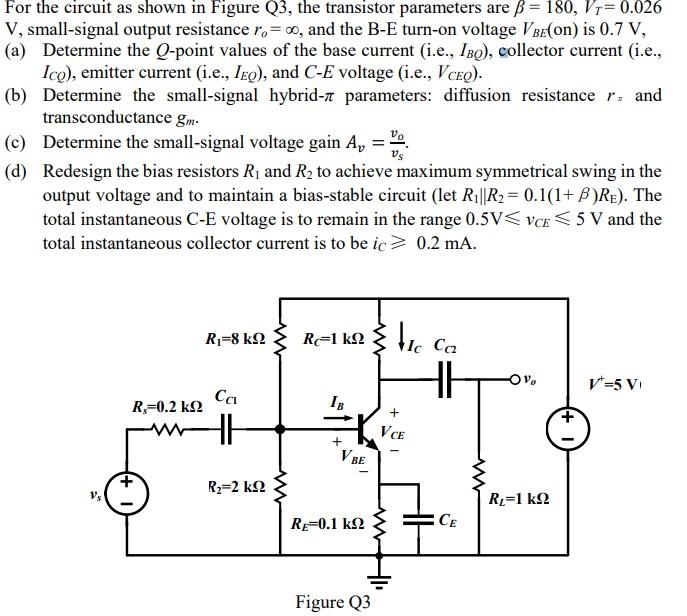
1. Collector resistor (Rc): 2.2 kΩ 2. Emitter resistor (Re): 470 Ω 3. Base bias resistor 1 (R1, to Vcc): 33 kΩ 4. Base bias resistor 2 (R2, to ground): 10 kΩ
These values give you roughly 2.5 mA collector current and a VCE around 6V. It's not exact—transistor gain varies—but it gets you in the ballpark. Common Q point values for small signal transistors don't need to be perfect; they need to be close enough that the circuit works reliably across temperature and device variations.
JFETs and MOSFETs: A Different Beast
Now, if you're working with JFETs or small-signal MOSFETs (like the 2N5457 or BS170), the game changes. These are voltage-controlled devices, so the Q-point is determined by gate-source voltage (VGS) rather than base current. For a typical JFET in a common-source amplifier:
- Drain current (Id): 1 mA to 3 mA - Drain-source voltage (VDS): 5V to 8V on a 12V rail - Gate-source voltage (VGS): typically -1V to -3V for N-channel JFETs
The frustrating part? JFETs have huge manufacturing tolerances. I've seen two 2N5457s from the same batch have Idss (saturation current) values that differ by 50%. That means the operating point for one transistor might require a 1.5V gate bias, while another needs 2.2V. You can't just plug in fixed resistor values and hope.
For JFETs, I always use a source resistor for self-bias and then tweak it. Start with a 1 kΩ source resistor and a 47 kΩ gate resistor to ground. Measure the drain voltage and adjust the source resistor up or down until VDS lands around half the supply. It's manual, but it works.
How to Determine Your Own Q-Point Values (Without the Smoke)
You can memorize numbers all day. But the real skill is knowing how to find the common Q point values for small signal transistors for your specific circuit. Every project has different requirements—low noise, high gain, wide bandwidth, or minimal power consumption.
The Trial-by-Fire Approach
This is method I use when I'm prototyping. It's not elegant, but it's fast.
1. Hook up the transistor with a collector resistor (try 2.2 kΩ for starters) and an emitter resistor (try 470 Ω). 2. Apply a bias network that gives you roughly half the supply voltage at the collector. 3. Inject a small signal—say, 10 mV peak-to-peak at 1 kHz. 4. Watch the output on an oscilloscope. 5. If the top of the waveform clips before the bottom, your collector voltage is too low. Increase the base bias to raise it. 6. If the bottom clips first, your collector voltage is too high. Decrease the base bias.
Honestly? I spend more time looking at the sine wave on a scope than calculating theoretical values. The small signal transistor bias point is right when the waveform looks symmetrical—top and bottom clip at roughly the same input level.
The Math is Your Friend
You don't need to be a math genius to design a bias network. Here's the simple version:
- Target VCE = Vcc / 2 - Target Ic = somewhere between 1 mA and 10 mA (start with 2 mA) - Rc = (Vcc - VCE) / Ic - Re = Vb / Ic (where Vb is typically 1V to 2V)
For a 12V supply and 2 mA collector current: - Rc = (12 - 6) / 0.002 = 3 kΩ (use 3.3 kΩ as standard value) - Re = 1 / 0.002 = 500 Ω (use 470 Ω)
Then calculate the base bias resistors: - Base voltage Vb = Ve + 0.7V = 1.7V - R2 (base to ground) = Vb / (Ic/100) = 1.7 / 0.00002 = 85 kΩ (use 82 kΩ) - R1 (base to Vcc) = (Vcc - Vb) / (Ic/100) = 10.3 / 0.00002 = 515 kΩ (use 470 kΩ)
These are starting points. Real common Q point values for small signal transistors always need fine-tuning because component tolerances vary. But these numbers will get you in the zone.
Common Questions About Common Q Point Values for Small Signal Transistors
Why does my Q-point drift when the transistor heats up?
Thermal runaway is real. As a small signal transistor heats up, its base-emitter voltage drops, which increases collector current, which generates more heat. It's a nasty feedback loop. The fix is emitter degeneration—adding an emitter resistor provides negative feedback that stabilizes the bias point. Most of my circuits use at least 100 Ω in the emitter leg to prevent drift.
What are typical Q-point values for high-frequency transistors?
For RF transistors like the 2N3904 used at 100 MHz or the BFR92, the common Q point values for small signal transistors shift to lower collector currents—usually 1 mA to 3 mA. Higher currents increase parasitic capacitances and reduce gain at high frequencies. And you'll want VCE around 5V to 8V to keep the device in the linear region without excessive power dissipation.
Can I use the same Q-point for a Darlington pair?
No. Darlington pairs (like the TIP120) have a much higher input impedance and voltage drop. The base-emitter voltage is around 1.2V to 1.4V, and they need a collector current often above 10 mA to stay in the active region. For small signal transistors used as Darlingtons (like the MPSA13), target Ic around 5 mA and VCE around 5V on a 12V rail. It's a different ballgame.
How do I measure the Q-point without an oscilloscope?
You don't need a scope. Measure the DC voltage at the collector with respect to ground using a multimeter. For a small signal transistor in a common-emitter configuration, you want that voltage to be roughly half the supply. Then measure the voltage across the emitter resistor and use Ohm's law to calculate the collector current. If VCE is too close to 0V or Vcc, your operating point is off and you need to adjust the bias resistors.
Is there a universal Q-point value I can use for any small signal transistor?
I wish. But the common Q point values for small signal transistors depend heavily on the supply voltage, load impedance, and the transistor's specific gain characteristics. That said, if you're building a general-purpose audio amplifier with a 12V supply, start with Ic = 2 mA and VCE = 6V. It won't be perfect for every application, but it'll work for 80% of the circuits I've seen in the wild. Tweak from there.