
How to Find the Minimum Element in a Partially Ordered Set
I remember my first real encounter with a partially ordered set. It was in a dependency resolver for a legacy build system. I figured I could just sort everything by version and grab the first item. That was a mistake. A costly one. The build broke in spectacular fashion, and I spent the next three days untangling a web of incomparable packages (think: Python 2.7 vs. Python 3.0 in the same environment). That painful lesson taught me that finding the minimum element in a partially ordered set is a fundamentally different problem from finding the smallest number in a list.
So, how do you actually do it? How do you find the minimum element when the rules of comparison are incomplete, when some items simply can't be compared to each other? This isn't about simple sorting algorithms. This is about navigating a lattice of relationships where the concept of 'smallest' becomes deceptively complex. Honestly, it's a problem that most developers get wrong on the first try. Let's fix that.
The Core Problem: Why It's Not as Simple as Sorting
Before we dive into the algorithms, we have to get the definition straight. A partially ordered set (or poset) is a set equipped with a binary relation that is reflexive, antisymmetric, and transitive. In plain English: you can have elements where neither one is less than or greater than the other. They are incomparable. That's the killer.
Think about a set of tasks in a project. Task A 'must be done before' Task B. Task B 'must be done before' Task C. Sure, that's a chain, a total order. But what about Task D, which has no dependency relation to any of them? You can't say D is smaller or larger than A. It just is. That incomparability is what makes finding the minimum element a distinct challenge.
What Exactly Is a Partially Ordered Set?
Let's be precise for a second. The relation in a poset is often written as ≤ (less than or equal to). But it doesn't have to be numeric. It could be 'is a subset of', 'divides', or 'is an ancestor of'. The key properties are:
Now, the minimum element in a poset is an element m such that for every element x in the set, m ≤ x. It must be less than or equal to everything else. That's a very strong condition. And here's the kicker: not every poset has a minimum element. You could have multiple 'smallest' candidates that are incomparable to each other, and then none of them qualifies as a true minimum.
- Reflexive: Every element is related to itself (a ≤ a).
- Antisymmetric: If a ≤ b and b ≤ a, then a = b. No circular comparisons.
- Transitive: If a ≤ b and b ≤ c, then a ≤ c.
Why Can't You Just Scan the List?
Look, if you have a total order (every element is comparable to every other element), then a simple linear scan will find the minimum. It's O(n). That's easy. But with a poset, scanning gives you a candidate, but you can't be sure another element doesn't exist that is incomparable to your candidate and also smaller than everything else in its own branch.
Seriously, imagine you have two chains: 1 < 2 < 3, and A < B < C. You scan and find 1. Is 1 the minimum element? No, because 1 is incomparable to A. A is not ≥ 1, and 1 is not ≥ A. So 1 fails the definition. You need at least one element that is comparable to every element and is the smallest among them. That's not something a simple loop catches. It's a big deal when you're working with dependency graphs or type hierarchies.
The Hunt for the Minimum: Algorithms That Actually Work
Alright, so we can't just sort. What can we do? There are a few practical strategies, and the right one depends on whether your poset is finite, its size, and how it's represented. Let's walk through them.
The Naive Approach (and Why You'll Hate It)
The most straightforward method is to compare every element against every other element. For each candidate, you check if it is less than or equal to all others. Here's the logic:
This works, but it's O(n2) comparisons in the worst case. For small sets (fewer than 100 elements), it's fine. For large posets, it's painfully slow. Honestly, it's the brute-force approach you use when you're debugging or when the data is tiny. For anything serious, we need a better way.
- For each element e in the set:
- Assume e is the minimum.
- For every other element f:
- Check if e ≤ f is true. If it's false (because f < e or they are incomparable), then e is disqualified.
- If e passes all comparisons, you have found a minimum element. (If you need the minimum, there can be only one.)
The Hasse Diagram Shortcut: Visualizing the Poset
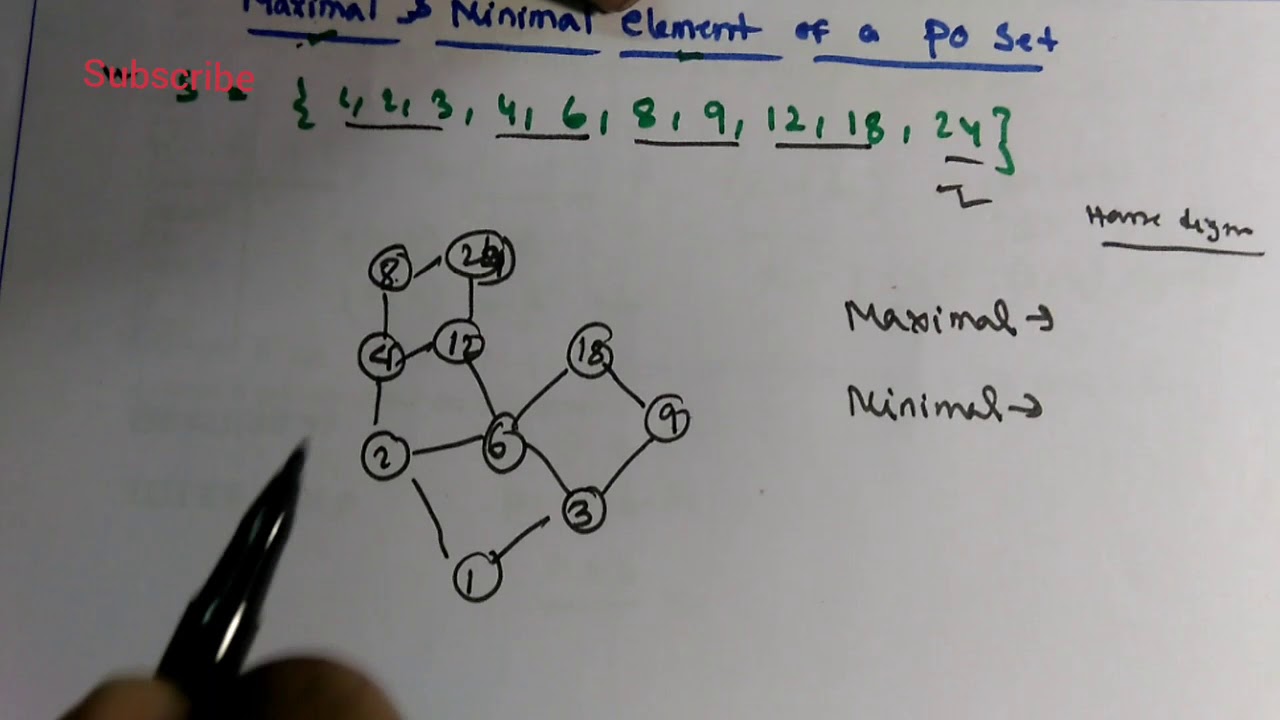
This is where a bit of mathematical intuition saves you time. A Hasse diagram is a graphical representation of a poset. You draw the elements as nodes, and you draw an edge from a to b if a < b and there is no element c such that a < c < b (this avoids drawing transitive edges). The diagram inherently shows the structure.
To find the minimum element visually: look for the nodes that have no incoming edges from below. Those are minimal elements (elements that have no elements smaller than them). Now, if there is exactly one such node, and that node is comparable to every other element (which you can check quickly by seeing if there's a path from it to every other node), then you have found the minimum element.
But here's the trick: if there are multiple minimal elements (e.g., two nodes at the bottom with no edges between them), then there is no single minimum element. You have a set of minimal elements, which is a different concept. The Hasse diagram gives you a clear, immediate answer: one bottom node = minimum; multiple bottom nodes = no minimum. It's a beautiful shortcut for visual analysis, but it requires you to build the diagram first, which can be O(n2) anyway.
The Removal Technique: A Practical Strategy
For computational efficiency, here's a method I've used in production for dependency checking. It works well if the poset is represented as an adjacency list of 'less-than' relationships. We call it the 'removal method':
- Start with a copy of the set S.
- Find all minimal elements in S: Elements that have no element smaller than them within S. This can be done by checking each element against its incoming neighbors.
- If there is exactly one minimal element, it is a candidate. If there are zero, the set is empty (no elements). If there are more than one, there is no minimum element in this poset.
- If you have a single candidate, you must verify it is comparable to all remaining elements. If it is, you've found the minimum. If it isn't (because some element is incomparable), then there is no minimum.
This method is O(n2) in the worst case for building the minimal element list, but in practice, with sparse relationships, it's much faster. It also gives you a clear answer: yes or no. No ambiguous 'almost minimum' nonsense.
When Things Get Tricky: Multiple Minimal Elements and the Empty Set
Now we enter the grey area. The terminology here is crucial because it's where most people stumble. A minimum element is unique and comparable to everything. A minimal element is simply one that has no smaller element. A poset can have many minimal elements. Think about a set of disjoint chains. Each chain has its own bottom. That bottom is minimal, but none of them is the minimum because they aren't comparable to the bottoms of other chains.
Identifying All Minimal Elements vs. One Minimum
The computation to find all minimal elements is often more useful in practice than searching for a single minimum element. For example, in a build system, you want all tasks that have no prerequisites. Those are the minimal elements, and you can run them in parallel. You don't need a single minimum.
The algorithm to find all minimal elements is straightforward: iterate through all elements. For each element, check if there exists any other element that is strictly less than it. If not, it's minimal. That's O(n2). A more efficient approach uses a topological sort or a Hasse diagram, but for most real-world datasets, the simple approach is fine. Seriously, don't over-engineer it if your poset has fewer than 10,000 elements.
The Infimum (Greatest Lower Bound) vs. The Minimum
This is a subtle but powerful point. In some posets, you don't have a minimum element, but you might have an infimum for the whole set. The infimum (or greatest lower bound) is the largest element that is less than or equal to every element. It might not be in the set itself. For example, consider the set of positive integers with the divisibility relation. There is no minimum element (1 is minimal, but is it the minimum? No, because 1 divides all integers, so in fact 1 is the minimum. But if the set were {2, 3, 5}, there is no minimum, but the infimum (if we consider the integers) would be 1, which is not in the set).
Distinguishing between the minimum element (must be in the set) and the infimum (can be outside the set) is critical in formal verification and lattice theory. But for everyday programming, if you're asked for the minimum, you care only about elements that exist in your dataset.
Real-World Applications: Where This Matters
You might be thinking, 'When am I ever going to need this in a real project?' The answer is: more often than you think. Let me give you two concrete examples.
Dependency Management and Build Systems
Every package manager (npm, pip, Maven) deals with a poset of dependencies. Each package has a set of versions, and versions have 'less than' relationships (2.0 < 3.0). But you also have incomparability: two different packages are not comparable. When resolving a build order, you need the minimal elements of the dependency graph (packages with no dependencies). But if you need a single minimum element (e.g., a base library that everything depends on and that depends on nothing), you're looking for a specific kind of 'root.' Not every project has one, and forcing the issue leads to circular dependency errors.
I once worked on a monorepo with 200+ microservices. The build system tried to find a single 'most foundational' service. It didn't exist. They wasted weeks trying to force a total order. The solution was to accept multiple minimal services and build them concurrently. That's the real-world lesson: don't look for a minimum element if your nature doesn't have one. Look for the set of minimal elements.
Database Schema and Partial Orders
Consider database schemas for versioned data. You have tables that depend on other tables (foreign keys). The dependency graph is a poset. If you want to migrate a database from one schema version to another, you need to find the minimum element of the set of applied schemas to know the starting point. But schemas might be applied in different orders on different branches. The 'minimum' might not exist across branches. In that case, you find the greatest lower bound of all applied schemas, which might be a schema that was never explicitly installed. This is a classic use of infimum calculations.
Common Questions About Finding the Minimum Element in a Partially Ordered Set
Can a partially ordered set have more than one minimum element?
No. By definition, a minimum element must be comparable to and less than or equal to every other element. If you had two distinct elements that both satisfied this, they would have to be less than or equal to each other, which by antisymmetry forces them to be equal. If you think you have two minima, you actually have two minimal elements, not two minima. It's a common terminology trap.
What is the difference between a minimal element and a minimum element?
A minimal element has no element strictly less than it. A poset can have many minimal elements. A minimum element is less than or equal to every element in the set. A minimum element is always minimal, but a minimal element is not necessarily a minimum (e.g., two chains with disjoint bottoms). Think of it this way: a minimum is the 'global smallest,' while a minimal is a 'local smallest.'
How do I find the minimum element in a finite poset efficiently?
For a finite poset, the most practical method is to first find all minimal elements (elements with no incoming edges from smaller elements). If there is exactly one minimal element, check if it is comparable to every other element (by tracing paths or verifying the relation directly). If it is, you have the minimum. If there are multiple minimal elements or the single minimal is incomparable to some element, there is no minimum. This runs in O(n2) for a generic poset, but you can improve it to O(n + m) if you have a Hasse diagram representation (where m is the number of covering relations).
Does every partially ordered set have a minimum element?
No. Absolutely not. This is the single most important point. Many posets have no minimum element. For example, the set of integers with the usual ≤ order has no minimum (it goes to negative infinity). The set of tasks with no common dependency often has multiple minimal elements but no single minimum. The existence of a minimum is a special property called 'being well-ordered from below.' Never assume it exists.