
The Unseen Anchor: Why Q-Point Stability in BJT Amplifiers Makes or Breaks Your Design
I still remember the first time a circuit I built literally cooked itself on the bench. It was a simple two-stage BJT amplifier, something I threw together from a textbook schematic. It worked beautifully in the simulation. On the actual board, it started humming, then got hot, and within thirty seconds, the collector current had doubled. The waveform? A distorted mess. That day, I learned the hard way that Q-point stability isn't a theoretical nicety—it's the difference between a reliable amplifier and a smoke generator. If you don't lock that bias point down, the transistor will drift, and your signal goes with it.
Let's get real here. Every BJT has a quiescent operating point, the so-called Q-point. It's the DC voltage and current you set when there's no input signal. Think of it as the anchor point for your AC signal. If that anchor is wobbling around, your signal will clip, distort, or vanish entirely. Seriously, understanding Q-point stability is the cornerstone of practical amplifier design. Without it, you're just hoping the silicon doesn't betray you.
The Silent Killer: How Temperature Wrecks Your Q-Point
The number one enemy of a stable Q-point is heat. Look—transistors are inherently temperature-sensitive devices. As the junction temperature rises, the base-emitter voltage drops by roughly -2 mV per degree Celsius. That might sound small, but in a high-gain circuit, it creates a domino effect. A lower VBE means more base current, which means more collector current, which generates more heat. It's called thermal runaway, and it's the fastest way to kill a BJT. Honestly? I've seen junior engineers chase distortion problems for hours, only to realize the gain stage was drifting in and out of saturation like a drunk sailor.
Thermal runaway isn't the only issue. Even a stable temperature environment doesn't guarantee a fixed Q-point. Beta (hFE) variation is another monster. Two transistors from the same batch can have beta values that differ by 100% or more. If your biasing network relies on a fixed base current, you're toast. The Q-point will jump all over the place when you swap out a transistor. This is why professionals obsess over DC bias stability long before they worry about AC gain.
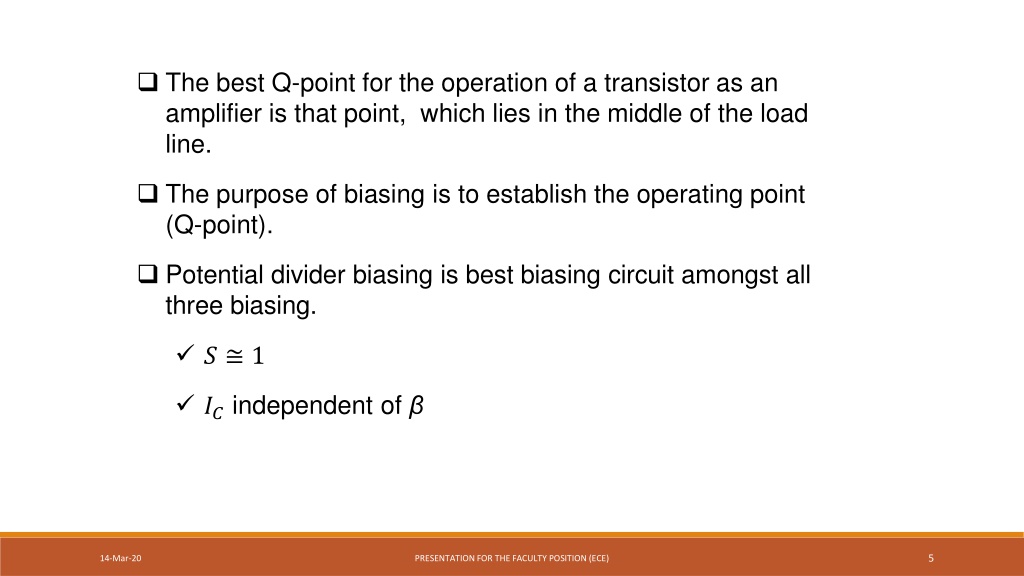
So what does an unstable Q-point actually look like on a scope? You'll see asymmetrical clipping. The top half of your sine wave will get squashed, or the bottom half will disappear. The gain will start to fluctuate as the transistor moves into the saturation or cutoff region. It's a big deal because you lose headroom. A well-stabilized Q-point sits in the middle of the DC load line, giving you maximum swing. When it drifts, you sacrifice dynamic range.
I can't stress this enough: a stable Q-point is the difference between a clean 10x amplifier and a signal that sounds like a broken fuzz pedal. The math is important, but the practical impact is what matters to your ears and your oscilloscope.
Why Fixed Bias is a Trap (And How to Escape)
The simplest biasing method is fixed bias. You put a resistor from VCC to the base, and you're done. It's a trap. Pure and simple. With fixed bias, your Q-point is almost entirely dependent on beta. Beta changes with temperature and manufacturing tolerances. You might set it perfectly at 25 degrees Celsius, but at 50 degrees, the collector current could triple. Don't use fixed bias for anything critical. It's fine for a switching circuit, maybe, but for a linear amplifier? It's a recipe for disaster.
Instead, you need feedback. The most common method is emitter degeneration. You put a resistor (RE) in the emitter leg. When collector current tries to increase, the voltage across RE rises, which effectively reduces the base-emitter voltage. It self-corrects. It's not perfect—you trade some gain for stability—but the trade-off is almost always worth it. A degenerated emitter gives you a stable bias point that can tolerate temperature swings and beta variations. I always design with at least 1 volt across RE to get solid feedback.
Another escape route is the voltage divider bias network. Instead of a single resistor to the base, you use two resistors to set a fixed voltage at the base terminal. This makes the base voltage nearly independent of beta. Combine that with an emitter resistor, and you've got a rock-solid operating point. Look—it's more components, but it's the industry standard for a reason. You can sleep easy knowing your amplifier won't drift into distortion when the room temperature rises.
Designing for Real-World Beta Variations
When I design a BJT amplifier, I always account for a worst-case beta spread. Let's say the datasheet says beta is between 100 and 300. I design my bias circuit so that the Q-point stays within 10% of the target value, regardless of which transistor I plug in. How? By making the base voltage stiff. You want the current through the voltage divider to be at least ten times the maximum base current. This rule of thumb ensures that the base voltage won't droop when the transistor demands more current.
But here's the nuance: making the voltage divider too stiff (using very low-value resistors) wastes power and loads down the input signal. It's a balancing act. You need to calculate the Thevenin equivalent resistance at the base and ensure it's low enough to provide stability but high enough to keep your input impedance reasonable. Honestly, this is where many hobbyists slip up. They either use resistors that are too big, leading to drift, or they go too small, killing the input signal.
A practical approach I use: set the emitter voltage to around 10-20% of VCC. Then calculate the base voltage (VB = VE + 0.7 V). Choose the voltage divider resistors to give that VB while drawing a divider current that's 10x the expected base current. This method naturally yields a stable Q-point that handles temperature, beta spread, and even minor supply voltage fluctuations.
Real-World Consequences of Ignoring Q-Point Stability
I once consulted for a small audio company that was shipping a distortion pedal that sounded amazing in the lab but awful on stage. The complaint was consistent: after 30 minutes of use, the tone changed, and the output dropped. They thought it was a capacitor issue. Nope. The Q-point was drifting with the heat from the enclosure. The transistor was moving into saturation, clipping the waveform asymmetrically. The fix? One extra resistor in the emitter leg and a tweak to the bias divider. It cost them pennies per unit and saved their reputation.
In RF amplifiers, Q-point stability is even more critical. A drifting bias point can cause the amplifier to oscillate, or it can shift the gain flatness across frequency. You don't get lucky with RF. The transistor's parasitic capacitances change with the collector voltage, and if the Q-point moves, your impedance matching goes out the window. You might end up with a device that works at one power level and fails at another.
Here's a quick list of symptoms that scream 'unstable Q-point':
- Asymmetrical clipping that changes with temperature or time.
- DC offset drift at the output, especially in multi-stage amplifiers.
- Gain variation that correlates with how long the unit has been powered on.
- Increased distortion at higher signal levels due to premature saturation or cutoff.
- Thermal runaway where the current keeps climbing until the part fails.
If you see any of these, stop and audit your bias network. It's almost always the culprit.
Another real-world scenario: switching power supplies in automotive electronics. The transistor may be at -40 degrees Celsius when the car starts, and then the engine bay hits 100 degrees. A poorly biased BJT will not function linearly across that range. You need a bias design that compensates for the VBE drop and the beta change. Emitter degeneration combined with a temperature-compensated voltage reference (like a diode string) is the standard approach. Don't skip it.
Quantifying Stability: The Stability Factor Approach
Engineers use something called a stability factor (S) to measure how much the collector current changes as beta or VBE changes. You don't need to commit the full derivation to memory, but you should know that a lower stability factor is better. For a fixed bias circuit, S is roughly equal to beta, which is terrible. For a voltage divider with emitter degeneration, S is much smaller, often in the range of 2 to 10. That's the number you target.
Design tip: you can approximate the stability factor with the formula S = (beta + 1) / (1 + (beta RE / RB)), where RB is the parallel combination of the base bias resistors. Keep RB small relative to beta RE. This will give you a low S and a stable operating point. Honestly, I've seen designs with RB that was 10 times larger than beta * RE, and the stability was garbage. Check your ratio. It's a quick sanity check before you solder.
Using a simulation tool is fine, but you should be able to predict the stability roughly with a pencil. If your math says the Q-point shifts by more than 20% over the expected beta range, your circuit is fragile. Redesign.
Component Selection and Layout for Thermal Stability
You can't ignore the physical side of stability. The layout matters. A transistor placed right next to a hot power resistor will have a different junction temperature than one with good air flow. Use thermal vias if you are using SMD packages. Keep power-dissipating components away from the BJT if possible. Pairing the bias transistor (if you use a current mirror) with the main transistor on the same substrate helps them track temperature.
Also, pay attention to resistor tolerances. A 5% resistor in the bias divider can shift the Q-point noticeably. Use 1% resistors for the critical bias components. It's a small cost for big reliability. And never, ever use resistor arrays where the ratio matters unless they are matched. I learned that the hard way when a 2-resistor array had a 3% mismatch that pulled the Q-point into cutoff on a cold day.
Final layout note: keep the emitter resistor physically close to the transistor. Long traces add inductance and can create high-frequency oscillations if the gain is high. You want the feedback loop to be tight and immediate for good biasing stability.
Common Questions About the Importance of Q-Point Stability in BJT Amplifiers
Why can't I just use a potentiometer to adjust the Q-point after assembly?
You can, and many prototypes do. But a pot introduces temperature drift and mechanical wear over time. It also requires manual calibration for every unit, which is not scalable for production. A fixed resistor network designed for Q-point stability is far more reliable. Use a pot for initial testing, then replace it with a fixed resistor once you've confirmed the values.
What is the single biggest factor that destroys Q-point stability?
Temperature. Without a doubt. The VBE drop of -2 mV/deg C is the primary driver. Next comes beta variation, but even that is influenced by temperature. If you design for temperature stability, you automatically handle most other drift factors. Emitter degeneration is your best single weapon against thermal drift.
Is Q-point stability important for small-signal amplifiers that only handle millivolt inputs?
Absolutely. In fact, it's even more critical there. A millivolt signal can be completely destroyed if the Q-point drifts and pushes the transistor into a nonlinear region. The bias sets the transconductance (gm), and if gm changes, your gain changes. For precision amplification, a stable Q-point is non-negotiable.
Can I use a constant-current source instead of an emitter resistor for better stability?
Yes, and this is a common technique in integrated circuits. Using a constant-current source in the emitter gives you an extremely high effective AC resistance while providing a fixed DC current. It's like having a super-stable bias. The trade-off is complexity and component count. For discrete designs, a simple resistor is usually good enough, but for high-performance or wide-temperature-range circuits, a current source is a great upgrade.
What if my amplifier works fine on the bench but fails in the field?
That's a classic sign of insufficient Q-point stability margin. The bench test might not cover extreme temperatures or different transistor batches from the supply chain. Verify your design with worst-case conditions: high temperature, low beta, and maximum supply voltage. If it holds, you're golden. If it drifts, go back and add more degeneration or stiffen the bias divider.
About press copyright contact us creators advertise developers terms privacy policy & safety how youtube works test new features nfl sunday ticket © 2026 google llc Enjoy the videos and music you love, upload original content, and share it all with friends, family, and the world on youtube. Whatever you're into, it's on @youtube. Get the official youtube app on iphones and ipads. Get the official youtube app on android phones and tablets. It also offers youtube premium, a paid subscription option for watching videos without ads. Share your videos with friends, family, and the world Share your videos and discover content from friends, family, and creators worldwide on youtube. Youtube incorporated the google adsense program, generating more revenue for both youtube and. Explore and enjoy a wide range of videos, music, and more on youtube.