
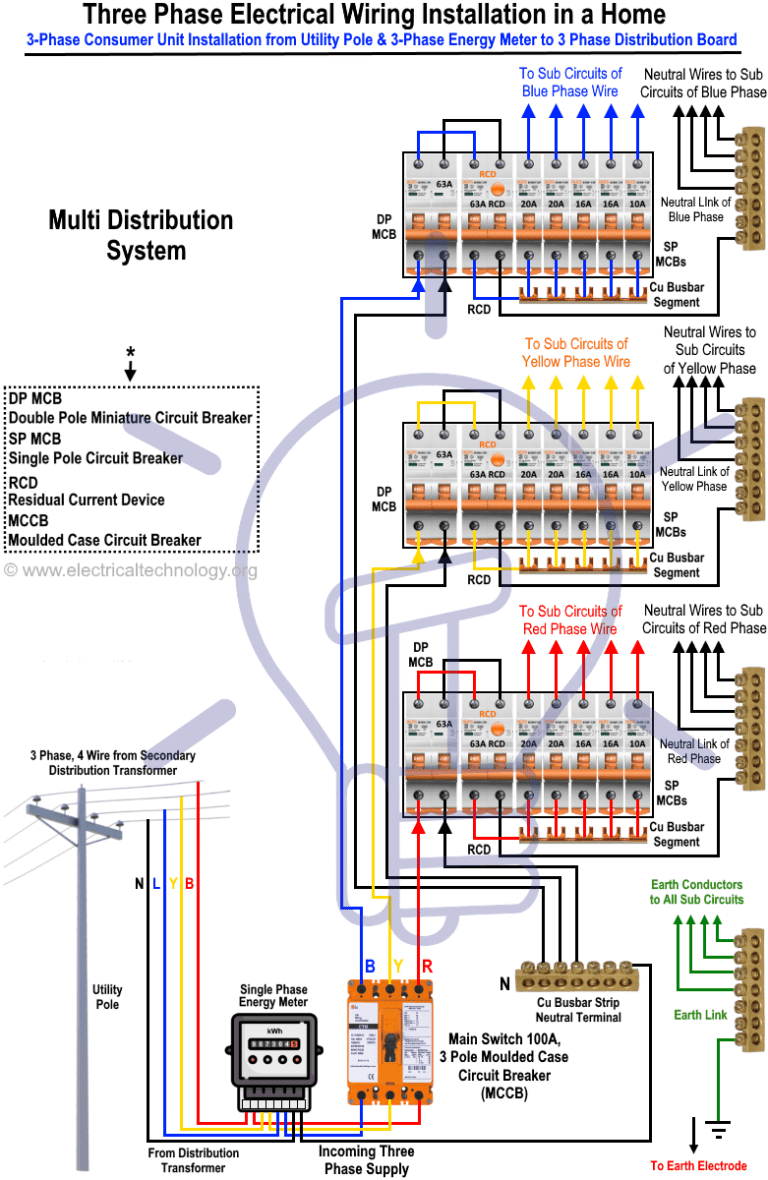
Wiring a 4-Wire 3-Phase System Why the Neutral Matters
I still remember the day a junior electrician on my crew insisted we could save copper by leaving the neutral disconnected in a 4-wire 3-phase panel. “It's all balanced loads, boss,” he said. Look—I've been doing this for over a decade, and I can tell you that kind of thinking is a one-way ticket to fried equipment and a code violation. Seriously, the neutral in a 4-wire 3-phase system isn't just some fluff wire you can ditch. It's the unsung hero that keeps voltages stable, prevents dangerous floating potentials, and makes the whole system safe for anything from a tiny control panel to a massive industrial plant. Let's dig into why that fourth wire matters more than most people realize.
The Anatomy of a 4-Wire 3-Phase System
Before we get into the gritty details, let's make sure we're all speaking the same language. A 4-wire 3-phase system typically consists of three phase conductors (usually labeled L1, L2, L3) and one neutral conductor. You'll see this configuration in most commercial and industrial setups in North America (208Y/120V or 480Y/277V) and in many international systems (400Y/230V). The neutral is the star point of the wye (Y) connection. And no, it's not the same as the ground wire—that's a different beast entirely, but we'll get to safety later.
What Are Those Four Wires, Really?
Think of the three phase wires as three separate power sources that are 120 degrees out of phase with each other. They rotate. They dance. And the neutral is the center point of that dance—the reference that all phase voltages are measured against. In a perfectly balanced system, the currents in all three phases sum to zero at the neutral point. So in theory, if every single load is perfectly balanced, the neutral carries no current. But theory is neat, right? Reality is messy.
Here's the kicker: in the real world, loads are rarely perfectly balanced. You have single-phase loads like lighting, receptacles, small motors, and electronics that are connected between one phase and neutral. That means current flows from the phase through the load and back to the transformer via the neutral conductor. Without that return path, you don't have a complete circuit—simple as that. The neutral in a 4-wire 3-phase system provides the necessary return path for all single-phase loads. Seriously, try running a 120V office outlet without a neutral. It won't work. And if you try to borrow the neutral from another circuit? You're asking for overloading and a fire hazard.
It's also worth noting that the neutral is typically sized differently depending on the harmonic content of the loads. Modern electronics—LED drivers, computers, variable frequency drives—generate harmonics that can actually cause the neutral to carry more current than any single phase. That's right: the neutral can become the hottest wire in the panel. So when you're wiring a 4-wire 3-phase system, you need to account for that. Don't just grab a standard wire size; check the anticipated load profile. I've seen neutrals literally melt because someone used a shared neutral from a two-pole breaker for three separate circuits. Nightmare fuel.
The Role of the Neutral in Balanced vs Unbalanced Loads
Let's break down balanced versus unbalanced with a quick example. Imagine a 208Y/120V panel feeding three identical resistance heaters—one on each phase. The currents are equal and 120 degrees apart. The vector sum is zero. The neutral carries nothing. Great. But now swap one heater for a bank of fluorescent lights that only uses 5 amps. Suddenly you have 20A on L1, 20A on L2, and 5A on L3. The imbalance current—let's say around 15A—has to go somewhere. That somewhere is the neutral conductor. Without it, the voltages on each phase become erratic. The star point shifts, and you might see 140V on one phase and 100V on another. Goodbye, sensitive electronics.
So the neutral literally stabilizes the phase-to-neutral voltages. It's the reference that keeps everything in line. If you disconnect it, you get a floating neutral condition. That's when things get spicy—and not in a good way. The system tries to balance itself by driving higher voltages across lower impedance loads. I've seen a 277V lighting circuit hit 340V because the neutral came loose. Burnt ballasts everywhere. So when you're wiring a 4-wire 3-phase system, remember: the neutral is not optional; it's critical for voltage regulation under unbalanced loads.
Why Skipping the Neutral Is a Recipe for Disaster
Honestly? I've met plenty of people who think they can save a conductor by omitting the neutral in a 4-wire 3-phase system, especially if they think all loads are three-phase only. But even in an industrial setting with only three-phase motors, there are often control transformers, panel lights, or convenience outlets that need a neutral. And if you don't run a neutral from the source, you're forced to create a local neutral by bonding the transformer output to ground—which can create unwanted ground loops and circulating currents. It's messy. It violates the NEC in most cases. And it's dangerous.
Voltage Imbalance and Equipment Damage
Voltage imbalance is the silent killer of three-phase motors. Even a 2% voltage imbalance can cause a significant increase in motor losses and overheating. When the neutral is missing or inadequate, the voltage imbalance becomes unpredictable. The phases drift apart. Some motors might overheat, some might run slowly, and some might trip their overloads. I once worked on a facility where the neutral was undersized for harmonics. The phase-to-neutral voltage on one leg was 125V while another was 115V. The computers were rebooting randomly. The VFDs were throwing faults. All because the neutral couldn't handle the harmonic currents.
In a properly wired 4-wire 3-phase system, the neutral provides a low-impedance path for return currents, ensuring that phase-to-neutral voltages stay within tolerance. Look—if you're designing or troubleshooting a system, always check the quality of the neutral connection. A loose neutral lug at the panel can cause the same voltage shifts as a missing neutral. I use a torque wrench on every neutral bus connection. No joke.
Safety Hazards of a Floating Neutral
Let's talk safety because this is where things get ugly. A floating neutral means the system reference is ungrounded (or poorly grounded). In a wye system, the neutral is supposed to be bonded to ground at the service entrance. That bond keeps the voltage between the neutral and ground near zero. If the neutral is missing, the voltage between neutral and ground can float to dangerous levels—potentially the full phase-to-phase voltage. Touch a neutral wire that has lost its reference, and you could get a lethal shock. Seriously, I've measured over 200V between a floating neutral and a nearby water pipe.
Furthermore, without the neutral, the ground path becomes the only return path for fault currents in single-phase circuits. That means ground wires—which are never designed for continuous current—can overheat and cause fires. Ground fault protection also becomes unreliable. You can't rely on a GFCI to protect a circuit if the neutral isn't properly connected. So when you're wiring a 4-wire 3-phase system, ensure the neutral is continuous, properly sized, and bonded according to code. It's not just about functionality; it's about keeping people alive.
Real-World Scenarios Where the Neutral Saves the Day
Enough theory. Let me give you some real cases from my career where the neutral in a 4-wire 3-phase system was the difference between smooth operation and a costly shutdown.
Office Buildings with Mixed Lighting and Outlets
A typical office floor might have a 200A 208Y/120V panel feeding hundreds of receptacles, LED troffers, a few small server rooms, and maybe some kitchen appliances. Those are all single-phase loads, and they're never balanced. One cubicle row might have more computers than another. The neutral handles the imbalance. I was called in once because lights were flickering and some computers were rebooting. The issue? The neutral bar in the panel had a loose connection from a previous contractor who decided to daisy-chain two neutrals on one terminal. The net result was a high-resistance neutral path that caused voltage swings up to 140V on some receptacles. Once we re-torqued all the neutral lugs and ensured a dedicated neutral for each circuit, the problems vanished. The neutral is your voltage police—don't handcuff it.
Industrial Motors and Single-Phase Tap-offs
In a factory, the main power might be 480Y/277V feeding large three-phase motors for conveyors and pumps. But you also need 277V lighting, and sometimes you need a 480V-to-120V step-down transformer for control power. That transformer is a single-phase load connected between one phase and neutral. Without a neutral, you can't power that transformer without creating an artificial neutral via a zig-zag transformer or a Wye-Delta setup. That's extra cost and complexity. A simple, properly sized neutral from the main service handles it elegantly. I've seen facilities where the neutral was omitted because "we only have three-phase motors." Then they added a 277V lighting panel later and had to run a separate neutral from the transformer secondary, which required major rework. Plan for the neutral upfront. You'll thank yourself.
Common Questions About Wiring a 4-Wire 3-Phase System Why the Neutral Matters
Do I always need a neutral in a 3-phase system?
Not always. If your system is a pure three-phase delta with no single-phase loads and no need for phase-to-neutral voltages, you can omit the neutral. But in a 4-wire 3-phase system (wye), the neutral is required by code because the system is designed to supply single-phase loads. Even in a delta system, you might need a neutral for grounded wye derived from a transformer. So the short answer: if you have any single-phase loads or a wye configuration, yes, the neutral is mandatory.
Can I share a neutral between multiple circuits?
Yes, but only under specific conditions. The NEC allows shared neutrals for multiwire branch circuits (common trip handle, simultaneous disconnect, etc.). However, with the rise of electronic loads and harmonics, shared neutrals can become overloaded. I strongly recommend a dedicated neutral for each circuit unless you're carefully calculating the harmonic content. In a 4-wire 3-phase system, sharing neutrals across phases can lead to net currents exceeding the neutral ampacity if the loads are non-linear. So be cautious.
Why does the neutral carry current even with balanced loads sometimes?
This usually happens due to harmonics, specifically triplen harmonics (3rd, 9th, 15th, etc.) from switched-mode power supplies. These harmonics add up in the neutral instead of canceling. In an office full of computers, the neutral can carry up to 1.7 times the phase current. That's why you need to size the neutral for the expected harmonic load, not just the balanced fundamental current. When wiring a 4-wire 3-phase system, consider derating factors and never assume the neutral will be zero.
What happens if the neutral is disconnected while the system is running?
Instant chaos. Phase-to-neutral voltages become unpredictable. Sensitive equipment can get overvoltage damage or undervoltage glitches. You may also see arcing at the break point. In worst-case scenarios, floating neutral can cause fires or electrocution risk. The right approach is to always check neutral connections are tight and that the neutral is bonded to ground per code. In a 4-wire 3-phase system, the neutral is the backbone of voltage stability—don't let it break.