
What Happens if You Wire a Polarized DC Capacitor Backwards
You know that sinking feeling. You're hunched over a circuit board, soldering iron in hand, and you realize you just swapped the leads on that aluminum electrolytic can. The blue cylinder is in, but the stripe is pointing the wrong way. You pause. Your thumb hovers over the power switch. What happens if you wire a polarized DC capacitor backwards? I've seen the results range from a dead-silent failure to a noise that sounds like a cap gun going off inside a tin can. It's not pretty.
Let's get one thing straight: polarized capacitors are not symmetrical components. They are designed with a specific anode and cathode. The dielectric—that thin oxide layer—only forms correctly when the positive voltage is applied to the anode. Flip that polarity, and you're essentially asking the part to do something its chemistry was never built to handle. In my decade-plus of bench work, I'd say roughly 80% of the smoked capacitors I've pulled were victims of reversed polarity. The other 20% were just old and tired. Seriously, it's that common.
The Instant Chemistry of a Reverse Polarity DC Capacitor
When you apply voltage in the wrong direction, the insulating oxide layer on the anode starts to break down almost instantly. This is not a slow process. Look—the electrolyte inside the capacitor is a conductive paste or liquid. Under reverse bias, this electrolyte begins to generate hydrogen gas through electrolysis. The pressure inside the can skyrockets.
The original oxide layer, which is only a few nanometers thick, acts as a perfect insulator in the correct orientation. Flip the polarity, and that layer becomes a semiconductor. It conducts current. And the more current that flows, the more heat is generated. We're talking localized temperatures that can exceed 150 degrees Celsius in seconds. It's a big deal because that heat accelerates the chemical breakdown. Sooner or later, something has to give.
The Vent Mechanism and the 'Pop' Factor
Most aluminum electrolytic capacitors have a built-in safety feature called a vent. On radial cans, it's a cross-shaped score mark on the top. On snap-in or screw-terminal caps, it's often a rubber bung at the base. This vent is designed to open at a specific internal pressure. When a capacitor is wired backwards, the gas pressure rises fast. The vent ruptures. You get a pop, a puff of smelly smoke, and sometimes a bit of electrolyte spits out.
I've seen vents blow on a regulated power supply prototype where a trainee reversed a 1000µF, 25V cap. The noise was surprisingly loud for such a small component. The smell? Like burnt fish and ammonia. It lingers. The component is obviously dead, but the real danger is that the electrolyte is corrosive. It can eat traces on the PCB if not cleaned up immediately. So if you hear that pop, shut the power down and inspect. Don't just sniff it and move on.
When the Cap Doesn't Blow: Silent Death by Leakage
Not every reversed capacitor makes a dramatic exit. If the applied voltage is low—say, less than 1 or 2 volts on a 16V rated part—the breakdown might be slow. You might not get a vent event. But what you do get is a massive increase in leakage current. A healthy polarized DC capacitor might leak a few microamps. A reversed one can leak tens or even hundreds of milliamps.
This leakage current loads down your power supply. It causes the capacitor to heat up. It might sit there, quietly cooking at 80 degrees Celsius, for hours. The performance of your circuit degrades. You see ripple voltage on a DC rail that should be clean. You chase ghosts in your design. Meanwhile, the capacitor is slowly dying, its internal chemistry permanently damaged. Eventually, even a low-voltage reverse bias will cause enough damage to short the part. Honestly? I've wasted entire afternoons debugging a circuit only to find a backwards cap that 'worked' but worked terribly.
Real-World Failure Modes: From Sizzle to Bang
Let me break down what actually happens on the bench. I've categorized this from least destructive to most destructive. It helps to know what you're looking for if you accidentally reverse a cap during a repair or build.
- Silent Failure: The circuit works, but the capacitor runs hot. Leakage current is high. The capacitance value might even appear normal on a cheap meter, but ESR is sky-high. This is the trickiest failure to catch.
- Vent Event: The top bulges or the bung pushes out. Smoke escapes. The cap is now an open circuit or a very high-resistance resistor. The PCB might need cleaning to prevent corrosion.
- Short Circuit: The internal foil layers touch. The capacitor becomes a dead short across the rail. This can blow fuses, damage the rectifier, or kill a switching regulator. I once saw a shorted backwards capacitor take out a $200 power supply module.
- Explosive Delamination: This is rare but real with large screw-terminal caps. The internal pressure builds faster than the vent can relieve it. The can splits. Electrolyte sprays everywhere. This is a fire hazard and a chemical hazard.
Why Tantalum Capacitors Are Especially Vicious
If you think electrolytics are bad, try reversing a tantalum capacitor. Tantalums are polarized too, but they don't have a controlled vent. They have a manganese dioxide or polymer electrolyte that burns aggressively. A reversed tantalum doesn't pop—it ignites. I'm not being dramatic. I've seen a failed tantalum produce a small flame that kept burning until all the material was consumed. The smoke is toxic.
Tantalum capacitors have a failure mode called 'field crystallization' under reverse bias. It causes a thermal runaway that can reach 500 degrees Celsius internally. That's hot enough to solder the cap to the board permanently. And forget about rework—the board around it is usually charred. For this reason, I always double-check polarity on tantalum caps three times before applying power. One mistake and you're scrapping an entire PCB.
The 'It Worked for a While' Trap
Here's a scenario that has bitten many experienced engineers. You build a prototype. You wire a polarized DC capacitor backwards by accident. You apply power. The circuit works. You think you're a genius. You leave the board running for an hour. Everything is fine. You move on to testing other sections.
Three weeks later, the board fails. You trace the issue back to that capacitor. Its ESR has shot up from 0.1 ohms to 50 ohms. The capacitance is now only 30% of its rated value. The oxide layer was slowly degrading the entire time. It was a ticking time bomb. This is what happens if you wire a polarized DC capacitor backwards at a voltage just below the threshold for immediate catastrophic failure. The damage is cumulative. Once the oxide layer is compromised, it doesn't heal. You can't fix it by turning the cap around later. The internal chemistry is permanently altered.
How Reverse Voltage Damages the Dielectric Layer
The dielectric in an aluminum electrolytic is aluminum oxide (Al2O3). This layer is formed during manufacturing by applying a positive voltage to the anode in an electrolyte bath. The reaction creates a uniform, insulating oxide. When you apply reverse voltage, the current tries to form oxide on the cathode foil instead. But the cathode foil isn't designed for that. It has a much rougher surface and a different etch pattern.
The result? The oxide that forms is patchy and full of defects. These defect sites become hotspots for current leakage. Each thermal cycle widens the defects. Over time, the leakage current increases exponentially. It's a runaway feedback loop that ends in failure. You can't stop it. You can only replace the capacitor. This is why I never recommend 'testing' a cap backwards even for a second, unless you're doing a specific failure analysis.
Exceptions to the Rule: Non-Polarized and Bi-Polar Capacitors
Wait. Are there capacitors that can tolerate reverse voltage? Yes, but they are clearly marked. Non-polarized electrolytic capacitors (often called bi-polar or NP capacitors) are constructed with two oxide layers back-to-back. They can handle AC signals or occasional reverse DC. You see them in speaker crossovers and motor start circuits.
But here's the catch: a standard polarized DC capacitor, even a high-quality one, cannot handle more than about 1 volt of reverse bias for any length of time. The datasheets will state 'reverse voltage: 1V max' or sometimes 10% of rated voltage for very short transients. If you exceed that, you're in the danger zone. So when someone asks 'what happens if you wire a polarized DC capacitor backwards' with a tiny voltage, the answer is still: slow damage. There are no free passes.
Multi-Section Capacitors and Common Pitfalls
Old-school can-style capacitors (the kind in tube amplifiers and vintage radios) often have multiple sections inside one can. You might have a 40µF section and a 20µF section, both sharing a common negative. If you connect the positive lead of one section to a negative rail, you not only damage that section, you can short the entire can to ground.
I once restored a vintage oscilloscope that had a multi-section can with the polarity marking rubbed off. I guessed. I guessed wrong. The 40µF section vented through the bottom, pushing the rubber seal out. Electrolyte dripped onto the chassis. It was a mess. I learned that day to always measure the can's polarity against the circuit traces before applying power, and to use a DC supply with current limiting for first power-up. It's a lesson that stuck.
What About the 'Reverse Polarity Protection' Myth?
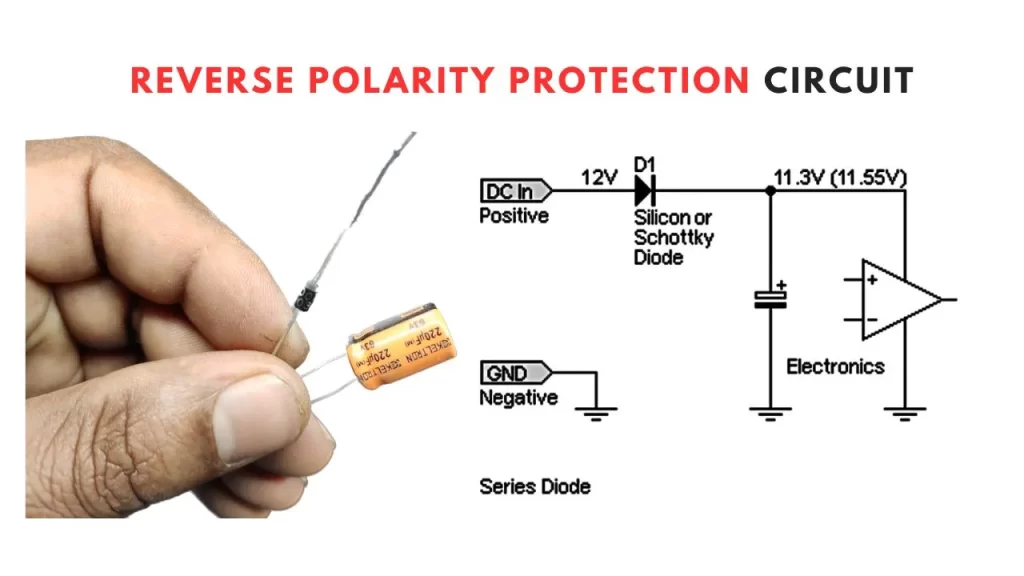
Some hobbyists believe that putting a diode in series with a polarized capacitor will protect it from reverse voltage. That's a partial truth. A series diode prevents reverse current, but it also drops 0.7 volts across it. More importantly, the capacitor itself sees the correct polarity at all times, so the protection isn't really protecting the cap—it's protecting the circuit from the cap failing.
If you accidentally install the cap backwards with a series diode, the diode will likely be reverse-biased and block current. The cap sees zero voltage. It won't damage the cap, but the circuit won't work either. So it's a failsafe, not a fix for sloppy wiring. The real solution is slower assembly and better labeling. Honestly? I use a sharpie to mark the positive terminal on every board I design. A dot of red nail polish works too. Do whatever it takes to avoid that sinking feeling.
- Visual Inspection: Before power-up, check every polarized part. The longer lead is positive for radial through-hole caps. The stripe indicates negative for most aluminum electrolytics.
- Low Voltage Test: Use a bench supply set to a low voltage with current limit at 100mA. If the current spikes on power-up, you've got a reversed cap.
- Thermal Check: After a few seconds of operation, touch the cap with the back of your finger. If it's warm, shut down and investigate.
- ESR Meter: If you suspect a silent failure, pull the cap and check it. ESR over 1 ohm for a cap rated under 1 ohm is a red flag.
Common Questions About What Happens if You Wire a Polarized DC Capacitor Backwards
Can a capacitor survive a brief reverse voltage spike?
Most aluminum electrolytic capacitors are rated for up to 1V of transient reverse voltage. Brief spikes under that threshold usually cause no immediate damage. However, repeated spikes or a spike exceeding the rating will gradually degrade the oxide layer. The safe rule is: avoid any reverse voltage if you want the capacitor to reach its rated lifespan.
Does the capacitance value change when a cap is reversed?
In the early stages of reverse bias, the capacitances often remains close to its rated value. This is what makes it tricky to detect. As the damage progresses, the effective capacitance drops and the dissipation factor increases. A capacitance meter alone won't catch a reversed cap. You need to measure leakage current or ESR.
Will a reversed capacitor always explode?
No. Explosions happen when the internal pressure builds faster than the vent can release it. This depends on the applied voltage, the capacitor's size, and the electrolyte chemistry. Small, low-voltage caps often just get hot and fail open. Large, high-voltage caps are more likely to vent violently. Tantalums are the most prone to ignition.
Is there any way to tell if a capacitor was reversed after it's removed from the circuit?
Sometimes. A reversed electrolytic often shows a slight bulge on the top or bottom, even if it didn't vent. The rubber bung may be discolored. With large screw-terminal caps, you might see electrolyte residue around the terminal seal. A good visual inspection combined with an ESR test is usually enough to confirm the failure mode.
Can I use a non-polarized capacitor as a replacement for a polarized one?
Technically yes, but it's rarely the best choice. Non-polarized electrolytics have larger physical size and often lower ripple current ratings for the same capacitance value. They also cost more. Use them only when the circuit genuinely sees voltage reversals, like in audio crossover networks. For a standard DC rail, stick with polarized caps and install them correctly.