
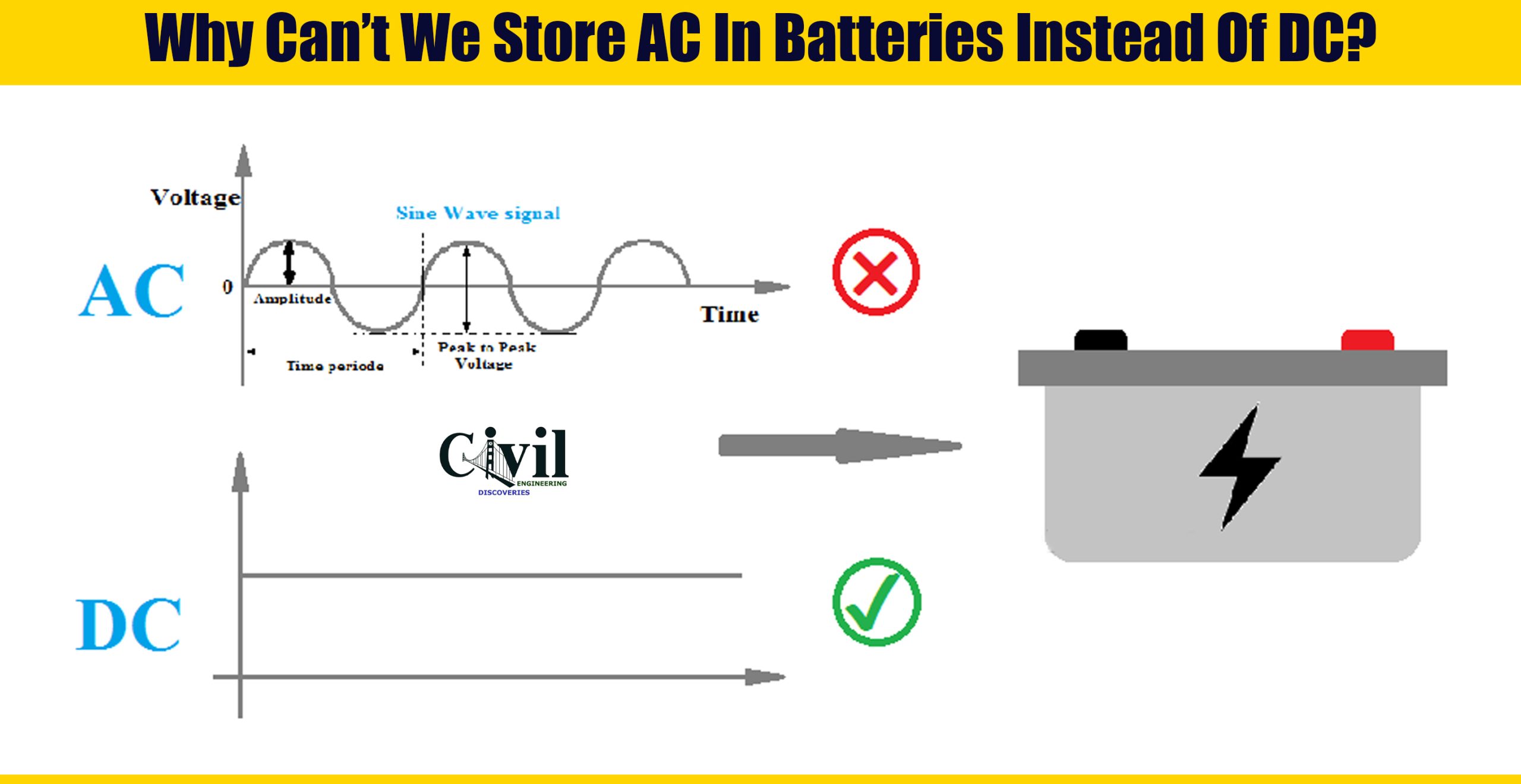
Why Do Automotive Batteries Use DC Instead of AC?
Ever been stuck in a parking lot with a dead battery, jumper cables in hand, and had that weird thought pop into your head? I have. Automotive batteries are fascinating little bricks of chemistry, but their most defining trait is that they only speak one language: Direct Current, or DC. Honestly? If you tried to feed your car’s battery Alternating Current (AC), you’d have a very expensive science experiment on your hands—and not the good kind. Let’s dig into the raw physics and practical reasons why every car battery on the planet stubbornly sticks to DC.
The Chemical Truth: Batteries Are Born as DC Devices
Look—this isn’t a design preference. It’s a fundamental law of electrochemistry. Inside that lead-acid box under your hood, you’ve got lead dioxide plates, sponge lead plates, and a sulfuric acid electrolyte. When you connect a load, chemical reactions force electrons to flow in one direction only: from the negative terminal to the positive terminal. That’s it. It’s a one-way street. AC, by definition, reverses direction 50 or 60 times a second. Your battery’s chemistry can’t reverse polarity that fast without literally ripping itself apart.
Seriously, try to make a battery produce AC and you’ll just get heat and hydrogen gas. The ions inside the electrolyte are physically moving. They can’t oscillate back and forth at grid frequency. They’re like a crowd of people in a narrow hallway—they can all shuffle one way, but you can’t make them do the Hokey Pokey at 60 Hz. So from the atomic level up, automotive batteries are inherently DC power sources. It’s not a choice; it’s the only language the chemistry speaks.
Even modern lithium-ion batteries in EVs follow the same rule. The lithium ions migrate from the anode to the cathode during discharge. Flip that direction 60 times a second and you’d destroy the intercalation structure within seconds. So no matter how advanced the tech gets, any device storing energy in chemical bonds will always output DC. It’s a big deal, and it’s why your alternator exists as a bridge between two worlds.
Let’s also kill a myth here: some folks think you could build a battery that outputs AC with clever wiring. Sure, you could mechanically switch the terminals with a relay, but that’s not generating AC from the chemistry—that’s just chopping DC into square waves. True AC requires a sinusoidal reversal of current flow, which the chemistry simply cannot support. So the answer to “why not AC” starts and ends with physics.
Why the One-Way Electron Flow Matters for Your Starter Motor
Your starter motor is a DC motor. It has brushes and a commutator specifically designed to handle unidirectional current. Feed it AC and those brushes would arc, spark, and probably weld themselves to the commutator in a fiery mess. Car batteries deliver massive amperage—hundreds of amps—to crank an engine. That power needs to be steady and predictable. AC would cause the motor to vibrate, hum, and deliver inconsistent torque. Honestly? Your engine wouldn’t even turn over once.
The DC system also simplifies the entire electrical architecture. Every bulb, sensor, and control module in your car runs on DC. They expect a stable 12-volt (or thereabouts) voltage with a clear positive and negative rail. Introduce AC into that mix and you’d need rectifiers everywhere just to convert it back. That adds cost, weight, and failure points. Why complicate a system that’s worked flawlessly for a century?
Think about the battery cables too. DC doesn’t suffer from the skin effect like high-frequency AC does. You can push massive current through thick copper cables without worrying about signal degradation or impedance mismatches. That matters when you’re trying to dump 600 amps into a cold starter motor at -20°F. AC at those currents would require much thicker, more expensive wiring to handle the reactive power losses.
The Alternator Deception: AC Is Born, Then Immediately Killed
Here’s where it gets fun. Your car’s alternator actually generates AC. Wait, what? Yes—inside that unit, a rotor spins inside a stator, inducing an alternating current in the stator windings. But immediately after that AC is born, it runs through a set of diodes called a rectifier bridge. That turns the AC into the pulsating DC that charges your automotive battery. Why go through this trouble? Because AC is easier to generate and step up/down with transformers, and the alternator’s design allows for better voltage regulation at varying engine speeds.
So the alternator is a liar. It pretends to be an AC machine, but its whole purpose is to deliver DC to the battery. The alternator’s rotor is electromagnetized by the battery itself (through the field winding), and as it spins, it cuts magnetic lines of force. The resulting AC is messy—it’s a sine wave, but it’s not clean grid power. The rectifier bridge chops off the negative half of the sine wave and flips it into a crude DC pulse. Then the battery’s internal resistance and capacitance smooth it out into a usable DC voltage.
This design was a brilliant compromise. Alternators are smaller, lighter, and more efficient than old DC generators (the things with commutators that used to fail constantly). By generating AC internally and rectifying it on the way out, we get the best of both worlds: efficient generation and DC storage. Without that trick, your battery wouldn’t last a week. Alternators produce AC at frequencies up to several thousand hertz depending on RPM—good luck keeping a battery happy with that raw waveform.
What Happens If You Hook a Battery to an AC Source?
Please don’t try this at home. Connect a standard car battery to a wall outlet (which is AC) and you’ll see fireworks. Literally. The battery will try to charge and discharge at 60 Hz, which means it will alternately try to store energy and release it. The internal plates will heat up, gas will vent, and the battery will likely explode or catch fire. AC voltage peaks at about 170 volts (for a 120V RMS circuit), which is far beyond what a 12V battery can handle. Even if you used a transformer to step it down to 12V AC, the reversal of current would still destroy the battery’s chemistry.
The battery’s internal resistance is optimized for DC charging. With AC, the electrons are forced to reverse direction, causing the chemical reactions to run backwards at 60 Hz. This creates enormous internal stress, rapid heating, and irreversible sulfation. In lead-acid batteries, the lead sulfate crystals that form during normal discharge are fine—they’re soft and reversible. But with AC, those crystals grow hard and large, permanently reducing capacity. It’s like trying to rewash a shirt that’s already dry—it just messes everything up.
Interestingly, some specialized batteries (like those used in grid storage) can handle bidirectional DC flow, but that’s not AC. That’s just changing the direction of DC for charge/discharge cycles. Big difference. Your car battery is designed for one job: absorbing DC current from the alternator and delivering DC current to the starter and electronics. AC is the enemy.
- Reason #1: Chemical reactions are one-directional—electrons flow from anode to cathode. AC reversal destroys the physical structure of plates.
- Reason #2: Starter motors and all car electronics are designed for DC. AC would cause arcing, vibration, and component failure.
- Reason #3: Battery charging requires controlled DC voltage profile—AC would overheat and gas the battery.
- Reason #4: Safety—AC at automotive amperages would create lethal electrical hazards and fire risks.
The Real-World Reality: DC Throughout the Vehicle
Take a look at any modern car’s wiring diagram. Every single component—the headlights, the radio, the ECU, the fuel pump, the USB chargers—runs on DC. The entire automotive electrical system is a 12V DC ecosystem. Why would we introduce AC into the battery when the rest of the car despises it? It just doesn’t make sense. Even hybrid and electric vehicles, which use high-voltage AC motors for propulsion, still store all energy in DC battery packs. The inverter (which turns DC to AC for the motor) is a separate unit.
The battery is the heart, and the heart pumps DC blood. The alternator is like the lungs—it generates AC but converts it to DC before it reaches the heart. This system has been refined over a hundred years. Engineers have considered AC battery systems, but they always come back to the same conclusion: it’s not worth the complexity, cost, or reliability hit. A lead-acid battery is cheap, simple, and incredibly rugged. Forcing it to handle AC would triple the cost and halve the lifespan.
Here’s a fun thought experiment: imagine a world where cars used AC batteries. You’d need a rectifier on every device. You’d need batteries with no polarity—just two terminals that swapped roles 60 times a second. The wiring would need to handle reactive power. The charging system would be a nightmare of synchronization. And a dead battery? Jumping it would require matching the AC phase, frequency, and voltage. Good luck with that. The DC system we have is elegant in its simplicity.
I’ve seen backyard mechanics try to wire a battery charger wrong and feed AC into a battery. The result is always the same: a bulging, leaking, ruined battery within minutes. The internal temperature spikes, the electrolyte boils, and the plates warp. It’s a hard fail, not a graceful degradation. So respect the DC nature of your battery—it’s not a limitation, it’s the feature that keeps your car starting reliably for years.
Could We Ever Switch Automotive Systems to AC?
Technically, yes. We could redesign every component. But it would be idiotic. Vehicle batteries store energy most efficiently as DC. AC storage would require capacitors or mechanical flywheels, neither of which come close to the energy density of chemical batteries. Even supercapacitors, which can store and release charge quickly, store it as DC. AC storage is a physics oxymoron.
Some experimental systems have tried using inverters between the battery and the load to run AC motors in mild hybrids. That’s exactly what EVs do. But the battery itself remains DC. It’s always a DC-to-AC conversion happening at the load side, not at the storage side. So the answer remains unchanged: automotive batteries use DC because they must. Chemistry demands it. Safety demands it. Practicality demands it.
In the future, we might see solid-state batteries or graphene-based cells that behave differently. But they’ll still rely on ion migration in one direction during discharge. That process is inherently DC. The only way to get AC from a battery is to use an external inverter. So the question “Why do automotive batteries use DC instead of AC?” has a single, solid answer: they have no other choice. And honestly? That’s a good thing.
- Fundamental Chemistry: Electrons move one way during discharge. Reversal damages the cell irreversibly.
- System Compatibility: Every car component expects DC. AC would require complete redesign.
- Charging Reality: Alternators convert to DC because batteries can only accept DC charging profiles.
- Safety and Cost: AC batteries would be dangerous, expensive, and unreliable.
Common Questions About Why Do Automotive Batteries Use DC Instead of AC
Can I charge a car battery with an AC outlet directly?
Never. A wall outlet provides AC at 120V or 230V. Plugging a car battery directly into it will cause explosion, fire, or both. You must use a battery charger that converts AC to a regulated DC voltage. Even cheap chargers have a transformer and rectifier built in for this exact reason.
Why don’t car manufacturers build AC batteries for efficiency?
Because no chemical storage system can generate AC. A battery is a DC device by nature. You can convert DC to AC with an inverter, but that adds cost and loses some energy as heat. For the 12V system in a conventional car, the losses from DC are negligible, and the simplicity of DC outweighs any theoretical efficiency gain from an AC system that doesn’t exist.
Does an alternator produce AC or DC?
The alternator generates AC internally, but a built-in rectifier bridge converts it to DC before it leaves the alternator case. So the output to the battery and car electrical system is DC. If you measured the output of an alternator without the rectifier, you’d see a chaotic AC waveform.
Is there any car that uses an AC battery?
No production car uses an AC battery. All vehicles—gasoline, diesel, hybrid, or electric—use DC batteries. Electric cars have DC battery packs that feed inverters to run AC traction motors, but the battery itself remains DC. There is no such thing as a commercially viable AC battery for automotive use.
What happens if I accidentally hook up a DC battery to an AC circuit?
If the AC circuit is powered, you’ll likely blow a fuse, damage the power source, and possibly destroy the battery. If it’s an unpowered AC circuit (like a disconnected appliance), the battery will try to power it, but AC devices won’t run on pure DC and may be damaged. Don’t mix the two.