
Storm drain vs culvert: Key differences in civil engineering
You’re standing at a construction site, staring at a concrete hole in the ground. Is it a storm drain? A culvert? Honestly, even some seasoned engineers mix them up. I’ve been in civil engineering for over a decade, and I still see drawings labeled wrong. It’s a big deal because if you design one thinking it’s the other, you’re going to have flooding, regulatory fines, or worse—structural failure. So let’s cut through the confusion. Right now.
Look—both storm drain and culvert systems move water. That’s where the similarity ends. One is a buried pipe network for urban runoff; the other is a short conduit under a road or embankment. The design philosophy, hydraulics, and even the materials differ. By the time you finish reading this, you’ll be able to spot the difference from fifty feet away. And you’ll never confuse them in your civil engineering projects again. Seriously.
What exactly is a storm drain? It’s not just a gutter.
A storm drain (also called a storm sewer, or drainage system) is a network of underground pipes, inlets, and outfalls designed to collect rainwater and meltwater from streets, parking lots, and roofs. Its job is to prevent urban flooding by quickly moving that water somewhere else—usually a stream, lake, or ocean. It’s the hidden backbone of every city you walk through.
The anatomy of a storm drain system
Think of it like a tree. The inlets (the grates you see at curbs) are the leaves. They feed into branch pipes, which merge into larger trunk lines. Eventually, the water exits at an outfall. The pipes are almost always round or elliptical, made of concrete, HDPE, or corrugated metal. And here’s the kicker: a storm drain is gravity-fed—no pumps. That means elevation changes matter a ton. You have to slope the pipes just right, or you get sediment build-up and stinky standing water.
I once inspected a subdivision where the designer used a flat slope to save excavation costs. The result? The pipe clogged within the first year. The homeowner’s association had to dig up the entire street. So rule number one: storm drain design demands precision in hydraulic grade line calculations. It’s not glamorous, but it’s critical.
Another thing: storm drains are never designed to carry sewage. That’s a separate, sanitary system. But in older cities, you’ll find combined systems—a nightmare I’ll save for another article.
Where you’ll find storm drains (and where you won’t)
Urban areas. Downtowns. Subdivisions. Commercial lots. If pavement covers more than 20% of the ground, you almost always need a storm drain network. But out in the countryside, on a gravel road with a small creek crossing? You’re looking at a culvert. The context tells you everything.
Here’s a quick list of typical storm drain components:
- Inlet structures (curb inlets, grate inlets, catch basins)
- Storm sewer pipes (usually 12-inch to 72-inch diameter)
- Manholes and cleanouts for inspection and maintenance
- Outfall structures with energy dissipation (riprap, headwalls)
Notice what’s missing—no road embankment, no headwall designed to hold fill. A storm drain is buried under the street, not through it.
Alright, so what’s a culvert? It’s a bridge’s little brother.
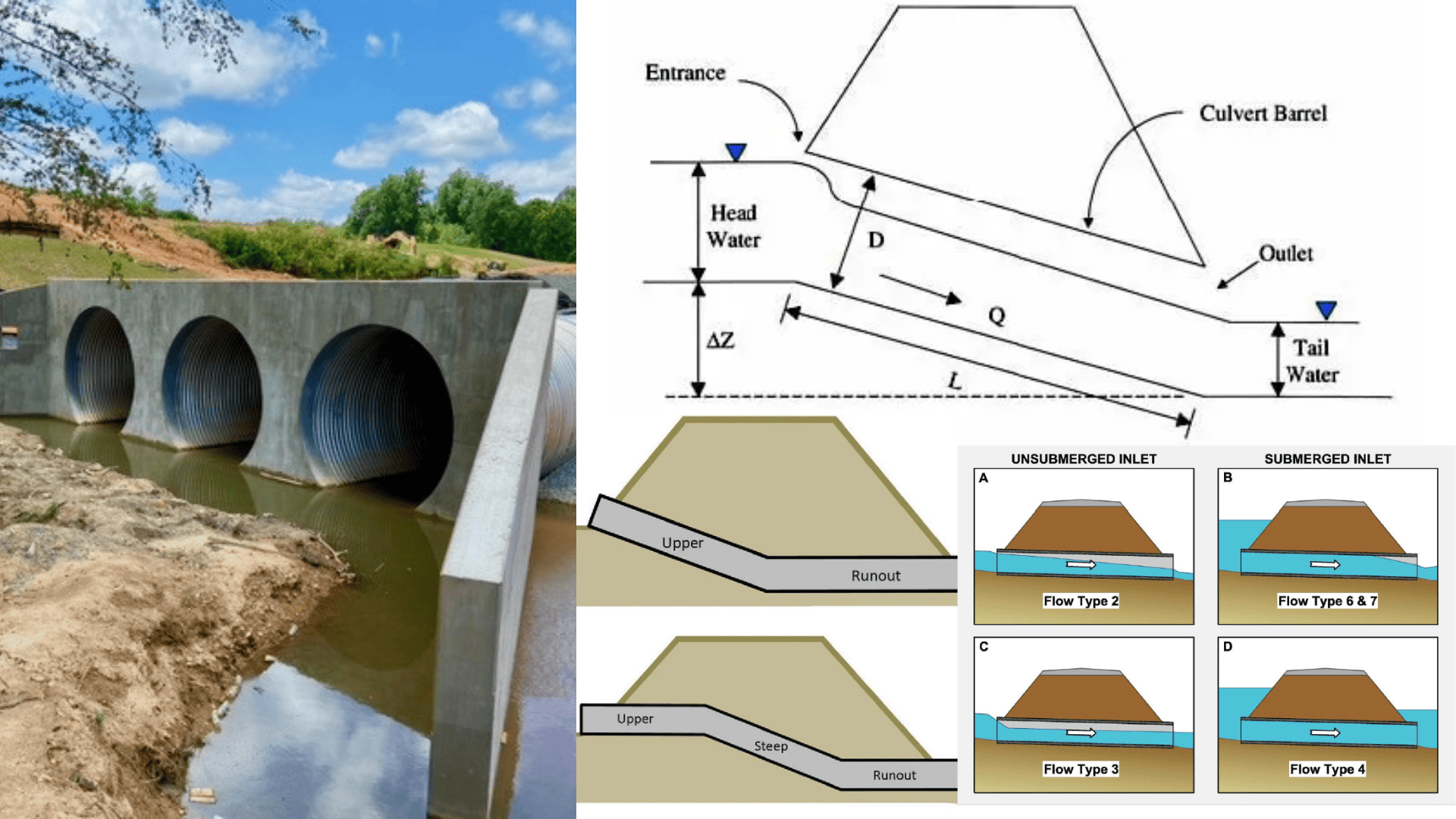
A culvert is a short, structurally enclosed conduit that allows water to flow under a roadway, railway, or embankment. It’s not a network—it’s a single crossing. You see them under driveways, forest roads, and highway fills. The key: it carries water from one open channel to another, not from a series of inlets.
How culverts are different in design and purpose
First, hydraulics. A culvert typically operates under inlet or outlet control. That means the water level at the entrance or exit governs how much flow it can handle. A storm drain pipe, on the other hand, is designed to flow partly full most of the time—it’s not meant to be pressurized. Culverts often run full bore during storms, and they have to handle high headwater elevations. This is where the engineering gets hairy.
Second, structural loading. A culvert supports the weight of the fill and traffic above it. A storm drain pipe only supports the soil cover and maybe a bit of live load if it’s shallow. So culverts use thicker walls, sometimes reinforced concrete box sections. I’ve seen culverts crack because the contractor skimped on bedding—it’s a disaster.
Third, length. A storm drain can run for miles. A culvert is rarely longer than a few hundred feet. It starts at the upstream channel, passes under the obstruction, and ends at the downstream channel. That’s it. No manholes, no inlets—just a straight shot.
And let’s talk shape. Culverts come in circles, arches, and boxes. The box culvert is a favorite for high-flow streams because it’s efficient and easier to stack multiple cells. Storm drain pipes are almost always round—it’s the best shape for structural load and hydraulic efficiency in a pipe network.
Real-world example: the backyard creek crossing
Imagine you’ve got a small stream cutting through a farmer’s field. A road needs to cross it. You install a pair of 48-inch reinforced concrete pipes under the fill. That’s a culvert. Now imagine the same road is in a town, and the water comes from street runoff and roof gutters. That runoff flows into a curb inlet, then into a pipe network that ends at the same stream. That network is a storm drain. The difference is function, not just scale.
Here’s a comparison table (in list form) for clarity:
- Purpose: Culvert = convey stream under an obstacle. Storm drain = collect and transport urban runoff.
- Length: Culvert = short (20–300 ft). Storm drain = long (100 ft to miles).
- Inlets: Culvert = open channel at both ends. Storm drain = multiple curb inlets/catch basins.
- Flow control: Culvert = often inlet/outlet control (pressurized). Storm drain = gravity, partly full flow.
- Structural design: Culvert = heavy loading (fills and traffic). Storm drain = lighter loads (soil cover).
Key engineering distinctions you can’t ignore
Now we get into the nitty-gritty. If you’re a civil engineering professional (or aspiring to be), these are the differences that matter during design, construction, and maintenance. Let’s break them down.
Hydraulic design: Full pipe vs partial pipe
Storm drains are designed using the rational method or hydrologic models to find peak runoff. The pipe is sized to carry that flow while flowing at most 80–90% full. Why? Because you need air space for trapped gases and to avoid surcharging. A surcharged storm drain can blow manhole covers off. I’ve seen it. It’s loud, dangerous, and expensive.
Culverts are designed using hydraulics that account for the open channel approach. You calculate headwater depth and tailwater conditions. The culvert can flow full (pressurized), but you have to ensure the headwater doesn’t overtop the road. Also, you must consider fish passage—a modern requirement in many regions. That means box culverts with natural stream bottoms, or baffles.
Materials and longevity
Both systems use concrete, metal, or plastic, but the specifications differ. For storm drain pipes, you often see HDPE (high-density polyethylene) because it’s lightweight and corrosion-resistant. But for a culvert under a heavy highway, reinforced concrete is king. Metal culverts are cheaper but can corrode in acidic soils. I once saw a 20-year-old corrugated steel culvert that had rusted through—the road above it was ready to collapse. Not fun.
A note on joints: Storm drain pipes use gasketed joints to prevent infiltration of soil and groundwater. Culvert sections are often banded or mortared, but some jurisdictions allow open joints for fish passage. Again, context rules.
Regulatory and maintenance differences
Storm drains fall under municipal stormwater permits (like the US EPA’s NPDES Phase II). You have to treat runoff in many cases—oil/separators, detention basins, etc. Culverts are mainly regulated by local flood control agencies and state departments of transportation. Maintenance is simpler: you crawl inside (if it’s big enough) and remove debris. But storm drains require vacuum trucks and jetting to clean out sediment.
One more thing: culvert inspections are often done visually from the ends. Storm drain inspections require closed-circuit TV cameras because the network is too long. I’ve spent hours watching grainy footage of pipes—thrilling, I know.
Common questions about storm drain vs culvert
Can a culvert be part of a storm drain system?
Technically, yes. A culvert can serve as the outlet of a storm drain network—it’s called an outfall culvert. But in that case, it’s still a culvert by structure and a storm drain component by function. The design still follows culvert hydraulics for the crossing, but the upstream pipes are storm drain. It’s a hybrid situation, and you need to separate the design criteria for each section.
Which one is more expensive to build?
Unit cost per foot? A storm drain pipe is generally cheaper because it’s smaller and shallower, but when you factor in manholes, inlets, and long trench runs, the total cost can be huge. A culvert tends to have higher unit costs (thicker walls, headwalls, riprap), but it’s short. So overall, culverts are often cheaper for a single crossing. Don’t quote me without seeing the site—prices vary wildly.
Do both require a hydraulic design report?
Absolutely. For any civil engineering project, you need a report showing that the storm drain or culvert can handle the design storm (usually a 10-year or 25-year event, sometimes 100-year for critical infrastructure). You also need to check for scour, buoyancy, and freeze-thaw. If you skip the report, good luck when the municipality asks for it.
What’s the biggest mistake engineers make when confusing the two?
Designing a culvert like a storm drain pipe—using the same Manning’s equation with open-channel assumptions when the culvert will actually inlet-control and run full. That underestimates the headwater elevation. I’ve seen this cause road overtopping during a moderate rainstorm. Conversely, designing a storm drain pipe as a culvert with full-pipe capacity can lead to surcharging and flooding in the upstream inlets. Know your flow regime.
Can a large box culvert be considered a bridge instead?
In some jurisdictions, if the span is over 20 feet (or 10 feet, depending on the code), it’s classified as a bridge. That changes the design code (AASHTO vs. culvert-specific). As an engineer, you need to check local definitions. In general, a culvert has a buried top, while a bridge has a clear span. But the line can blur. I’ve dealt with projects where we called it a “culvert-bridge.” The bureaucrats love that ambiguity.
So there you have it. Storm drain vs culvert isn’t just semantic—it’s about hydraulics, structure, and purpose. Next time you see a pipe under a road, look upstream. If there’s a stream channel, it’s a culvert. If there’s a grate in the gutter, it’s a storm drain. Now go design something that won’t flood.