
How Bohr Changed the Atomic Model Forever
So you think atoms are simple little balls? Tiny solar systems with electrons zipping around like planets? Honestly, before 1913, that was the best guess anyone had. And it was wrong. Completely, disastrously wrong. Look—the old model, the Rutherford model, was revolutionary for its time. It showed a tiny, dense nucleus with electrons orbiting around it. But it had a massive flaw. A physics-killer of a flaw. If electrons really orbited like planets, they would spiral into the nucleus in a fraction of a second. The atom would collapse. Matter would not exist. You would not exist.
That's the problem Niels Bohr walked into. And when he walked out, he had fundamentally rewritten how we see the universe. It's a big deal. Let me walk you through how Bohr changed the atomic model from a death sentence into the cornerstone of modern physics. Seriously, the man saved the atom.
The Pre-Bohr Mess: Why the Atom Had a Death Wish
Before we get into the good stuff, you need to understand the crisis. The Rutherford atomic model was a thing of beauty and a complete nightmare. It said the atom was mostly empty space with a positive nucleus and negative electrons orbiting it. The problem? According to classical electromagnetism, any charged particle that accelerates (like an electron on a circular path) must radiate energy. Just like a radio tower emits radio waves, an orbiting electron would emit light.
As the electron lost energy, it would slow down. It would fall into a lower orbit. Then it would lose more energy, and fall again. This cascade would take about one ten-billionth of a second. In that time, the electron would spiral right into the nucleus. The atom would self-destruct.
But atoms don't self-destruct. They sit there, perfectly stable, for billions of years. Something was horribly, fundamentally broken with our understanding of physics. It was a mess. And the mess had a name: the ultraviolet catastrophe of atomic stability.
Enter a young Danish physicist who had just finished a stint working with J.J. Thomson (the electron discoverer) and then with Rutherford himself. Bohr saw the problem wasn't the atom—it was the rules we were applying to it. He realized the universe didn't follow classical physics at the atomic scale. It followed something much weirder.
The Quantum Intrusion: Where Planck and Einstein Had Already Broken Ground
Bohr didn't invent quantum theory. That credit goes to Max Planck (who, in 1900, proposed energy came in discrete packets called quanta) and Albert Einstein (who, in 1905, used that idea to explain the photoelectric effect). But those were isolated ideas. Nobody had applied them directly to the structure of the atomic model.
Bohr's genius was in synthesis. He took the quantum concept and slammed it directly into the heart of the atom. He said, in essence: 'The classical rules don't apply here. We need new rules.' And he proposed two of the most audacious rules anyone had ever suggested in physics.
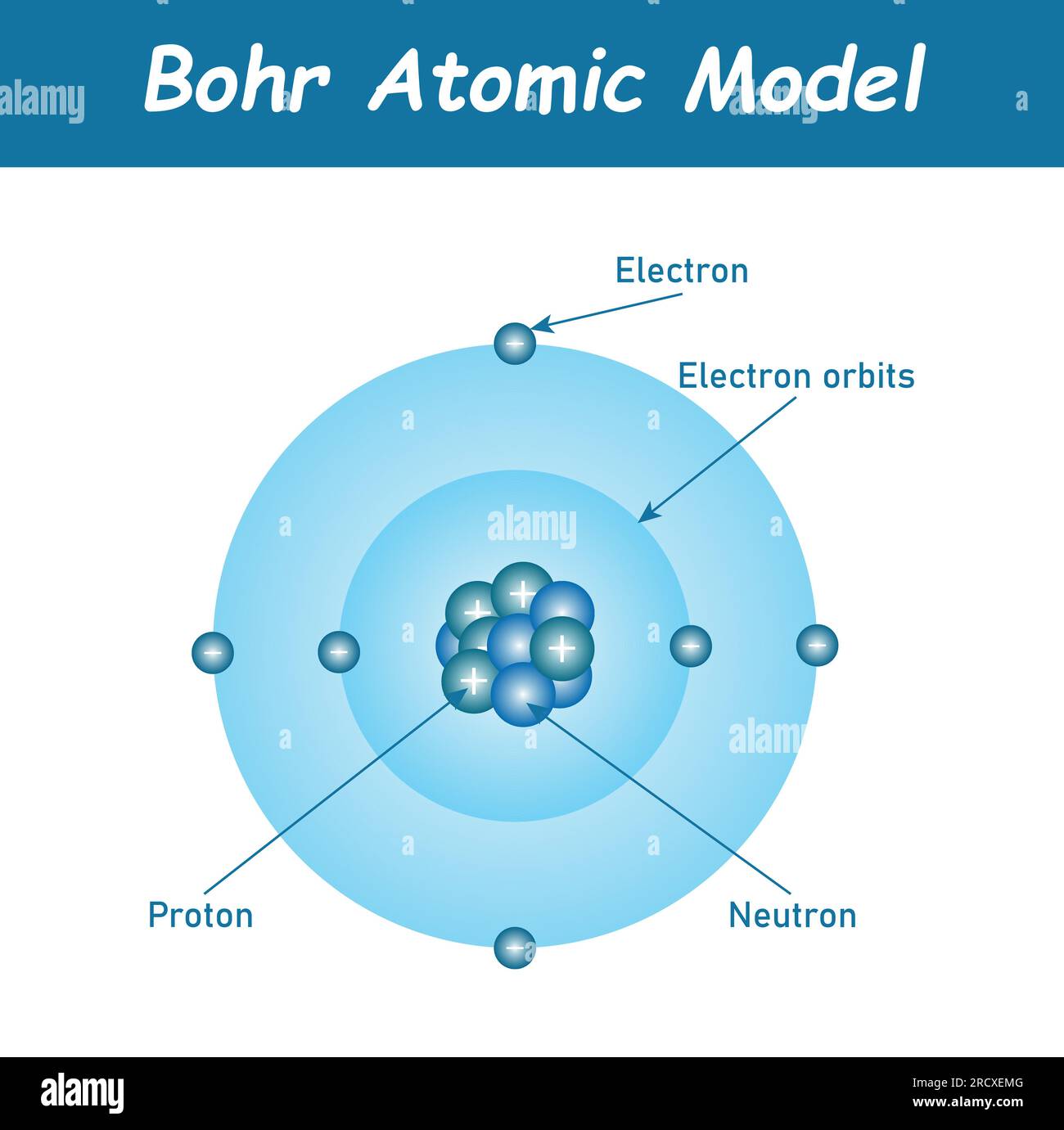
First, he said electrons can only occupy certain specific orbits. Not any orbit. Only certain, discrete ones. Think of it like a staircase. You can stand on step 1, step 2, or step 3—but you can't stand halfway between step 1 and step 2. That was a direct violation of classical mechanics, where any radius of orbit is possible. It was a quantum leap of logic.
Second, and this is the kicker: when an electron is in one of these allowed orbits, it does NOT radiate energy. It just sits there, stable. No spiraling. No collapse. The classical rule that accelerating charges radiate? Suspended for these special orbits. That was the only way to save the atom. And it worked.
The Quantized Orbits: Why Electrons Are Picky Travelers
Let's dig deeper into those orbits. Bohr postulated that the angular momentum of an electron in an allowed orbit is quantized. That means it can only be an integer multiple of Planck's constant divided by 2π. That's the famous equation: mvr = nħ, where n is a positive integer (1, 2, 3...).
I won't lie to you—this equation came out of nowhere. Bohr basically said, 'I need a rule that gives me stable orbits, and this integer rule works.' It was a brilliant piece of theoretical guesswork. But the beauty is what it predicted. Using that simple rule, plus classical electrostatic attraction, he calculated the radii of those allowed orbits for the hydrogen atom.
The smallest orbit (n=1) had a radius of about 0.529 angstroms. That's the famous Bohr radius. The next orbit (n=2) was four times bigger. N=3 was nine times bigger, and so on. The orbits scaled as n². This wasn't just mathematical trickery—it matched experimental data on atomic sizes perfectly.
But here's the real magic: when an electron jumps from a higher orbit (n=2) to a lower orbit (n=1), it emits a photon of light with an energy exactly equal to the difference between those two orbits. And that energy difference? It corresponds to a specific wavelength. A specific color of light. Bohr had just explained why hydrogen emits only specific spectral lines, not a continuous rainbow. It was a smoking gun for quantum theory.
The Quantum Leap: How Electrons Jump Without a Ladder
This is where things get wonderfully weird. The phrase 'quantum leap' is now part of everyday language, but it came directly from Bohr's atomic model. An electron doesn't smoothly move from one orbit to another. It doesn't pass through the space in between. It just disappears from one orbit and reappears in another. Instantly. Discontinuously.
Einstein hated this idea. He famously said, 'God does not play dice with the universe.' But the experimental evidence was overwhelming. The spectral lines of hydrogen were razor-sharp—they showed transitions between discrete energy levels. There was no 'smearing' out. The electron literally vanished from one state and materialized in another.
This concept of the quantum jump is the single most important idea in how Bohr changed the atomic model. It meant that energy levels in atoms are like rungs on a ladder. You can only stand on a rung. You can jump from rung three to rung one, but you can't hover at rung two and a half. This quantization of energy is the foundation of all modern chemistry, electronics, and laser physics.
People ask me: 'But what happens during the jump?' The honest answer? We don't know. It's instantaneous. It breaks our intuition. But that's the reality at the quantum scale. Bohr didn't try to explain the jump mechanism—he just accepted it as a fundamental feature of nature. That's the hallmark of a great physicist: knowing when to stop asking 'why' and just describe 'how.'
The Spectroscopic Smoking Gun: Explaining the Hydrogen Spectrum
Before Bohr, scientists had been painstakingly measuring the spectral lines of hydrogen for decades. Johann Balmer had already found a mathematical formula for some of them (the Balmer series in the visible range). But nobody knew why the formula worked. It was pure numerology.
Bohr took Balmer's empirical formula and derived it from first principles using his quantum model. He showed that the Rydberg constant—a number that had been measured experimentally—could be calculated theoretically from fundamental constants like Planck's constant, the electron mass, and the elementary charge. The agreement was staggering. It wasn't just close—it was within experimental error.
I remember reading the original 1913 paper. The moment Bohr calculated that constant and saw it matched, he must have felt a jolt of pure joy. He had explained not just the Balmer series, but the Lyman series (ultraviolet), the Paschen series (infrared), and all the others. One simple model, one set of postulates, explained decades of accumulated data.
Look—this was the moment quantum theory became undeniable. Before Bohr, quantum was a weird idea about blackbody radiation. After Bohr, quantum was the only way to explain why hydrogen glows with specific colors. It was the watershed moment for modern physics.
The Limits of the Model: Where Bohr Got It Wrong
Now, I need to be honest with you. The Bohr model is not the final word. It's a stepping stone. A brilliant, revolutionary stepping stone, but it fails on several levels.
- It only works for hydrogen. For atoms with multiple electrons (like helium or carbon), the model gives wrong predictions. The electron-electron interactions are too complex for such a simple picture.
- It can't explain spectral intensities. Bohr's model tells you which spectral lines exist, but not how bright they are. Understanding the probability of a quantum jump required more advanced quantum mechanics.
- The orbits are a fiction. Electrons don't move in well-defined circular or elliptical paths. Their exact position and momentum cannot be simultaneously known (Heisenberg's uncertainty principle). The electron is more like a cloud of probability density. Bohr knew this intuitively with his correspondence principle, but the full picture came later.
- It fails for angular momentum. The Bohr model predicts the ground state of hydrogen has angular momentum of ħ. The actual quantum mechanical prediction? Zero. The electron in the 1s orbital has no orbital angular momentum. Bohr was off by a factor of one quantum unit.
Despite these flaws, you cannot overstate the impact. Bohr didn't just propose a model—he changed the rules of the game. He introduced quantization as a fundamental principle of atomic structure. Without Bohr, there is no quantum mechanics. There is no Schrödinger equation. There is no modern understanding of the atom.
Bohr's Lasting Legacy: The Atom Goes Quantum
Let's talk about what came next. Bohr's ideas directly inspired Louis de Broglie to propose wave-particle duality (if light can be a particle, why can't matter be a wave?). De Broglie's wave theory then led Erwin Schrödinger to develop his wave equation—the full quantum mechanical description of the atom. Werner Heisenberg used a different mathematical approach (matrix mechanics) to achieve the same results.
All of these giants were building on the foundation Bohr laid. The Bohr model was the bridge between classical physics and the quantum world. It was the necessary intermediate theory that provided the conceptual framework for the revolution.
Today, we still teach the Bohr model to every physics and chemistry student. Not because it's perfectly accurate—it isn't—but because it's intuitive. It gives you a mental picture of quantized energy levels. It explains why atoms emit and absorb light at specific wavelengths. It's the gateway drug to quantum mechanics.
Look—I've spent over a decade working with atomic-scale systems. Every time I see a laser emit a precise wavelength, I think of Bohr. Every time I use a transistor (which relies on quantum tunneling), I think of Bohr. Every time I look at the spectrum of a distant star and identify its chemical composition, I think of Bohr. He changed the atomic model from a paradox into a predictive, testable theory. He made the universe make sense at its smallest scale.
The Correspondence Principle: Bohr's Final Gift to Physics
One of Bohr's most elegant ideas was the correspondence principle. It states that for large quantum numbers (n going to infinity), the predictions of quantum mechanics must match classical physics. In other words, the weird quantum world must smoothly blend into the everyday world we experience.
This principle was Bohr's way of maintaining continuity. He knew his model was radical, but he also knew it couldn't contradict well-established classical results for macroscopic systems. The correspondence principle became a key tool for checking the validity of new quantum theories. It ensured that quantum mechanics was not a separate physics, but a deeper, more fundamental layer of the same physics.
Think about it this way: an electron in a very high orbit (n=1000) behaves almost classically. Its energy levels are so close together that the jumps seem continuous. The radiation frequency it emits when moving between adjacent high-n orbits matches the classical orbital frequency. Bohr showed that quantum and classical physics meet at the boundary. It's a beautiful demonstration of intellectual humility—the willingness to say that your revolutionary theory must still be consistent with everything that came before.
Why It Still Matters Today
You might ask: why should a 21st-century reader care about a model from 1913? Because the Bohr model is the direct ancestor of every technology based on quantum phenomena. Lasers, LEDs, solar cells, MRI machines, atomic clocks, and nuclear magnetic resonance all trace their theoretical roots back to Bohr's quantized energy levels.
When you use a GPS, the satellites carry atomic clocks. Those clocks rely on the hyperfine transition of cesium atoms—a quantum jump between two very precise energy levels. Understanding that jump requires understanding Bohr's original insight: energy in atoms comes in discrete packets.
When you see a neon sign glowing bright red, you're seeing electrons in neon atoms jumping between quantized energy levels. The specific red color (about 632.8 nanometers for a helium-neon laser) is determined by the exact energy difference between those levels. Bohr's model, even in its simplified form, gives you the mental framework to understand why that color is fixed and reproducible.
Honestly? The Bohr model is not dead. It's been superseded, yes. But every physicist and chemist carries it in their mental toolkit. It's the first thing you reach for when you need to understand a new spectroscopic result or design a quantum dot. It's the Rosetta Stone of atomic physics.
Common Questions About How Bohr Changed the Atomic Model
Why was Bohr's model considered revolutionary?
Because it broke with classical physics in two fundamental ways. First, it proposed that electrons can only exist in specific, stable orbits without radiating energy. Second, it introduced the idea of 'quantum leaps'—instantaneous jumps between these orbits. These ideas were completely contrary to everything physicists believed at the time, yet they perfectly explained the hydrogen spectrum. It was the first successful application of quantum theory to atomic structure.
What is a quantum leap in the Bohr model?
A quantum leap is the instantaneous transition of an electron from one allowed energy level to another. The electron does not travel through the space between orbits—it simply disappears from one and appears in the other. During this jump, the atom emits (or absorbs) a photon of light with an energy exactly equal to the difference between the two energy levels. This is why atomic spectra consist of sharp, discrete lines rather than a continuous smear of colors.
What are the main limitations of the Bohr model?
The model works perfectly only for hydrogen (one electron). For multi-electron atoms, the simple orbital picture fails because it ignores electron-electron interactions and other quantum effects. It also cannot predict spectral line intensities or explain why the ground state of hydrogen has zero angular momentum. Additionally, it treats electrons as particles in fixed orbits, while modern quantum mechanics describes them as probability waves with no well-defined position or trajectory.
How did the Bohr model lead to modern quantum mechanics?
Bohr's introduction of quantized energy levels directly inspired de Broglie's wave-particle duality (1924), which led to Schrödinger's wave equation (1926) and Heisenberg's matrix mechanics (1925). The Bohr model provided the essential conceptual framework that allowed these later theories to develop. It was the necessary first step—the proof that a quantum description of the atom was not just possible, but required by experimental evidence.
The atomic model we use today is far more sophisticated, but it stands on the shoulders of Bohr's original insight. He didn't just fix the atom—he changed forever the way we think about reality at its most fundamental level. That's why, over a century later, we still study and honor the work of Niels Bohr.