
How HVAC risers distribute air through multiple floors
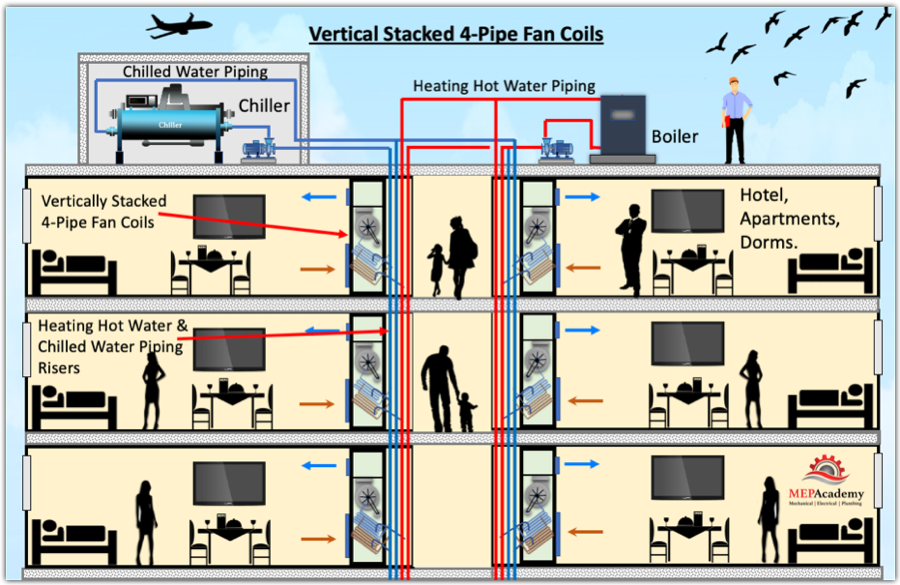
I once watched a rookie contractor try to balance a 20-story office tower without understanding the HVAC risers. He treated each floor like an independent system and ended up with a lobby that felt like a wind tunnel and a top floor that was basically a sweatbox. Honest mistake. But it taught me something critical. You cannot fake the physics of vertical ductwork. You either respect the column of air moving through the building, or your tenants will remind you every single day.The HVAC riser isn't just a big pipe. It's the spine of any multi-story air distribution system. It takes conditioned air from the mechanical room—usually in the basement or on the roof—and literally shoves it upward (or downward) through a dedicated vertical shaft. Think of it like the main artery in your chest. If that artery gets pinched or poorly designed, everything downstream suffers. Seriously. The whole building becomes a collection of hot and cold complaints.
The Vertical Backbone: What an HVAC Riser Actually Does
Look—when we talk about HVAC risers, we are talking about the primary pathway for air distribution between floors. It's a large, rectangular or round duct that runs from the central air handling unit (AHU) to every level of a building. But it's not a simple pipe. It's a carefully engineered channel that accounts for pressure changes, duct friction, and the sheer weight of the air column itself. Yes, air has weight. And in a 30-story building, that weight matters.The magic happens at each floor. A branch duct T's off the main HVAC riser. That branch feeds the VAV boxes, fan coil units, or direct supply registers on that specific floor. The vertical ductwork carries the primary air, and the branches do the local distribution. But here's where most people screw up—they forget that the riser itself has to be sized differently for every floor. The bottom of a riser carries the total air volume for all floors above it. The top floor only carries its own load. So the duct gets smaller as you go up. It's a taper. Not a uniform tube.
Why Your Building's Bones Depend on It
Every multi-floor building has a skeleton. Concrete, steel, maybe some timber. But the HVAC riser is part of the building's mechanical skeleton. If you design it wrong, you can't just swap it out later. Retrofitting a main riser in an occupied building is a nightmare. We're talking core drilling, sheetrock demolition, and tenants eating dust for weeks. So you have to get it right the first time.The air distribution system relies on the riser to maintain consistent static pressure. Static pressure is just the air's push against the duct walls. Too little static pressure at the top floor, and the VAV box can't open its damper enough to satisfy the thermostat. Too much static pressure at the bottom floors, and you get that annoying whistling sound from diffusers. It's a balancing act. And the HVAC riser is the tightrope.
Honestly? The most common failure I see in new construction is undersized risers. Contractors try to save a few bucks on sheet metal. They install a riser that's just barely big enough for the theoretical airflow. But they forget about real-world conditions—dirty filters, partially closed dampers, or a future tenant who adds a server room. By then, the riser is choked. Multi-floor systems hate being choked.
The Physics of Pushing Air Up (and Down)
Air wants to go the path of least resistance. That's a problem for vertical ductwork. Gravity pulls air down, and static pressure pushes it equally in all directions. So when you push air up a riser, you lose pressure to friction and to the weight of the column. Engineers call this the 'stack effect' and 'pressure regain.' I call it a constant headache if you don't plan for it.You have to calculate the friction loss per foot of riser height. Then you add the elevation pressure loss (about 0.036 inches of water column per foot of vertical rise). Sounds small, right? But in a 200-foot tall building, that's over 7 inches of water column pressure loss just from gravity. That's massive. If your fan can't overcome that, the top floors starve for air. Bottom line—HVAC risers in tall buildings almost always need a mid-level booster fan or a carefully zoned system. You can't rely on a single basement fan for a skyscraper. It just doesn't work.
The Real-World Challenges of Multi-Floor Air Distribution
Theory is great. But let me tell you what happens on a Tuesday morning at 8 AM. A tenant on the 14th floor calls complaining about cold air blasting from the diffuser. Meanwhile, the 3rd floor is sweating. Your HVAC riser is the culprit. It's delivering air, but the distribution is lopsided because the balancing dampers on the 14th floor branch are wide open, and the 3rd floor damper is stuck closed. That's not a design problem. That's a maintenance and installation problem.Another nasty issue—duct leakage. A riser that passes through 20 floors has hundreds of feet of seams, joints, and connections. If the duct isn't sealed properly (and I mean SMACNA Class A sealant, not duct tape), you lose air at every seam. That air escapes into the wall cavities, the ceiling plenums, or the shaft itself. That's stolen conditioned air. It never reaches the intended floor. Over a whole year, that leakage costs you thousands in energy waste and unhappy tenants.
Pressure Drops and the Cold Coffee Problem
Here's an analogy I use with clients. Imagine a giant straw that goes from the coffee pot to your cup on the 10th floor. But the straw has 10 tiny holes drilled along its length. The coffee will spill out at every hole before it reaches your cup. Your HVAC riser works the same way. Every branch takeoff, every elbow, every transition creates a 'hole' where pressure can drop. The air distribution system has to fight these losses.I've seen buildings where the mechanical engineer didn't account for the pressure drop of the fire dampers installed at every floor penetration. Each fire damper adds about 0.05 to 0.1 inches of pressure drop. Multiply that by 20 floors, and you've lost 1 to 2 inches of static pressure just from safety devices. The fan doesn't know that. It just struggles. So you either upsize the fan, increase the riser size, or install a zone booster. Ignoring this is why some buildings have 'cold coffee' on the top floors—weak airflow, unsatisfied setpoints.
Balancing Act: Dampers, VAV Boxes, and Stubborn Tenants
Balancing a multi-floor system is a dark art. I've done it with hand-held anemometers and a lot of patience. The goal is to have each floor receive exactly the design airflow, no more, no less. You do this by adjusting manual balancing dampers at each branch takeoff from the HVAC riser. But tenants mess with things. They close supply registers. They block diffusers with furniture. Or they install illegal split systems that mess up the return air path.VAV boxes help. These are terminal units that modulate airflow based on zone temperature. They sit between the riser branch and the diffusers. They're great for comfort, but they can throw the system out of balance if the minimum airflow settings are wrong. I once spent a day recalibrating 40 VAV boxes because the factory defaults were set for a different riser pressure. The vertical ductwork was fine. The controls were the mess. So yes, HVAC risers need the whole system—ducts, dampers, and controls—to play nice together.
Designing a Riser That Actually Works: A Practitioner's View
You want my advice? Don't design the riser in isolation. Design it with the building's core and structural grid in mind. A common mistake is putting the HVAC riser too close to the elevator shaft. That creates noise issues. Or running it through a tight chase that makes future maintenance impossible. I've seen riser access doors that were 12 inches wide. You can't put a human in there. You can barely fit a flashlight.Pencil it out like this:
- Velocity matters. Keep main riser velocity below 1500 fpm to minimize noise and friction. - Static pressure gradient. Plan for a pressure decrease of 0.1 to 0.2 inches per floor. - Fire and smoke dampers. Required at every floor penetration. Factor them in. - Access doors. Every 20 feet or at every major branch. Your service tech will thank you. - Duct material. Galvanized steel, minimum 22-gauge for risers over 100 feet tall.
Sizing, Stack Effect, and Fire Dampers
Stack effect is the natural movement of air due to temperature difference between inside and outside. In winter, warm air rises up the building. That rising air pulls cold air through the HVAC riser and other shafts. It can overpower your mechanical system. I've seen lobby doors that won't close because of stack effect pulling air up the elevators. Your vertical ductwork has to be designed to resist this. Use motorized isolation dampers or pressure relief dampers near the top of the riser.Fire dampers are non-negotiable. But they're also a pain. Every damper needs a fusible link and a resettable actuator. And you need to test them annually. An untested fire damper is a liability. It can seize in the open position, compromising fire safety. Or seize closed, cutting off airflow to a floor. I always specify access doors directly adjacent to each damper. No exceptions. It's the only way to inspect them without cutting drywall.
The Critical Role of Insulation and Access Doors
Insulation on HVAC risers is often skipped for cost. That's a mistake. Uninsulated risers in an unconditioned shaft will shed heat or cold into the shaft. That changes the air temperature before it reaches the floor. In summer, the supply air gains heat from the shaft, and the top floor gets warm air instead of cold. Plus, condensation forms on the duct surface during cooling season. Mold problem waiting to happen.Access doors—don't cheap out. Install them at every floor level, on the side of the riser facing the mechanical room or corridor. They need to be large enough to pass a 6-inch round damper through for replacement. Mark them clearly on the building plans. I've spent hours crawling through chases trying to find a riser that was buried behind drywall. It's not fun. A well-maintained HVAC riser with proper access can last 40 years. A hidden one will cause problems in year three.
Common Questions About How HVAC Risers Distribute Air Through Multiple Floors
What happens if an HVAC riser is undersized?
An undersized HVAC riser creates high static pressure losses. This leads to insufficient airflow at the farthest floors (usually the top). You'll see low supply air temperatures and poor comfort. The fan will also work harder, increasing energy bills. Eventually, you might need to add a booster fan or replace the riser entirely—both expensive fixes.
Can you retrofit an HVAC riser in an existing building?
Yes, but it's disruptive. You typically need to create a new shaft or use an existing chase. This involves core drilling through slabs, cutting through walls, and coordinating with fire protection systems. I recommend a phased approach—one floor at a time—to minimize tenant impact. Use split duct sections that can be assembled in tight spaces.
How often do HVAC risers need maintenance?
At least annually. You should inspect all access doors, check for duct leakage, test fire dampers, and clean any debris from the bottom of the shaft (where dust accumulates). In high-rise buildings, a biannual inspection is better. Listen for unusual noises like whistling or rattling—those indicate pressure issues or loose components.
Does the riser size change for taller buildings?
Absolutely. For buildings over 10 stories, risers are often tapered or zoned. The bottom section carries the most air volume, so it gets the largest cross-section. Above that, the duct reduces in size. Some tall buildings use multiple independent risers for different zones (low-rise, mid-rise, high-rise) to manage pressure better.
Is it better to have one big riser or multiple smaller ones?
Multiple smaller risers are generally better for redundancy and pressure management. A single massive riser creates extreme static pressure gradients. If it fails, the whole building is down. With multiple risers, you can isolate one zone for maintenance while others remain operational. It costs more upfront but saves headaches later.