
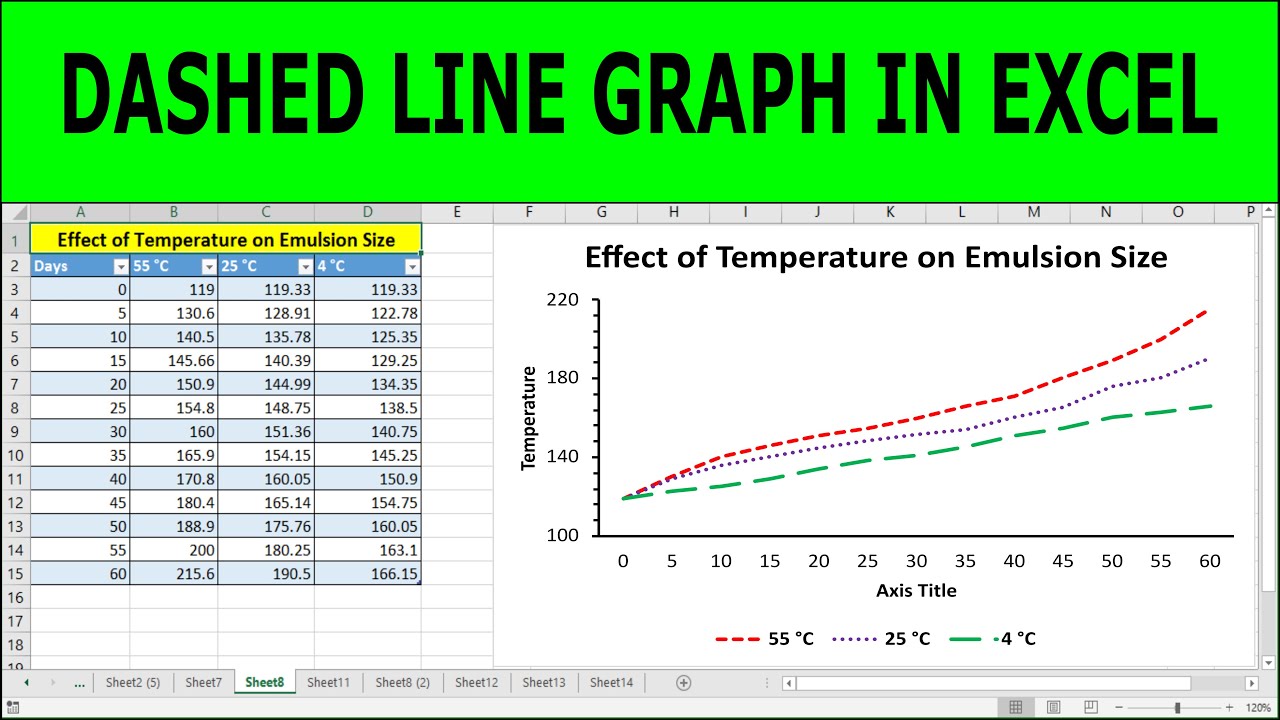
The Difference Between Dashed Lines and Solid Lines in Data Graphs: More Than Just a Line Drawing
I remember the first time a junior analyst handed me a chart that looked like a plate of spaghetti. Every series was a solid line in a different color, and my eyes crossed trying to track a single trend. When I asked why she didn't use a dashed line for the projected data, she blinked and said, "I thought that was just for style." Honestly? That moment haunts me. The difference between dashed lines and solid lines in data graphs is not about aesthetics. It's a fundamental language of visual encoding. Get it wrong, and you're essentially mumbling to your audience. Get it right, and you make complex data feel intuitive. Look—every time you choose a line style, you are making a promise to the viewer about the nature of that information.
This isn't some dusty rule from a 1980s design manual. It's how our brains parse certainty versus uncertainty, reality versus a hypothesis. The solid line is the heavy lifter of data graphs. It screams, "This happened. I measured it. Trust it." The dashed line, on the other hand, whispers, "Maybe. Probably. This is what I think will happen, but don't bet the farm." Understanding this distinction separates a chart that informs from a chart that confuses. Seriously, it's that critical.
The Core Dichotomy: Certainty vs. Projection
Let's get this straight from the jump. The primary difference between dashed lines and solid lines in data graphs boils down to the certainty of the data source. You have two fundamental flavors of data: empirical (observed) and speculative (predicted or interpolated). A solid line is the default, the Esperanto of line charts. You use it for actual, recorded measurements. It represents a continuous set of actual events or observations. You don't need to think about it; you just draw it.
A dashed line is your signal for a change in state. It is a visual flag. It can indicate a forecast, an estimate, a target, or a gap in data collection. Every dash is a tiny pause, a visual hesitation that tells the viewer, "Hold up. The rules have changed." I've seen executive decisions made on the wrong side of this simple distinction. It's not minor. It's a big deal.
Why Solid Lines Dominate for Historical Data
Think of a solid line as the fingerprint of reality. When you plot quarterly sales figures, daily temperatures, or website traffic from last month, you are drawing a factual record. The line connects points A to B to C because those points exist in time and space. Your brain interprets this continuity as integrity. There is no visual guesswork. The solid line implies a direct, causative relationship between the x-axis and the y-axis.
Here’s the thing—if you use a dashed line for this historical data, you are psychologically undermining your own evidence. You are telling your audience, "I'm not sure about these numbers," even if they are perfectly audited. It’s a subconscious downgrade. Your chart will feel weaker. For that reason, always default to a solid line for any data set that has actually occurred. It's the visual anchor that everything else in the graph orbits around.
The Daunting Job of the Dashed Line in Predictive Data
Projections are fragile. They are educated guesses built on assumptions. Using a dashed line for these forecasts is not just a best practice; it's an ethical responsibility. When you show a revenue projection for Q4 with the same visual weight as your Q3 actuals, you are, whether you mean to or not, implying equal certainty. That is dangerous. The dashed line provides a crucial layer of data graph honesty.
The visual pattern is literally broken. Your eye cannot glide smoothly over a dashed line without noticing the gaps. This activates a different part of the viewer's brain—the skeptical part. It creates a healthy distance. I often tell my teams to think of the dashed line as a guardrail. It keeps the viewer from falling into the trap of treating a model as a fact. Use it for forecasts, budget targets, or any scenario analysis. It's the single most effective way to visually label "handle with care."
Practical Use Cases: When to Switch from Solid to Dashed
Knowing the theory is fine, but you need the playbook. Let's walk through the specific scenarios where the difference between dashed lines and solid lines in data graphs becomes your most powerful storytelling tool. You wouldn't use a hammer for a screw, right? Same logic applies here. Every line style has a job description, and you need to hire the right one for the task.
This is where experience kicks in. I've seen dashboards with fifteen solid lines and zero dashed lines. It's a visual hellscape. You need contrast. You need hierarchy. The dashed line is not a second-class citizen; it is a specialist. Its job is to draw the eye to the uncertainty node. It says, "This is the interesting part. This is where the drama is." It's a narrative tool.
Actual vs. Projected: The Classic Dynamic Duo
This is the bread and butter of business dashboards. You have your actual sales (solid) and your sales forecast (dashed). They often overlap. The moment the dashed line dips below the solid line, you know you have a problem. Without the dashed line, you have no benchmark. Without the solid line, you have no context. The combination is devastatingly effective.
- Solid Line: Your actual Q1 performance. It's non-negotiable.
- Dashed Line: Your Q1 budget target. It's aspirational.
- Result: The visual gap between them tells the entire story of operational success or failure.
I see a lot of people using different colors for this. Don't get me wrong, color helps. But using a dashed line for the projection is a redundant layer of encoding that works even if the color-blind viewer can't tell the difference. It's an accessibility win. It's a clarity win. It's the standard for a reason.
Confidence Intervals and Error Margins
Now we go deep. Sometimes you don't just have a single projection—you have a range. A dashed line is perfect for showing the upper and lower bounds of a confidence interval. The middle line (the mean or median) might be a thick solid line, but the wings? Those are dashed. They represent uncertainty. They are the edges of the plausible envelope.
This is where your audience really pays attention. Showing a dashed line for your 95% confidence interval is the academic gold standard. It visually communicates, "We expect the real value to fall somewhere in this zone, but we aren't exactly sure where." It's honest. It's humble. And it makes your graph infinitely more trustworthy. If you only use solid lines, you're implying a precision you likely don't have. That's a quick way to lose credibility with anyone who knows their numbers.
Visual Hierarchy: Letting the Lines Breathe
Good data visualization is about focus. You need to guide the viewer's eye to the most important piece of information first. A chart covered in uniform solid lines has no hierarchy. Everything screams equally loud. The difference between dashed lines and solid lines in data graphs gives you an instant tool for creating this visual hierarchy without changing colors.
The solid line naturally commands more visual weight. It is dense. It fills the space. Our eyes are wired to pay attention to dense, continuous patterns. A dashed line, by contrast, appears lighter, airier, and less dominant. This is perfect for secondary data sets that provide context but should not dominate the main narrative. You want the headline data to be solid and the supporting data to be dashed.
When to Use Dashed Lines for Missing Data
Data sets have holes. Maybe your sensor broke for a week. Maybe you have quarterly data that you need to connect to annual data. Connecting a solid line across a gap is a lie. It implies that the data continued smoothly when you know it did not. This is one of the most common errors I see in amateur data graphs. They use a solid line that skips over a chasm of nothing.
You have two options. First, you can break the line entirely (leaving a visual gap). That is often the most honest approach. Second, you can use a dashed line to bridge the gap. The dashed line becomes a bridge of interpolation. It says, "We don't have the data for these specific points, but based on the trend, we are guessing the line looks like this." It is a visual apology. It is a confession of ignorance, and in data, that confession builds trust.
- Continuous data recorded: Always a solid line.
- Data gap exists (no record): Leave a break or use a dashed bridge.
- Future prediction: Always a dashed line.
Dashed Lines for Targets and Thresholds
Target lines are another perfect use case. Imagine a line chart of monthly defect rates. You have a solid line showing the actual defect rate rising and falling. You draw a horizontal line at the acceptable threshold of 5%. Is that line solid or dashed? It should be dashed every time. It is not a measured data point; it is a goal. It is a rule. It exists in the conceptual space, not in the observed reality.
This is a subtle but powerful psychological shift. A solid line threshold looks like a wall. It feels rigid and unchangeable. A dashed line threshold feels like a target you are shooting for. It invites the comparison without forcing a false equivalence. The moment the solid line (actual data) crosses the dashed line (target), you have a visual alarm bell. The contrast creates the drama. It's a simple trick, but it's incredibly effective in executive summaries and operational dashboards.
Common Questions About the Difference Between Dashed Lines and Solid Lines in Data Graphs
Can I use a dashed line for negative data or losses?
Absolutely, but be careful. While the dashed line typically signals uncertainty, it can also be used to signal a different type of data, like a negative trend or a loss compared to a baseline. For example, you might use a solid line for overall revenue and a dashed line for revenue after returns. The dashed line here indicates a derived or adjusted figure, not necessarily a prediction. The key is consistency and a clear legend. Just don't mix two different reasons for the dash in the same chart without labeling it clearly.
What if my publication only allows black and white printing?
This is where dashed lines become your best friend. In grayscale, all colors look like shades of gray. A red solid line and a blue solid line look identical. You have no contrast. In a black-and-white context, you should rely exclusively on line styles (dashed, dotted, dash-dot) to differentiate your data series. This is the original purpose of the dashed line—differentiation without color. It's an essential skill for anyone publishing in scientific journals or printing reports.
Is it ever okay to use a solid line for a projection?
Honestly? No. Not if you care about accuracy. Look—there is a very narrow exception if you are visualizing a short-term, high-confidence forecast that is updated in real-time (like a weather track for the next 15 minutes). But for 99% of business and scientific visualization, a solid line for a projection is misleading. It implies a level of certainty that doesn't exist. You are setting your audience up for a false sense of security. Use the dash. It shows you know what you're doing.
What's the best way to style dashed lines? Any tips?
You want the dashes to be visible but not distracting. A common mistake is making the dashes too small or the gap too large. The dashes should be visually distinct from the line weight. For a standard 2px line, a dash pattern of 4px dash, 2px gap is often a good starting point. Avoid using too many different dash patterns in one chart (dotted, dashed, dash-dot-dash) because it becomes visual noise. Stick to one or two dashed line patterns per graph. Your audience will thank you.
At the end of the day, the choice between a dashed line and a solid line is a choice about respect for the data. It is a commitment to showing the viewer exactly what you know and, just as critically, what you don't know. Use the solid line as your foundation of truth. Use the dashed line as your beacon of possibility and caution. That distinction is the difference between a chart that simply displays numbers and a chart that actually communicates wisdom.