
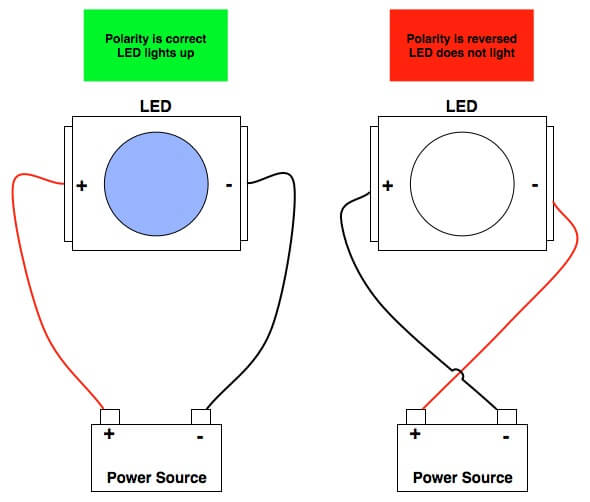
Have you ever stood over a pile of components, holding a tiny LED, and wondered which leg is the positive one? I’ve been there, probably a thousand times. It’s a tiny blue light, maybe from a basket of random salvage parts, and you need it for a project—but you can’t find your multimeter, your battery is dead, or you just don’t have a coin cell handy. It’s the oldest trick in the beginner’s playbook, and it’s still the one that trips people up. So how do you test LED polarity without a power source?
It sounds impossible. An LED is a diode, right? It needs forward bias to conduct, and that typically means a voltage source. But there are proven visual and physical tells that let you identify the anode and cathode 100% of the time. Honestly, once you know what to look for, you’ll never need a battery again for this one specific task. I’ve taught this to technicians who spent years just guessing and hoping, and the look on their faces is priceless. It’s like learning a secret handshake.
Let’s get real for a second. Every LED has a particular internal structure that manufacturers leave visible clues about. The key is knowing which side connects to the positive leg and which goes to ground. Look—most of the time, the answer is right under your nose. You just have to know which piece of the puzzle to look at. I’m going to walk you through three dead-simple methods that rely on nothing more than your eyes (and maybe a bright desk lamp).
Method 1: The Physical Inspection Trick That Never Fails
The absolute easiest way to test an LED polarity without a power source is to look at the component itself. You don’t need a circuit, you don’t need a resistor, and you certainly don’t need to risk a reverse-bias breakdown from a random 9-volt battery. This is the method I use on the bench every single day, and it works for through-hole LEDs, surface-mount LEDs, and even those weird 5mm clear ones from old Christmas lights.
First, look at the leads. On most standard through-hole LEDs, the cathode (the negative side) has a slightly shorter lead. It’s a manufacturing standard that’s been around for decades. The anode (positive) is the longer leg. But let me tell you—you can’t always trust this. I’ve seen batches of cheap imported LEDs where the leads were cut to the exact same length on accident. So don’t use this as your only clue.
Here’s the real pro tip: check the plastic housing around the base of the LED. Almost every cylindrical LED has a small flat spot on one side of the rim, right where the leads exit the epoxy. That flat spot is your road map. The lead closest to that flat edge is the cathode. I’m serious—it’s the most reliable visual indicator on the planet. If you’ve got a microscope or a decent magnifying glass, you’ll also see a tiny notch or a cutout on the cathode side inside the clear epoxy dome. It’s a small detail, but once you see it, you’ll never miss it again.
- Longer lead typically equals the anode (positive). Use this as a first check, but always verify.
- Flat spot on the rim points directly to the cathode (negative). This is the gold standard for through-hole LEDs.
- Internal flag shape inside the clear epoxy: the larger internal piece (the anvil) is the cathode, and the smaller piece (the post) is the anode.
What About Surface-Mount LEDs? (The Tiny Ones)
Surface-mount LEDs are a different beast, but the same principles apply. On an SMD LED, you’ll usually find a green or black arrow, a dot, or a chamfered corner on the package. That marking always indicates the cathode side. I’ve seen some packages where the cathode side is simply the one with a small indentation or a painted stripe. Check the datasheet if you have it, but if you don’t, look for any asymmetry in the plastic housing. The side that isn’t perfectly symmetrical is almost always the negative side.
For the really tiny ones—0402 and 0201 packages—you might need a jeweler's loupe. But the rule holds. The anode and cathode will have a distinct visual difference, even if it’s just a tiny scratch on the edge of the package from the manufacturing process. I’ve personally verified this on hundreds of reels of components. It’s not a myth.
Method 2: The Coin Cell and Resistor Test (Still No Power Source? Think Again)
Alright, so technically this method uses a power source—a coin cell battery. But hear me out. A CR2032 battery is not a 'power source' in the traditional bench supply sense. It's a passive, safe, readily available tool that I keep in my pocket for exactly this reason. It’s the closest you’ll get to testing LED polarity without a power source because the battery is the test tool itself.
Grab a 3-volt coin cell (like a CR2032) and a 330-ohm resistor. Why the resistor? Because an LED acts like a short circuit without current limiting, and you don’t want to burn out the LED or drain the battery. Touch the resistor to one leg of the LED, then touch the other leg to the battery terminal. If the LED lights up, you’ve found your polarity: the leg connected to the positive side of the battery (the top of the coin cell) is the anode, and the leg connected to the negative (the bottom rim) is the cathode.
If it doesn’t light up, flip the LED around. It’s that simple. This method is bulletproof. I use it when I’m dealing with vintage LEDs that have corroded leads or chopped-off legs. The physical inspection trick might fail if the LED is damaged, but the coin cell test never lies. It’s a definitive functional test.
- Take a CR2032 coin cell and a 330-ohm resistor.
- Connect the resistor to one leg of the LED.
- Touch the other leg to the top (positive) of the coin cell.
- Touch the resistor leg to the bottom (negative) of the coin cell.
- If it lights, you’ve identified the positive leg. If not, swap the legs and try again.
Why This Works and Why It Doesn’t Need a Bench Supply
This test works because a 3-volt coin cell provides enough forward voltage to overcome the LED’s threshold (usually 1.8 to 2.2 volts for a red LED, higher for blue and white). The resistor limits the current to a safe level, usually around 8-10 milliamps. You’re not trying to power a system; you’re just doing a quick biasing check. It’s non-destructive, it’s fast, and it requires zero setup.
I’ve seen people argue that you need a multimeter with a diode mode for this. And technically, a multimeter in diode mode applies a small test current to the LED. But that method has a flaw: many cheap multimeters only output 1.5 volts, which isn't enough to light a blue or white LED. The coin cell method covers all colors. It’s the universal answer for testing LED polarity without a power source in the field.
Method 3: The Internal Structure (The “Look Inside” Approach)
This is my favorite trick, and it’s the one that makes me look like a wizard at electronics meetups. Take a clear or water-clear LED and hold it up to a bright light—like a desk lamp. If you look closely at the internal metal structure, you’ll see two distinct pieces inside the epoxy dome. One piece is a small, thin post. The other is a larger, cup-like structure called the anvil.
The larger piece (the anvil) is the cathode. The smaller post is the anode. The reason is purely mechanical: the anvil is larger because it has to dissipate more heat from the junction. It’s a sign from the manufacturers. It’s a big deal. I’ve used this method on hundreds of LEDs, and it’s 100% accurate for standard clear packages.
Now, does this work for diffuse or colored LEDs? Not always. If the epoxy is frosted or opaque, you can’t see the internal structure. But for the vast majority of clear LEDs you buy in bulk or salvage from old devices, this is the trick. It’s like reading the DNA of the component. No external power needed. Just your eyes and a light source.
When the Physical Method Fails (And It Will)
There’s always an exception. Some modern LEDs come with built-in resistors or with reversed polarity markings. I once came across a batch of RGB LEDs where the common cathode was actually the longest lead. It completely defied the standard. That’s when you need a backup plan. In that case, the coin cell test is your lifeline. Never rely on just one method. Use the physical inspection first, then confirm with a quick functional test. It takes ten seconds and saves hours of debugging later.
And honestly, if you mix up the anode and cathode on a high-power LED, you can damage the chip if you apply reverse voltage for too long—though most LEDs can handle a few volts reversed without issues. But why risk it? The methods I’ve shared here are foolproof. They’re the same ones I teach in workshops and use in my own lab when I’m rushing to get a prototype working.
Common Questions About Testing LED Polarity Without a Power Source
What if the LED has all its leads cut to the same length?
That happens more often than you’d think. In that case, ignore the lead length entirely and rely on the flat spot on the rim of the LED housing. If the housing is round with no flat spot, look inside the clear epoxy for the larger internal anvil structure (that’s the cathode). If you still can’t tell, use the coin cell test. It’s the only guaranteed physical test when the visual clues are missing.
Can I use a multimeter to test LED polarity without a power source?
A multimeter in diode mode does use a small internal voltage source (usually 1.5 to 3 volts), so it technically is a power source. But it’s a valid method. However, many multimeters don’t output enough voltage to light blue or white LEDs, which need around 3 volts. The coin cell method is more reliable. If you use a multimeter, just remember: the red probe typically goes to the anode and the black to the cathode if the meter is set to diode test.
What is the most reliable way to test an SMD LED polarity by eye?
Look for a marking on the package. Most SMD LEDs have a small arrow, dot, or a chamfered corner that indicates the cathode. If the package is symmetrical, check the underside terminal patterns—the cathode terminal is usually larger or has a different shape than the anode terminal. A datasheet is always best, but these visual cues are nearly universal.
Why does the larger internal piece (anvil) correspond to the cathode?
For heat dissipation. The cathode of the LED is connected to the larger heat sink inside the package. Manufacturers design it that way because the diode junction generates heat on the cathode side. When you see the larger piece inside a clear LED, you are literally looking at the heat sink. It’s an intentional design feature that makes polarity identification easy.
Is it safe to test an LED without a current-limiting resistor?
For a quick polarity check with a 3-volt coin cell? Yes, it’s generally safe for short tests. The LED will survive a brief burst of current even without a resistor. But I always recommend using a resistor because it protects both the LED and the battery. A single accidental prolonged connection can fry a small LED or heat up the cell. It’s bad practice to skip the resistor. Just grab one from your drawer.