
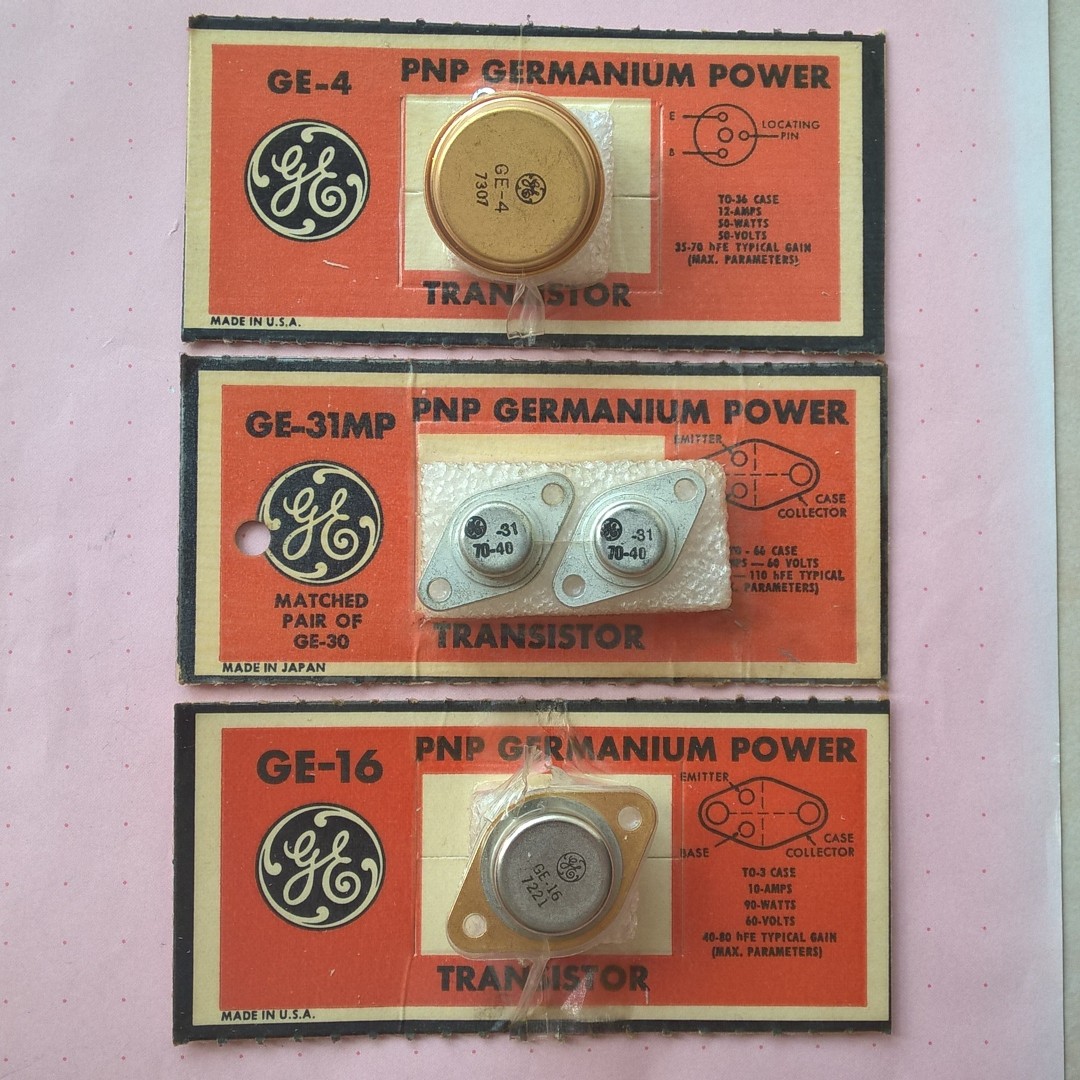
Why Germanium Is Essential for Manufacturing Vintage Transistors
Have you ever held a vintage transistor radio from the 1950s and wondered why it sounds warmer, fuzzier, or just different than a modern silicon-based device? The secret lies in the tiny gray-black crystal inside. It's not silicon. It's germanium. And look—if you're trying to restore an old piece of audio gear, build a classic fuzz pedal, or simply understand the history of solid-state electronics, you need to know why germanium isn't just a historical footnote. It's the irreplaceable soul of the entire vintage transistor era.
I've spent well over a decade working with these components. Seriously. I've tested hundreds of OC71s, AC128s, and 2N130s. I've watched people replace dead germanium transistors with modern silicon equivalents and then wonder why their amplifier sounds like a dying vacuum cleaner. The answer isn't nostalgia. It's physics.
The Unique Electrical Properties That Make Germanium Irreplaceable
Let's get one thing straight upfront. You cannot simply substitute a silicon transistor for a germanium transistor and expect the same circuit behavior. It doesn't work that way. The materials are fundamentally different at the atomic level.
Lower Forward Voltage Drop (The Soft Clipping Secret)
Here's the biggest reason. A standard silicon transistor typically needs about 0.6 to 0.7 volts across the base-emitter junction to start conducting. A germanium transistor? It starts conducting at roughly 0.2 to 0.3 volts. That's a massive difference. Honestly, it changes everything about how a circuit responds to an input signal.
In audio circuits, particularly in overdrive pedals and vintage amplifiers, this lower threshold creates a phenomenon called "soft clipping." The transistor begins to saturate earlier and more gradually than silicon. It doesn't just slam into a hard wall. It eases into it. That's where the famous warm, compressed, "singing" tone of classic rock and blues comes from. You can't replicate that with a silicon part without adding a dozen extra components. It's a big deal.
Higher Carrier Mobility and Frequency Response
The electrons inside germanium move faster than they do in silicon. It's a simple material science fact: germanium has higher electron and hole mobility. This meant that early vintage transistors could achieve decent frequency response with relatively simple manufacturing techniques.
For radio frequency applications in the 1950s and 60s, this was critical. Germanium transistors could handle frequencies up to several hundred megahertz when silicon devices at the time were still struggling. Many classic portable radios used germanium alloy-junction transistors that could oscillate and amplify at AM and shortwave frequencies with minimal bias current. The efficiency was remarkable for the era.
Lower Saturation Voltage (Battery Efficiency Matters)
Vintage gear ran on batteries. Heavy, expensive, short-lived batteries. Germanium transistors have a lower collector-emitter saturation voltage compared to silicon. This meant a circuit could operate with a lower supply voltage and still function correctly.
Think about it. A vintage pocket radio might run on a single 9-volt battery. If you swapped in silicon transistors, the circuit might not even turn on, or it would distort badly because the voltage is simply too low to bias the silicon junctions properly. Germanium was the enabler of portable electronics. It allowed designers to squeeze performance out of tiny power budgets.
The Manufacturing Reality of Vintage Germanium Transistors
Now, here's where the conversation gets practical. Why is germanium essential for manufacturing vintage transistors today? Because we are literally trying to replicate a process that died out in the early 1970s. And it's not easy.
The Alloy-Junction Process (A Lost Art)
Most vintage transistors, especially the ones used in fuzz pedals and audio amplifiers, were made using the alloy-junction technique. A small pellet of indium or aluminum was literally fused (alloyed) onto a thin wafer of germanium. The heat and pressure created the P-N junction.
- Temperature control was critical. Too hot? The indium penetrates too deep and shorts the junction. Too cold? No junction forms at all. - The germanium wafer itself had to be extremely pure, often doped with tiny amounts of antimony or arsenic. Impurities of one part per million could ruin an entire batch. - The base width was controlled by the amount of time and heat applied. This directly determined the transistor's gain (beta) and frequency response.
Today, to manufacture a true recreation of an OC71 or AC128, you need a specialist lab. You need NOS (New Old Stock) germanium wafers. You need technicians who understand the old doping profiles. It's not a scalable process. It's handcrafted electronics with a 70-year-old recipe.
Thermal Sensitivity (The Curse and the Charm)
Let's talk about the elephant in the room. Germanium transistors are incredibly sensitive to heat. They leak current. A lot.
Reverse leakage current (ICBO) in germanium can be 100 to 1000 times higher than in silicon. As the device warms up, leakage increases. As leakage increases, the bias point shifts. As the bias shifts, the transistor can enter thermal runaway and destroy itself.
This sounds like a nightmare. And it can be. But for circuit designers in the 1950s, it was a constraint they learned to work with. They built circuits with resistor dividers that allowed for this drift. They used negative feedback to stabilize the operating point. And the resulting sound—that unpredictable, slightly unstable, organic quality—is precisely what musicians and audiophiles crave.
- List of challenges with germanium manufacturing today: - Sourcing pure germanium ingots is expensive and limited. - The alloy-junction process requires specialized equipment no longer mass-produced. - Yield rates are low; many "new" old stock parts are actually rejects that failed testing decades ago. - Matching transistors for gain and leakage is tedious but mandatory for stereo circuits.
Why You Can't Just Use Silicon (And Why People Keep Trying)
Every few years, someone claims they've developed a "silicon replacement" for a germanium transistor that sounds exactly the same. Look, I've tested them. They don't. They get close, maybe within 80%. But they miss the magic.
The Impedance Interaction
Germanium transistors typically have lower input impedance and higher output impedance than silicon equivalents. This changes how the circuit interacts with the pickup or the following stage. A silicon transistor might "load" the signal differently, causing a loss of treble or a change in phase. The entire circuit topology was designed around the specific impedance characteristics of germanium.
The Noise Floor
Vintage germanium transistors are noisy. They produce a distinct hiss and sometimes a low-frequency "pop" or crackle. In a modern context, this is a defect. In a vintage fuzz pedal, this is part of the texture. It adds a layer of complexity to the sound that a clean, sterile silicon transistor simply cannot produce. You can add noise to a silicon circuit artificially, but it sounds fake. It lacks the harmonic relationship.
The Forward Bias Curve
We mentioned the 0.2V threshold earlier. But the exact shape of the current-voltage curve is different. Germanium has a softer "knee." It doesn't turn on as abruptly. This creates a different harmonic distortion profile. Even-order harmonics are more pronounced. That's the "fat" sound.
- List of true use cases where germanium is the only option: - Fuzz Face and Tone Bender pedals: The classic circuit relies on the specific leakage and gain of germanium for its gated, sputtering sustain. - Vintage radio restoration: Replacing the RF or IF stage with silicon kills the sensitivity and selectivity of the original design. - Early computer restoration: Machines like the IBM 1401 used germanium logic cards. Silicon parts won't interface correctly with the voltage levels. - High-end audiophile preamps: Some enthusiasts insist on germanium for its "musical" distortion in microphone preamps.
Common Questions About Why Germanium Is Essential for Manufacturing Vintage Transistors
Why did manufacturers stop using germanium if it sounds so good?
Simple: cost, reliability, and temperature stability. Silicon is dirt cheap, far more abundant, and doesn't require the same level of manufacturing precision. A silicon transistor will work reliably from -40 to +125 degrees Celsius. A germanium transistor might stop working on a hot summer day. For mass-market consumer electronics, silicon was a no-brainer.
Can I still buy new germanium transistors today?
Yes, but they are rare and expensive. A few specialty manufacturers in Russia and China still produce limited runs of germanium transistors, often for military or industrial applications. But most are NOS (New Old Stock) that sat in a warehouse for 50 years. You need to test every single one for leakage and gain. Honestly, expect a 50% reject rate on eBay lots.
Is there a modern silicon transistor that sounds exactly like germanium?
No. There are "germanium-voiced" silicon transistors, but they use internal circuit tricks, like adding resistors or Schottky diodes, to mimic the voltage drop. They can sound good. Some even sound great. But they don't have the same leakage characteristics or the soft knee. For a restoration purist, they're a compromise.
How do I safely test a vintage germanium transistor?
Use a multimeter with a germanium diode test mode, or build a simple test circuit with a 9V battery and a resistor. Measure the leakage current between collector and base with the emitter open. Anything under a few hundred microamps is usually okay for audio. For gain, use a component tester that can handle low-current devices. Do not apply too much heat when soldering. Use a heatsink clip on the leads.
Is germanium dangerous to handle?
Bare germanium itself is not highly toxic, but it can be a skin irritant in dust form. The bigger risk is the lead content in the solder joints and the indium used in the alloy-junction process. Treat old parts like any vintage electronics. Wash your hands. Don't breathe the dust if you are grinding or cutting cases.
At the end of the day, germanium isn't just a material. It's a piece of history locked in a tiny metal can. It represents the very beginning of the solid-state revolution, with all its imperfections and happy accidents. For the restorer, the musician, or the historian, understanding why germanium is essential for manufacturing vintage transistors is the difference between just fixing a circuit and truly reviving a piece of technology that changed the world.