
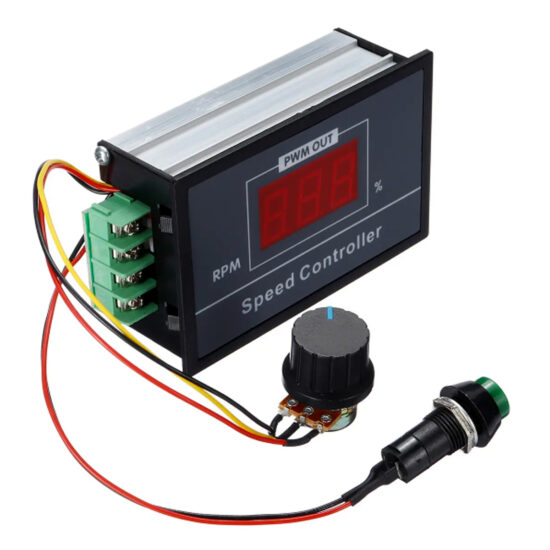
Why PWM Is the Backbone of Modern Motor Speed Controllers
You know that feeling when you grab a power drill, squeeze the trigger, and the bit spins up with buttery smooth precision? Or when your Roomba navigates a corner without slamming into the baseboard? That's not magic. That's PWM—pulse-width modulation—working its quiet, efficient magic inside the motor speed controller. Honestly? If you've ever wondered why modern motors don't just use a simple resistor to dial speed up and down, you're about to find out. The short answer is that PWM gives you control, efficiency, and heat management that older methods couldn't dream of. But let's dig deeper, because the story is way more interesting than just "it saves power."
Here's the thing: when I first started tinkering with electronics back in the day, we used variable resistors to control motor speed. It was crude, it was hot, and it was inefficient. Imagine trying to slow down your car by riding the brakes instead of taking your foot off the gas. That's basically what linear control does. PWM flips that paradigm. Instead of wasting energy as heat, it switches the motor on and off so fast that the motor sees an average voltage. The result? Smooth speed control, minimal heat, and a happy motor that lasts longer. It's a big deal.
Look—I've spent over a decade designing, debugging, and occasionally swearing at motor controllers in everything from robotics to industrial conveyor systems. And I can tell you this: if you strip away all the marketing fluff, PWM is the single most important technique in modern motor control. It's not just a feature; it's the foundation. So let's pull back the curtain and see exactly why pulse-width modulation won the race.
The Fundamental Problem with Old-School Motor Control
Before PWM took over, the go-to method for varying motor speed was linear regulation. You'd put a variable resistor (rheostat) or a transistor in its linear region between the power supply and the motor. By dropping some voltage across that component, you could reduce the voltage reaching the motor. Simple, right? Sure, but it came with a nasty downside: heat. Seriously, a lot of heat. The power that didn't reach the motor had to go somewhere, and that somewhere was the control element itself. I've seen rheostats literally glow red under heavy load.
Here's the math that matters: if you run a 12V motor at half speed using a linear regulator, you're dropping 6V across the regulator at whatever current the motor draws. If the motor pulls 2 amps, that's 12 watts of pure heat. For what? Just to slow the motor down. That's not control; that's a space heater with a spinning attachment. Worse, the wasted power scales with the load, meaning high-torque, low-speed scenarios become thermal nightmares.
Another issue? Efficiency. Linear methods rarely break 50% efficiency at partial speeds. In battery-powered devices—think drones, electric scooters, or cordless tools—that's a killer. You get maybe half the runtime you could have. And torque suffers, too. Lower voltage means lower torque, so your motor becomes weak and sluggish when you need it most. Trust me, nothing kills a project faster than a motor that stalls because you tried to slow it down the wrong way.
Finally, the control response was terrible. Want to go from slow to fast quickly? With a linear regulator, you're fighting thermal inertia and voltage lag. The system feels sluggish. PWM solved all of this in one fell swoop. And it did it by thinking differently about what "voltage" actually means to a motor.
Why Linear Control Just Couldn't Keep Up
Linear regulators aren't all bad—they're still used in audio amplifiers and sensitive analog circuits where noise is a dealbreaker. But for motors? They're a disaster waiting to happen. Motor speed controllers that rely on linear methods suffer from poor thermal management and bulky heatsinks. I remember working on a small robot project where the linear speed controller took up half the chassis just to dissipate heat. It was absurd.
Here's a practical comparison: a PWM-based controller running at 50% duty cycle delivers roughly the same average voltage as a linear regulator dropping half the supply, but it wastes almost no power in the controller itself. The transistor is either fully on (low resistance) or fully off (no current flow). In the on state, the voltage drop across the transistor is tiny—maybe 0.1 to 0.5 volts. That means power dissipation is near zero. The motor sees pulses of full voltage, and its own inductance smooths them out into a steady current.
So why did we ever use linear control? Because it was simple and the components were cheap. But as motors got smarter and applications got more demanding, pulse-width modulation became the obvious choice. It's not even a contest anymore.
The Efficiency Tipping Point: How PWM Changes the Game
Let's talk numbers. A well-designed PWM controller can achieve 85-95% efficiency across a wide speed range. Compare that to linear control, which might hit 50% at best when running at half speed. That efficiency gap isn't just academic—it translates directly into battery life, component lifespan, and overall system performance. In a drone, that could mean an extra 10 minutes of flight time. In an industrial conveyor, that's thousands of dollars saved on electricity per year.
Now, I know what you're thinking: "But doesn't switching create electrical noise?" Absolutely. And that's a valid concern. But modern motor speed controllers handle this with proper filtering, shielded cables, and careful layout design. The trade-off is overwhelmingly positive. The efficiency gains so massively outweigh the noise issue that you'd be hard-pressed to find a modern motor controller that doesn't use PWM. It's the standard.
One more point: PWM allows for regenerative braking. When you reduce the duty cycle, the motor can act as a generator, feeding energy back into the system. Try doing that with a linear regulator. You can't. That's why electric vehicles use PWM controllers—they recover energy during deceleration. It's a beautiful thing.
How PWM Actually Works Inside a Motor Controller
Let's get down to the nuts and bolts. A PWM signal is essentially a square wave with a fixed frequency and a variable duty cycle. The duty cycle is the percentage of time the signal is high (on) versus low (off). A 50% duty cycle means the power is on half the time and off half the time. The motor's inductance and inertia smooth out the pulses, so the rotor sees a continuous average voltage. It's like pouring a bucket of water into a river—the pulses merge into a steady flow.
The frequency of the PWM signal matters, and it's not a one-size-fits-all situation. Too low, and you'll hear audible buzzing or see visible speed ripple. Too high, and switching losses in the transistors start eating into your efficiency. In practice, most controllers use frequencies between 1 kHz and 100 kHz. For DC motors, 20-50 kHz is common because it's above human hearing and still efficient. For servo motors or stepper motors, you might go higher or lower depending on the application.
Here's a step-by-step breakdown of how a typical PWM motor speed controller processes the signal:
- Input Command: You turn a knob, press a trigger, or send a digital signal (like from a microcontroller).
- PWM Generation: The controller translates that command into a specific duty cycle. A higher command means a wider pulse (more on-time).
- Switching Stage: A power transistor—usually a MOSFET or IGBT—switches on and off at the PWM frequency, connecting and disconnecting the motor from the power supply.
- Motor Response: The motor's winding inductance stores energy during the on-time and releases it during the off-time, creating a smooth current flow.
- Feedback Loop: Many modern controllers include a tachometer or Hall sensor to measure actual speed and adjust the duty cycle to maintain it. That's closed-loop control.
This whole process happens thousands of times per second. It's fast, it's precise, and it's incredibly reliable when done right.
The Role of MOSFETs and IGBTs in PWM Switching
You can't talk about PWM without giving a shout-out to the switching devices. MOSFETs (Metal-Oxide-Semiconductor Field-Effect Transistors) are the workhorses for low-to-medium power applications. They switch fast, have low on-resistance, and are cheap. For higher power systems—like electric car drivetrains—IGBTs (Insulated-Gate Bipolar Transistors) take over because they handle higher voltages and currents with lower conduction losses.
The key here is that these devices are either fully on or fully off during pulse-width modulation. In the on state, they act like a nearly closed switch with very low resistance. In the off state, they act like an open circuit. This binary operation is what makes PWM so efficient. The devices only dissipate significant power during the brief transition between states—the "switching loss." Good design minimizes this by using fast gate drivers and proper snubber circuits.
I've seen plenty of rookie mistakes where someone uses a slow transistor and wonders why their controller gets hot. The switching frequency is too high for the device, and it spends too much time in the linear region. Choose the right MOSFET or IGBT for your motor speed controller, and you're golden. Choose wrong, and you're shopping for replacement parts.
Dead Time, Duty Cycle, and the Art of Timing
If you're using PWM in an H-bridge configuration (common for bidirectional motor control), you have to deal with "shoot-through." That's when both the high-side and low-side transistors turn on at the same time, creating a short circuit across the power supply. The result? Instant magic smoke. To prevent this, you insert a small delay called "dead time" between switching the high-side off and the low-side on. It's typically a few microseconds, but it's absolutely critical.
Dead time introduces a tiny nonlinearity in the output, but modern controllers compensate for it in software. It's one of those details that separates a hobby project from a professional-grade motor speed controller. I can't tell you how many times I've seen dead time settings cause a motor to run rough or draw excessive current. It's always the first thing I check when debugging.
The duty cycle itself is the star of the show. At 0%, the motor is off. At 100%, it's at full speed. Everything in between gives you proportional control. But here's the nuance: the relationship between duty cycle and motor speed isn't always perfectly linear due to friction, load, and magnetic saturation. That's why closed-loop control is so important. A PWM controller with feedback can adjust the duty cycle dynamically to maintain a set speed, even under varying load.
Real-World Applications Where PWM Dominates
Walk into any factory, and you'll see PWM everywhere. Conveyor belts, robot arms, CNC spindles, fans, pumps—you name it. The reason is simple: pulse-width modulation gives you precise, efficient, and repeatable control over speed and torque. It's not just about turning a motor; it's about turning it exactly the way you want, every time.
Take cordless power tools, for example. The variable-speed trigger on your drill isn't a potentiometer—it's a PWM controller. Pull the trigger a little, and you get a 20% duty cycle. Pull it all the way, and you get 100%. The motor responds instantly, and the battery lasts longer because there's no resistive waste. That's why modern tools can pack so much punch in a compact package.
In robotics, PWM is the lifeblood of locomotion. Those little servos in your robot arm? They use PWM to set position. The DC motors in your rover? PWM for speed. Even stepper motors, which are often driven with microstepping, use a variant of PWM to control current. Without it, robotics would be a jerky, inefficient mess.
And let's not forget the automotive world. Your car's radiator fan, windshield wipers, and even the fuel pump might be controlled by PWM. Why? Because it allows the ECU to run these components only as fast as needed, saving fuel and reducing wear. In electric vehicles, the main traction motor is controlled by a sophisticated PWM inverter that manages both speed and torque with incredible precision.
PWM in Drones and UAVs: Efficiency at Speed
Drones are a perfect example of why PWM is indispensable. A quadcopter's flight controller sends PWM signals to each of the four electronic speed controllers (ESCs). Each ESC interprets the signal and drives a brushless DC motor using, you guessed it, more PWM. The result is a machine that can hover, tilt, and dart in any direction with microsecond-level precision.
The alternative—linear control—would produce so much heat that the drone would crash from thermal failure alone. Plus, the weight of the heatsinks would make flight impossible. PWM-based ESCs are small, light, and efficient. They run cool even under full throttle. That's why you can buy a palm-sized drone that flies for 20 minutes on a tiny battery.
One trick I've learned over the years: when tuning a drone ESC, the PWM frequency matters hugely. Higher frequencies (like 32 kHz or even 48 kHz) reduce motor noise and improve efficiency, but they also increase switching losses. Lower frequencies (8-16 kHz) are easier on the components but can produce audible whining. Finding the sweet spot for your specific motors and props is part art, part science.
Industrial Automation: Where Precision Meets Power
Walk into a modern factory, and you'll see motor speed controllers running 24/7. They drive conveyor belts, sortation systems, and robotic pickers. In these environments, reliability is everything. A failure means downtime, and downtime costs money. PWM controllers are preferred because they're solid-state—no brushes, no mechanical contacts, no wear items. They can run for years without maintenance.
Another advantage is the ability to precisely control acceleration and deceleration. With pulse-width modulation, you can ramp up the duty cycle gradually, avoiding mechanical shock and load shifting. This is huge in applications like bottle filling or packaging, where abrupt starts could spill product or jam machinery. The controller can also implement custom speed profiles for different stages of a process.
I once worked on a system where we had to synchronize a dozen conveyor belts running at different speeds. PWM made it trivial. Each belt had its own controller, and we just adjusted the duty cycles to match the ratios. No mechanical gearboxes, no complex linkages. Just clean, digital control. That's the power of PWM in action.
Common Questions About Why PWM Is Used in Modern Motor Speed Controllers
Does PWM reduce the torque of a motor?
Not directly. The average torque is proportional to the average current, which is controlled by the duty cycle. At low duty cycles, the motor sees lower average voltage and thus lower average current, so torque is reduced. But because PWM delivers full voltage pulses, the motor retains its full torque capability during the on-time. With proper feedback, you can actually maintain torque at low speeds, which is something linear control struggles with due to voltage drop.
Can PWM damage a motor?
It can if you get the frequency wrong or if the waveform has excessive ringing. High-frequency PWM can cause voltage spikes that stress the motor winding insulation over time. Modern controllers include snubbers and filtering to mitigate this. Also, running a motor at very low duty cycles (under 10%) for extended periods can cause it to run hotter because the cooling fan (if present) is also slowing down. But in general, PWM is safe and even extends motor life by reducing thermal stress compared to linear control.
What's the difference between PWM and variable frequency drives (VFDs)?
Great question. VFDs are a specific type of motor speed controller used mainly for AC induction motors. They convert AC to DC, then back to AC at a variable frequency using PWM techniques. So in a way, VFDs are a superset of PWM technology. The key difference is that VFDs change the frequency to control speed, while simpler DC motor PWM controllers vary the average voltage. Both rely on pulse-width modulation for the actual power switching.
Does the PWM frequency affect motor noise?
Absolutely. At frequencies below 20 kHz, you can hear the switching as a whine or buzz. That's the motor laminations vibrating from the pulsed magnetic field. At higher frequencies (20 kHz and above), the noise moves into the ultrasonic range, and humans can't hear it. However, some animals can, so if you're building something for a veterinary or agricultural setting, you might need to choose carefully. Also, very high frequencies (100 kHz+) can increase losses in the motor core.
Is PWM always better than linear control?
For motor speed control, yes, almost always. The efficiency, heat management, and torque characteristics are overwhelmingly superior. The only exceptions are in extremely low-power, noise-sensitive circuits where the switching noise of PWM could interfere with sensitive analog signals. Even then, you can use filtered PWM or a combination of linear and switching techniques. But for 99% of motor applications, PWM is the right choice.
Pulse-width modulation isn't just a clever technical trick; it's the reason we can have everything from whisper-quiet ceiling fans to high-performance electric cars. It's efficient, it's precise, and it's reliable. I've seen the technology evolve from crude 555-timer circuits to sophisticated microprocessor-controlled systems with adaptive algorithms. And through it all, the core principle remains the same: switch fast, waste little, control everything. That's why PWM is used in modern motor speed controllers, and that's why it will stay that way for the foreseeable future.