
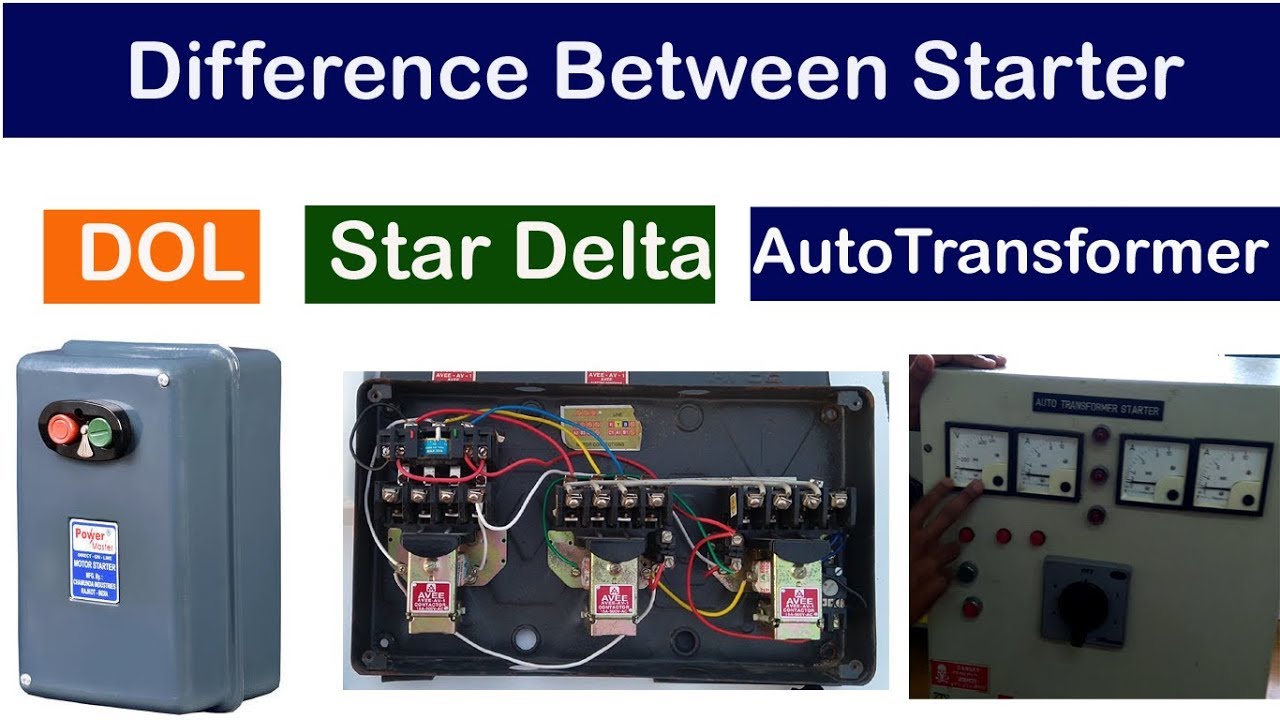
Comparing Performance of DOL vs Star Delta Motors: What Actually Works in the Field
I once watched a 50 HP compressor motor literally jump off its base during a Direct-On-Line start. Seriously. The foundation bolts sheared clean off. That was the moment I stopped treating motor starting methods as a theoretical exercise and started seeing them as the critical, mechanical choice they really are. Choosing between a DOL (Direct-On-Line) starter and a Star Delta starter isn't just about looking at a wiring diagram. It's about understanding how your motor will behave under stress, how your grid will handle that sudden demand, and how much your maintenance budget can stomach.
Look—there's no single “best” option here. Both methods have been serving industries for decades, and both can ruin your day if you pick the wrong one for the application. We're going to break down the real-world performance differences, not just the textbook theory. I've seen DOL setups run flawlessly for twenty years, and I've seen Star Delta conversions fail within six months because nobody considered the torque dip during transition. Let's get into the gritty details.
The Brutal Reality of Direct-On-Line (DOL) Starting Performance
The Physics of a Full-Voltage Slam
When you hit that start button on a DOL starter, you are connecting the motor directly to the full supply voltage. There's no ramp, no finesse, and no mercy. The motor sees rated voltage instantly, and the rotor goes from zero to full speed as fast as the mechanical load will allow. What does that mean for performance? You get the maximum possible starting torque right out of the gate. Typically, that's around 150% to 200% of the motor's full-load torque. For loads that need a massive kick to get moving—like a rock crusher or a large conveyor belt—this is a blessing.
But here's the catch, and it's a big one. That torque comes at the price of inrush current. We're talking about a current surge that can be 6 to 8 times the motor's full-load current. For a 100 HP motor running at 100 amps full load, that's potentially 800 amps slamming into your system. Honestly? That can cause voltage dips across your entire facility. Lights flicker, other equipment hiccups, and sensitive electronics might brown out. The performance advantage of high torque is real, but it's useless if your electrical infrastructure can't handle the kick.
Mechanically, the shock is just as brutal. The sudden torque application creates severe stress on the motor shaft, coupling, gearbox, and the driven load. I've seen gear teeth stripped and belts snap purely from DOL starting. The simplicity of a DOL circuit is beautiful—it's just a contactor and an overload relay—but the mechanical price tag can be ugly. For smaller motors, up to maybe 7.5 HP, this isn't usually an issue. Above that? You start playing a dangerous game with your drivetrain.
Where DOL Actually Makes Sense (and Where It Doesn't)
Let's be practical. If you have a motor that is under 10 HP and the supply transformer is beefy enough to handle the inrush, DOL is often your simplest, cheapest, and most reliable option. I use them all the time for small pumps, fans, and compressors in workshops. The cost of a DOL starter is a fraction of a Star Delta setup, and troubleshooting it is dead simple. No complicated timers, no six-contact contactors, just power in, power out.
However, for larger motors—say, 25 HP and above—the performance of DOL becomes a liability unless you have a very stiff power grid. A soft grid, like a generator supply or a long feeder line, will suffer a severe voltage dip. The motor might not even start if the voltage drops too much. And even if it does, the heating effect from that massive inrush current is significant. Repeated DOL starts can cook the motor windings prematurely. I've got a rule of thumb: if the motor is rated above 30 HP and it cycles on and off frequently, DOL is almost always the wrong choice. You'll be replacing bearings and contactors within a year.
- DOL Pros: Maximum starting torque, lowest component cost, simple wiring, easy maintenance.
- DOL Cons: Enormous inrush current, severe mechanical shock, high voltage dip, not suitable for frequent starting.
- Best Uses: Small motors (under 10 HP), low-inertia loads, stiff power grids, infrequent starts.
How Star Delta Starting Changes the Performance Game
The Transition Phase: Where the Magic (and Trouble) Happens
The whole idea behind a Star Delta starter is to reduce that painful inrush current. During the “Star” phase, the motor windings are connected in a star configuration. This effectively puts the windings in series, so each winding only sees about 58% of the line voltage. The result? The starting current drops to roughly one-third of the DOL starting current. Instead of 800 amps, you might see 270 amps. That's a lot easier on your transformer and your generator. The performance here is about control, not raw power.
But here is the part that often gets glossed over in the sales brochures: the starting torque drops by the same amount—about one-third. You're losing over 60% of your starting torque. For a load that requires high breakaway torque, like a loaded conveyor or a positive displacement pump, the motor might struggle to accelerate in Star mode. Worse, the dreaded “transition bump” can occur when the system switches from Star to Delta. If the motor hasn't reached about 90% of its rated speed before the switch, it will slam into a second current spike that can be almost as high as a DOL start. I've seen these transition spikes cause nuisance tripping of breakers and even weld contactor tips closed.
The complexity of the wiring is also a factor. A Star Delta starter requires three contactors (mains, star, and delta), a timer relay, and careful phase sequential wiring. Every extra component is a potential failure point. The timer setting is critical. Set it too short, and the motor is still crawling when it switches to Delta, causing that nasty current spike. Set it too long, and the motor spends too much time in the low-torque Star mode, overheating the windings. I've seen maintenance techs spend hours dialing in a timer, only to find the load had changed slightly.
The Hidden Cost You Need to Budget For
There's a sneaky cost associated with Star Delta that most people don't consider: the motor itself must be designed for it. You need a motor with both ends of all three windings brought out to the terminal box (six leads). Not all motors are built this way, especially smaller ones. If you buy a standard three-lead motor, you cannot use a Star Delta starter with it. You have to specify a Delta-connected motor at the outset, which can limit your choices and sometimes costs a bit more upfront.
Also, the reduced starting torque doesn't just affect whether the motor starts—it affects how fast it accelerates. For high-inertia loads like large fans or flywheels, the acceleration time in Star mode can be painfully long. If the thermal overload relay is set based on Delta running current, the prolonged high current in Star mode can cause it to trip before the motor even gets to the Delta phase. It's a balancing act, and it requires a genuinely experienced electrician to get it right the first time. The performance trade-off is clear: you lower current stress on the supply but increase mechanical stress on the motor during the start sequence.
- Current Reduction: Inrush current drops to roughly 33% of DOL values.
- Torque Reduction: Starting torque also drops to roughly 33% of DOL values.
- Transition Risk: Poor timing can negate all benefits.
- Component Count: Requires 3 contactors, timer, and 6-lead motor.
Comparing Performance Side-by-Side: The Real Numbers
Beyond Starting Current: Torque, Heat, and Maintenance Cycles
When you compare DOL and Star Delta performance head-to-head, you have to look at more than just the peak current during startup. You need to consider the total energy dissipated as heat in the motor windings during a start. A DOL start dumps a huge burst of heat in a very short time. A Star Delta start spreads that same energy over a longer period but at a lower intensity. Which is worse for the motor? Honestly, repeated DOL starts are usually harder on the insulation system because of the sheer thermal shock. But a long, stalled Star Delta start—where the motor sits in Star mode at locked rotor current—can actually cook the windings to death faster because the cooling fan isn't moving air yet.
Maintenance intervals are another big performance metric. In my experience, equipment on DOL starters for large loads will need bearing replacements and shaft alignment checks more often. The mechanical shock just accelerates wear. Star Delta motors tend to have longer bearing life but more frequent issues with the switching contactors, especially the Delta contactor, which can suffer from arcing during the transition. The timer itself is a consumable item—analog timers drift, and digital timers fail. I've replaced more Star Delta timers than I have DOL contactors, statistically speaking.
Let's talk about efficiency. During the running state (Delta mode), there is no difference between a motor started with DOL and one started with Star Delta. Once the motor is up to speed and the switchover is complete, the electrical characteristics are identical. The performance difference is entirely in the starting and stopping dynamics. This is a critical point that gets missed. A Star Delta starter doesn't save energy during normal operation. It only reduces the stress on the supply during the start.
How to Decide Based on Your Actual Load Profile
If you are dealing with a low-inertia load like a centrifugal pump that unloads at start, or a fan with a light-duty damper closed, Star Delta is often overkill. A DOL starter will do the job cheaply and reliably. The pump will accelerate quickly, and the inrush current will be short-lived. The voltage dip will be a blip, not a brownout. In these cases, the extra cost and complexity of Star Delta just don't justify themselves.
But if you have a high-inertia load, like a large centrifuge or a ball mill, the decision gets trickier. DOL might snap your coupling. Star Delta might not generate enough torque to accelerate the load to 90% speed before the transition, causing the current spike anyway. For those applications, honestly? You might be better off looking at a soft starter or a VFD (Variable Frequency Drive). Star Delta is a compromise. It's a cheap compromise, but it's a compromise nonetheless. It was designed for a specific era of motor technology and power grid limitations. It still has a place, but you must know its limits.
- Choose DOL if: Motor under 15 HP, stiff grid, low-inertia load, budget is minimal.
- Choose Star Delta if: Motor between 15-75 HP, moderate grid stiffness, load requires less than 50% starting torque, upfront cost matters more than long-term complexity.
- Skip Both and Go Soft Start if: Load is high-inertia, you need controlled acceleration, maintenance resources are scarce, or you have a weak generator supply.
Common Questions About Comparing Performance of DOL vs Star Delta Motors
Can you use a DOL starter on any motor?
Technically, yes, any three-phase induction motor can be started DOL. The question is whether you should. The motor must be rated to handle the high mechanical and thermal stress of a full-voltage start. For motors above 25 HP, most manufacturers recommend against DOL starting unless the supply is specifically designed for it. Always check the motor datasheet for permissible starting frequency and maximum inrush duration.
Does Star Delta reduce the starting torque too much for heavy loads?
It can. The torque is reduced to about one-third of the DOL torque. If your load requires more than 50% of the motor's full-load torque to break away, you will likely have trouble with Star Delta. The motor may stall in Star mode, overheat, and never properly transition to Delta. For crushers, extruders, and heavy conveyors, you usually need the full torque of DOL or the controlled ramp of a soft starter.
How do I set the transition timer on a Star Delta starter?
There is no universal setting. The timer should allow the motor to reach at least 85-95% of its synchronous speed before switching from Star to Delta. A good starting point for a typical pump or fan is 5 to 10 seconds, but you need to verify it with an ammeter. Watch the current. It should drop significantly (to near the no-load current) just before the switch. If the current spike after the transition is as high as the initial start current, your timer is too short.
Is a Star Delta starter cheaper than a soft starter?
Yes, significantly. A proper Star Delta starter setup costs maybe 30-50% less than a basic soft starter for the same motor size. However, this gap is narrowing fast. More importantly, the soft starter offers adjustable current limit and torque control, which eliminates the transition spike risk. If you factor in the cost of potential downtime from a mis-timed Star Delta switchover, the soft starter often proves cheaper in the long run for critical applications.