
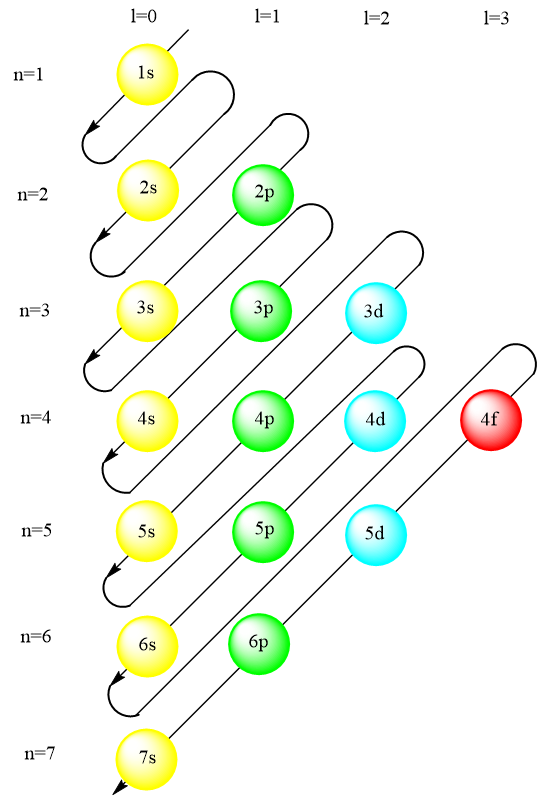
Energy Levels and Why 4s Fills Before 3d: The Story of a Chemical Contradiction
I remember the exact moment this concept broke my brain in undergrad. My professor drew the Aufbau diagram on the board, and there it was—4s sitting comfortably below 3d. Then she pointed to the periodic table and showed us that the 3d block starts in row four. It felt like a personal attack on logic. Seriously. How can 4s fill before 3d when the 3d orbitals are literally in the third shell? If you’ve asked that same question, you’re not alone. And the answer is more about quantum mechanics and less about ordering numbers.
Let's get one thing straight: the energy levels aren't as neat as a staircase. They overlap. They cross. And in the case of the 4s and 3d orbitals, they play a game of musical chairs that dictates the entire electron configuration of the transition metals. I’ve spent over a decade teaching this stuff, and I still find it ridiculously elegant once you peel back the layers.
So grab your coffee (or your existential dread—both work). We're going to nail down why energy levels behave this way and why the 4s orbital fills before the 3d orbital every single time.
The Great Orbital Crossover: How the 4s Level Sneaks Ahead
The first thing we have to ditch is the idea that principal quantum number (n) equals energy ranking. It doesn't. Nature doesn't care about your neat little number system. She cares about the sum of n plus the azimuthal quantum number (l). This is the (n + l) rule, also called Madelung’s rule, and it’s the real boss here.
For the 4s orbital, n = 4 and l = 0, so (n + l) = 4. For the 3d orbital, n = 3 and l = 2, so (n + l) = 5. Lower (n + l) means lower energy. It’s that simple. The fills before behavior is dictated by this sum, not by shell number alone. It's a big deal because it breaks the naive pattern we all learned in middle school.
But here’s the kicker: once both orbitals are occupied, the energy levels shift again. After filling, the 3d orbital actually drops below the 4s in energy. You read that right. The filling order and the stability order are not the same thing. That’s the nuance that trips up most students—and even some textbooks.
Let me break it down further with two critical sub-points.
What the Aufbau Principle Actually Says
The Aufbau principle (German for “building up”) states that electrons fill the lowest energy orbitals first. But “lowest energy” isn’t static. It changes as the nuclear charge increases and as electrons interact with each other. For atoms with atomic numbers up to around 20 (calcium), the 4s orbital genuinely sits at a lower energy than 3d. That’s why you see electron configurations like [Ar] 4s² for calcium and not [Ar] 3d².
- For hydrogen, 4s and 3d are degenerate (same energy) only in a vacuum. - As you add protons, the s orbital’s superior penetration ability lowers its energy relative to d. - The 4s electron spends more time near the nucleus than a 3d electron does. That’s the penetration effect. - Shielding from inner electrons also plays a role, but penetration is the star of the show.
I’ve seen students zoom past this and assume it’s a memorization trick. It’s not. It’s a physical effect based on the shape of the orbitals. Electrons in s orbitals have a nonzero probability of being at the nucleus. d orbitals have a node there. That changes everything.
The Physics of Penetration and Shielding
Penetration is the ability of an electron to get close to the nucleus. An s electron has the highest penetration because its radial distribution function peaks closest to the nucleus. A d electron? Not so much. It’s shielded by the s and p electrons in the same shell, and that shielding reduces the effective nuclear charge felt by the d electron.
So when you’re building up from potassium (Z=19) onward, the 4s orbital is lower in energy because it “sees” a higher effective nuclear charge. The 3d orbital is still higher because it’s screened by the 4s and 3p electrons. The result? The 4s fills before 3d hands down.
But once the 4s is occupied and you add more electrons to 3d, something interesting happens. The 3d orbital’s energy drops dramatically. It’s almost like the 4s was a ladder that helped you reach the roof, but once you’re there, you don’t need the ladder anymore. The energy levels of the 3d actually become lower than the 4s after the orbital is partially filled. That’s why transition metals lose 4s electrons first during ionization.
Real-World Consequences: Why This Matters for Transition Metals
This isn’t just a trivia fact for chemistry exams. This behavior defines the entire block of d-block elements. The fact that 4s fills before 3d but 3d becomes the lower energy level post-filling explains why transition metals have variable oxidation states, why they’re colored, and why they make excellent catalysts.
I can’t tell you how many times a student has asked, “Why does iron lose the 4s electrons first if 4s filled first?” The answer: because after filling, the energy levels switch. The 4s orbital is higher in energy once both are occupied. So when you ionize, the higher energy electrons leave first. It’s counterintuitive, but it’s consistent.
Here are a few real-world implications that hinge on this orbital energy crossover:
- The magnetic properties of iron, cobalt, and nickel come from unpaired d electrons. The 4s/3d crossover determines which electrons are unpaired. - The catalytic activity of platinum and palladium relies on the availability of d orbitals for bonding. That availability is a direct result of this filling pattern. - The color of gemstones like ruby (chromium-doped corundum) is due to d-d transitions. Those transitions depend on the splitting of exactly these energy levels.
Electron Configurations of Scandium Through Zinc
Let’s walk through the first-row transition metals. These are your scandium (Sc) through zinc (Zn). Every single one of them fills the 4s orbital first, then starts dumping electrons into the 3d.
- Sc: [Ar] 4s² 3d¹ - Ti: [Ar] 4s² 3d² - V: [Ar] 4s² 3d³ - Cr: [Ar] 4s¹ 3d⁵ (yes, that’s an exception—we’ll get there) - Mn: [Ar] 4s² 3d⁵ - Fe: [Ar] 4s² 3d⁶ - Co: [Ar] 4s² 3d⁷ - Ni: [Ar] 4s² 3d⁸ - Cu: [Ar] 4s¹ 3d¹⁰ (another exception) - Zn: [Ar] 4s² 3d¹⁰
Notice how the 4s always gets its electrons before the 3d starts filling in earnest. That’s the fills before behavior in action. And notice the exceptions: chromium and copper break the pattern because a half-filled or fully filled d subshell offers extra stability. In those cases, the energy gain from a stable 3d configuration outweighs the usual preference for a filled 4s.
The Infamous Exceptions: Chromium and Copper
You can’t talk about energy levels and the 4s/3d crossover without addressing the black sheep. Chromium should be [Ar] 4s² 3d⁴, but it’s not. It’s [Ar] 4s¹ 3d⁵. Copper should be [Ar] 4s² 3d⁹, but it’s [Ar] 4s¹ 3d¹⁰.
Why? Because the energy levels of the 3d orbital drop even further when the subshell is half-filled (5 electrons) or fully filled (10 electrons). The exchange energy and electron repulsion terms favor these arrangements. The 4s electron essentially gets promoted to the 3d because the net energy of the system is lower.
Honestly? This is one of those moments where quantum mechanics feels almost like it has a personality. It’s quirky. It’s stubborn. But it’s also absolutely beautiful once you accept the rules.
These exceptions aren’t just random. They are predictable if you understand that stability isn’t about filling orbitals in a rigid order, but about minimizing the total energy of the whole atom. The fills before rule is a guideline, not a law carved in stone.
A Practical Way to Remember This (Without Losing Your Mind)
Look—I’ve taught this to high school students, undergrads, and even some bewildered grad students. The trick is to stop thinking in terms of shells and start thinking in terms of effective nuclear charge and orbital shape. But if you want a shortcut that works for the vast majority of elements on the periodic table, here it is.
Use the periodic table as your cheat sheet. The table is literally arranged by filling order. Read it row by row, and you’ll see that the 4s block (Group 1 and 2 in row 4) comes before the 3d block (the first transition series). The table itself is a visual representation of the (n+l) rule. You don’t need to memorize a single electron configuration if you can read the grid.
Let me give you a simple ordered list for writing configurations from scratch:
- Find your element on the periodic table.
- Count the rows—each row corresponds to a principal quantum number (n).
- Look at the block: s-block (left two columns), p-block (right six), d-block (middle ten), f-block (the two rows below).
- Write configurations in order of increasing atomic number, not increasing n.
- For d-block elements, write the s orbital of the previous shell first, then the d orbital.
That’s it. The table is your roadmap. The fact that 4s fills before 3d is baked into the very structure of the periodic law.
Why Your High School Teacher Might Have Lied to You
I’m going to be blunt: many introductory chemistry courses oversimplify this. They teach the Aufbau principle as if it’s a strict rule that never breaks. Then students hit transition metals and think the whole system is broken. It’s not broken. It’s just more nuanced than a simple filling chart.
The energy levels of 4s and 3d are incredibly close. For atoms with low atomic numbers, the difference is small enough that external factors (like the presence of ligands in coordination compounds) can reverse the ordering. That’s a whole other discussion for another day, but it’s important to know that the fills before behavior is not absolute for all environments. In isolated atoms, yes. In molecules or solids? It can shift.
I’ve had students ask me, “Shouldn’t the 3d fill before 4s if 3d is lower after filling?” The answer is no—not during the building-up process. The filling order is determined by empty orbital energies. Once the atom is built, the occupied orbital energies rearrange. It’s like building a house: you install the foundation before the roof, but after construction, the roof is higher than the foundation. Different stages, different priorities.
Common Questions About Energy Levels and Why 4s Fills Before 3d
Does 4s always fill before 3d for every element?
Yes, for neutral atoms in their ground state, the 4s orbital fills before 3d for elements up to zinc (Z=30). Beyond that, the pattern continues with 5s filling before 4d and 6s filling before 5d. However, there are exceptions for transition metals in higher periods due to relativistic effects, especially for elements like gold and mercury.
Once filled, is 4s or 3d lower in energy?
Once both orbitals are occupied, the 3d orbital is lower in energy than the 4s. That’s why transition metals lose the 4s electrons first when forming cations. The 4s becomes the higher energy orbital after the 3d is populated. It’s a classic role reversal.
Why do chromium and copper break the filling pattern?
Because half-filled and fully filled d subshells have extra stability due to exchange energy and reduced electron repulsion. Chromium takes one electron from the 4s to achieve a half-filled 3d (5 electrons), and copper does the same to achieve a fully filled 3d (10 electrons). The total energy of the atom is lower this way, even though the 4s is not completely filled.
How does this affect ionization energies?
Ionization energies for transition metals often involve removing the 4s electron first, even though it’s from a higher shell. This is because the 4s electron is more loosely held after the 3d is filled. The first ionization energy tends to be lower than you might expect for transition metals because of this orbital energy crossover.
Is this just for transition metals, or does it apply elsewhere?
It applies to any d-block and f-block elements. The same principle governs why 5s fills before 4d and 6s fills before 5d. Even lanthanides and actinides follow a similar pattern with f orbitals. The (n+l) rule is universal for neutral ground-state atoms.