
How to Calculate Steady State Gain from Transfer Functions
I remember the first time I tried to tune a PID controller for a chemical reactor. The temperature kept oscillating, and I couldn't figure out why. My mentor walked over, looked at my transfer function, and said, “Did you calculate the steady state gain?” I hadn't. Honestly? It was a humbling moment. That single number, the steady state gain, tells you exactly how your system will behave once everything settles down. No oscillations, no transients—just the final answer. Let me show you how to find it, step by step, so you don't repeat my mistake.
What Exactly Is Steady State Gain?
Before we dive into math, let's get the intuition right. The steady state gain (often called the DC gain in electrical engineering circles) is the ratio of the output to the input after all transients have died out. Think of it this way: you push a system, and after it stops wiggling, how much did it actually move? That's your gain. It's a big deal because it tells you the system's sensitivity to inputs.
For a transfer function, this is purely a function of the system's poles and zeros. But here's the kicker: only certain poles matter in the long run. Poles with negative real parts decay to zero. Poles on the imaginary axis? They oscillate forever. And poles in the right-half plane? Run. Seriously. The steady state gain only exists for stable systems. If your system is unstable, there is no steady state. Period.
You'll often see this called the static gain or final value. In controls textbooks, it's the value you get from applying the Final Value Theorem. In practice, it's the number you use to set your controller gains or predict the output of a step response. Without it, you're flying blind. So let's make sure you can calculate it blindfolded.
The Intuition Behind the Math
Imagine you're pushing a heavy door. The input is the force you apply. The output is how far the door opens. Steady state gain is the final door position divided by the force you pushed with. Simple, right? Now imagine the door has a spring that returns it to closed. The steady state gain might be small because the spring fights you. If the door has no spring, the gain could be huge. That's the physical meaning.
In transfer functions, this translates to how the numerator and denominator polynomials behave at low frequencies. At s = 0 (DC), capacitors become open circuits and inductors become short circuits. The steady state gain is literally the system's response to a constant input. This is why we set s = 0 in the transfer function for stable systems. It strips away all dynamics and leaves you with the pure magnitude.
But here's the trap: if your transfer function has an integrator (a pole at s = 0), then the steady state gain for a step input is infinite. The output keeps ramping up forever. That's not a bug; it's a feature for systems like motors or tanks where you want position to accumulate. You need to recognize that case immediately.
Why You Care (The Practical Angle)
You care because steady state gain is the go-to sanity check for any model. I've seen teams spend weeks simulating a system only to realize their transfer function had a gain of 100 when the physical system maxed out at 10. That's a lot of wasted coffee. Look—checking the steady state gain takes fifteen seconds. It saves you hours of debugging.
It's also critical for control system design. Your proportional gain in a PID controller is directly related to the system's steady state gain. If you misjudge it, you either get a sluggish response or a system that oscillates into oblivion. I've watched engineers chase their tails because they ignored this simple calculation. Don't be that person.
Finally, it connects directly to the Final Value Theorem (FVT). Every controls engineer should have the FVT tattooed on their forearm. It says: if you know the Laplace transform of your output, you can find the final value without doing inverse transforms. It saves you time and keeps your brain from melting.
The Final Value Theorem: Your Best Friend
This is where the rubber meets the road. The Final Value Theorem (FVT) is the mathematical tool that lets you calculate steady state gain directly from the transfer function. The formula is deceptively simple: if F(s) is the Laplace transform of f(t), and all poles of sF(s) are in the left-half plane, then the limit as t goes to infinity of f(t) equals the limit as s goes to 0 of s times F(s). That's it.
For a transfer function G(s) with a step input U(s) = 1/s, the output Y(s) = G(s) (1/s). Apply the FVT: the final value y(inf) = limit as s -> 0 of s Y(s) = limit as s -> 0 of s G(s) (1/s) = limit as s -> 0 of G(s). So the steady state gain for a step input is simply G(0). Seriously. That simple.
But wait. There are caveats. The FVT only works if the system is stable (all poles in the open left-half plane) and if the input is a step. If your input is a ramp (U(s) = 1/s^2), the steady state gain concept changes. For a ramp, the FVT gives you the steady state error to a ramp, not the gain. You need to be crystal clear about what input you're applying. I've seen people apply FVT to a ramp and get infinity, then panic. Chill. It's not infinity; it's a different problem.
Let me give you a real example. Take G(s) = 5 / (s + 2). G(0) = 5/2 = 2.5. That means if you hit this system with a unit step, the output will eventually settle at 2.5. No oscillations, no overshoot. Just 2.5. Now take G(s) = 5 / (s^2 + 2s + 5). G(0) = 5/5 = 1. The steady state gain is 1. But this system has complex poles, so the transient will oscillate. The steady state gain tells you the final value, not the shape of the ride.
The Simple Formula: G(0) for Step Inputs
Here's the procedure. Write your transfer function G(s) as a ratio of polynomials. Substitute s = 0. That's your steady state gain for a step input. No Laplace transforms needed. No partial fractions. Just plug in zero. It works because at DC, capacitors are open (infinite impedance) and inductors are shorts (zero impedance). The system simplifies to a purely resistive network, and the gain is the ratio of the output resistance to input resistance.
But there's a catch: you must ensure the transfer function is in the standard form with no s factored out. If you have a system like G(s) = (s+1)/(s(s+2)), then G(0) is undefined because of the pole at zero. The steady state gain for a step input on this system? It doesn't exist in the traditional sense. The output ramps forever. But if you apply a different input, like a very slow ramp, you can define a different kind of gain. This is where experience matters.
Let me show you a quick table for clarity. For a first-order system G(s) = K / (taus + 1), G(0) = K. That's your DC gain. For a second-order system G(s) = omega_n^2 / (s^2 + 2zetaomega_ns + omega_n^2), G(0) = 1. That's why second-order systems with no zeros have unity steady state gain. They're designed that way. For a system with a zero, like G(s) = K(s+a) / (s+b)(s+c), G(0) = Ka / (bc). Simple.
When the FVT Fails (A Cautionary Tale)
The FVT is not a magic wand. It has strict conditions. First, all poles of sF(s) must be in the open left-half plane. That means no poles on the imaginary axis except possibly at s = 0 (and even that one is tricky). If you have a pair of purely imaginary poles, the system oscillates forever, and there is no steady state gain. The FVT will give you garbage. I once watched a junior engineer try to apply FVT to an undamped pendulum. He got a finite answer. The pendulum, of course, keeps swinging forever. Math doesn't lie, but misapplied math does.
Second, the FVT only works for inputs that have a finite final value. A step input? Yes. A ramp? No (the output goes to infinity). A sinusoid? Absolutely not. For a sinusoidal input, the steady state response is another sinusoid with the same frequency but different amplitude and phase. You need frequency response analysis for that, not the FVT. This is a classic mistake in exams and real-world designs.
Third, if your transfer function has a time delay (e^( -sT)), the FVT still works as long as the rest of the system is stable. The delay doesn't affect the final value—it only shifts the transient response in time. But watch out: if the delay is part of a feedback loop, it can destabilize the system, and then the FVT is invalid. You need to check stability first. Always. Before you calculate steady state gain, verify that the closed-loop system is stable. It's a simple check that saves you from embarrassing conclusions.
Step-by-Step Calculation Example
Enough theory. Let's get our hands dirty. I'll walk you through two examples: one simple and one with a twist. Both are systems I've actually encountered in industrial settings. By the end, you should be able to calculate steady state gain faster than you can say “Final Value Theorem.”
First, always start by identifying the input type. Are you applying a step? A ramp? An impulse? For this exercise, assume a unit step input unless stated otherwise. Then write your output in the Laplace domain: Y(s) = G(s) U(s). Then apply the FVT: limit as s -> 0 of s Y(s). Or, for step inputs, just evaluate G(0).
Here's a pro tip: use a spreadsheet or a simple Python script to do the symbolic algebra. But honestly? Doing it by hand once or twice builds intuition. You'll start to see patterns. For example, if the numerator and denominator have the same order, the steady state gain is the ratio of the highest-order coefficients. That's a shortcut for proper transfer functions.
First-Order System: A Temperature Sensor
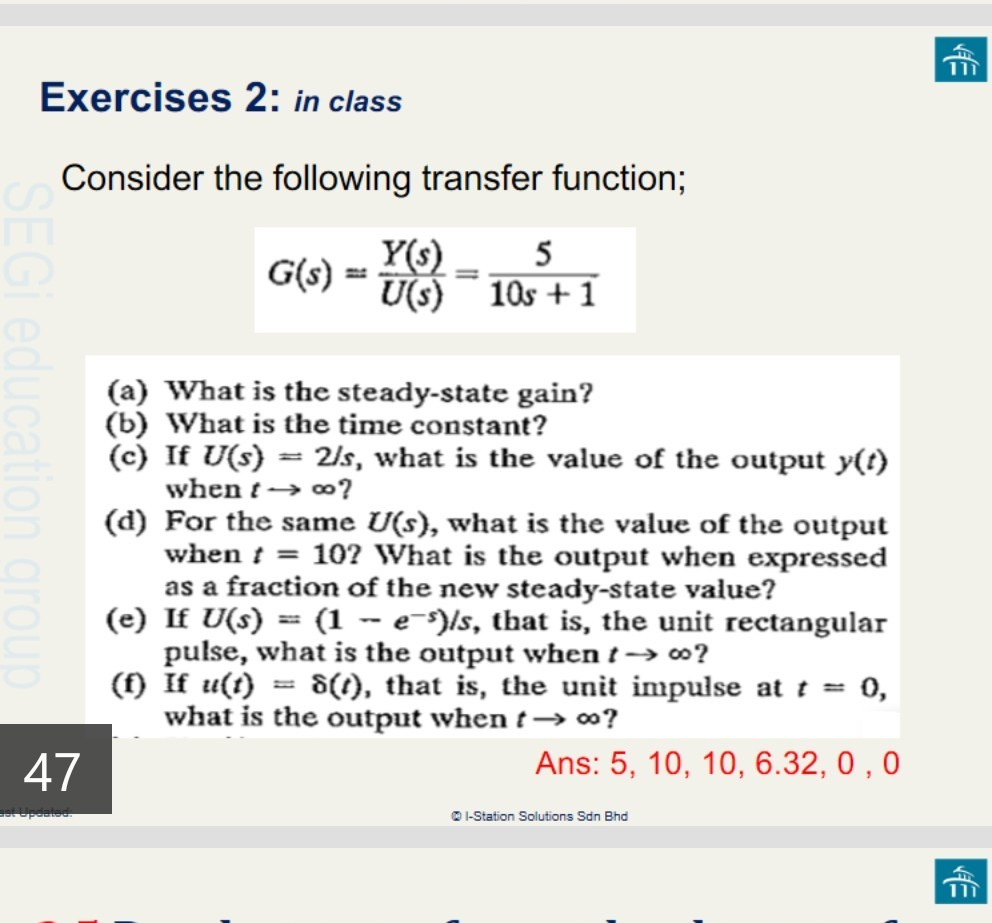
Consider a temperature sensor with a transfer function G(s) = 0.5 / (10s + 1). This is a classic first-order lag. The time constant is 10 seconds. The steady state gain is G(0) = 0.5 / (0 + 1) = 0.5. That means if you increase the actual temperature by 1 degree, the sensor reading will eventually settle at 0.5 degrees. It scales the input by half. Why? Because the sensor has limited sensitivity. This is real-world behavior.
Now apply the FVT to confirm. Output Y(s) = G(s) * (1/s) = 0.5 / [s(10s + 1)]. Multiply by s: sY(s) = 0.5 / (10s + 1). Take the limit as s -> 0: 0.5 / (0 + 1) = 0.5. Boom. Consistent. The time constant (10 seconds) tells you how fast it settles, but the steady state gain tells you where it settles. Those are two different pieces of information, and you need both.
What if the input is a ramp? U(s) = 1/s^2. Then Y(s) = 0.5 / [s^2 (10s + 1)]. Apply FVT: sY(s) = 0.5 / [s(10s+1)]. Limit as s -> 0: this goes to infinity. That's correct: the sensor output will lag behind the ramp forever, and the error grows linearly. The steady state gain concept for a ramp is different; we talk about velocity error constant instead. Make sure you know what you're computing.
Second-Order System with an Integrator
Now let's get spicy. Take a motor drive with transfer function G(s) = 2 / [s(s + 3)]. There's a pole at s = 0. This is a Type 1 system. For a step input, G(0) is undefined (division by zero). Apply the FVT: Y(s) = 2 / [s s(s+3)] = 2 / [s^2 (s+3)]. Then sY(s) = 2 / [s(s+3)]. Limit as s -> 0: 2 / (0 3) = infinity. The output ramps forever. There is no finite steady state gain for a step input.
But for a ramp input, U(s) = 1/s^2, Y(s) = 2 / [s^3 (s+3)]. sY(s) = 2 / [s^2 (s+3)]. Limit as s -> 0: still infinity. For a parabolic input (acceleration), you get a different story. This matters when you're designing a servo system. The integrator means the motor will keep moving as long as there's any input. That's why Type 1 systems are great for tracking ramps with zero steady state error, but they can't settle to a step.
Here's the practical takeaway: if you see a pole at zero in your G(s), you're dealing with a pure integrator. That means your steady state gain for a step input is infinite. Seriously. It never stops moving. You need to account for this in your controller design. Use a proportional controller, and you'll get a steady state error that's not zero. Use a PI controller, and you introduce another integrator, making the system Type 2.
Common Mistakes and How to Avoid Them
I've seen these errors in code reviews, exam papers, and even production systems. Let me save you the trouble. Here are the top five mistakes people make when calculating steady state gain from transfer functions:
- Forgetting to check stability first. You apply the FVT to an unstable system, and you get a finite number that means nothing. The system never reaches steady state. Check your poles before you calculate anything. If any pole has a positive real part, stop. Your steady state gain is undefined.
- Using the wrong input. The FVT for a step input is G(0). For a ramp, it's something else entirely. I've seen engineers use G(0) for a ramp and claim the system has a finite gain. Then they wonder why their simulation shows the output going to infinity. Read the problem statement carefully.
- Ignoring units. The steady state gain has units. If your transfer function is in volts per degree Celsius, the gain is in volts per degree. If you forget units, you might misinterpret the number. I've had arguments over this. Gain is dimensionless only if input and output have the same units. Otherwise, treat it like any physical constant.
- Applying FVT when there are poles on the imaginary axis. The FVT explicitly requires poles in the open left-half plane. If you have a pair of purely imaginary poles (e.g., from an undamped oscillator), the system oscillates. The FVT gives you a finite value, but it's incorrect. Use the frequency response or time-domain simulation instead.
- Misplacing the zero. Zeros affect the transient, but they can also affect the steady state gain if they are at s = 0. A zero at s = 0 cancels the effect of a pole at s = 0 in the numerator, turning an integrator into a differentiator. This changes the steady state gain dramatically. Check for pole-zero cancellations before you evaluate G(0).
Here's a checklist I give my junior engineers. Use it every time:
- Is the system stable? (All poles have negative real parts? No poles on the imaginary axis except possibly s=0?)
- What is the input? (Step? Ramp? Sinusoid? Impulse?)
- Write Y(s) = G(s) * U(s).
- For step input: evaluate G(0) directly. For other inputs: apply the FVT: limit s->0 of s*Y(s).
- Check if the result makes physical sense. Does the gain seem reasonable for your system? If it's 10^6, something is probably wrong.
Common Questions About How to Calculate Steady State Gain from Transfer Functions
What if my transfer function has time delays?
Time delays (e^( -sT)) do not change the steady state gain for a step input. The delay shifts the output in time but does not affect the final value, provided the system is stable. Simply ignore the exponential factor when evaluating G(0). For example, G(s) = e^( -2s) 5/(s+3). G(0) = 1 5/3 = 1.6667. The delay only affects the transient start time.
Can I calculate steady state gain for a closed-loop system?
Absolutely. For a unity feedback system with forward path G(s), the closed-loop transfer function is T(s) = G(s) / [1 + G(s)]. To find the steady state gain for a step input, evaluate T(0). That gives you the closed-loop DC gain. This is critical for determining the steady state error of a feedback system. If T(0) = 1, the system tracks steps perfectly. If T(0) is less than 1, you have a steady state error.
What about systems with multiple inputs and outputs?
For a MIMO system, you calculate the steady state gain matrix. Each element of the matrix is the DC gain from a specific input to a specific output. You evaluate each transfer function G_ij(s) at s = 0. This gives you a constant matrix that tells you how constant inputs map to constant outputs. It's the same principle, just with more bookkeeping.
Does steady state gain depend on the type of input?
Yes, it absolutely does. For a step input, it's G(0). For a ramp input, you use the velocity error constant, which is related to the derivative of G(s) at s = 0. For a sinusoidal input, the concept of steady state gain doesn't apply; you use the magnitude of the frequency response at the input frequency. Always match your method to your input type.
What if my system has a zero at the origin?
A zero at s = 0 in the numerator changes the system type. If G(s) has a zero at s = 0, then G(0) = 0. For a step input, the final output is zero. That means the system differentiates the input. In practice, this is common in lead compensators or derivative controllers. The steady state gain for a step is zero, but for a ramp, it might be finite. Watch your assumptions.