
Geological Differences Between Deltas and Alluvial Fans: What Actually Separates Them (And Why It Matters)
I was standing on a gravel bar in northern New Mexico a few years back, staring at a massive wedge of sediment that stretched from a canyon mouth clear across the valley floor. My colleague, a brilliant sedimentologist, leaned over and asked if I thought it was a delta. I laughed. Look—if you've spent a decade staring at these things, you learn fast that confusing an alluvial fan with a delta is like mistaking a fire hydrant for a tree. They both sit there, they both involve sediment deposition, but the why and where of their formation could not be more different.
Honestly? It's a fundamental distinction that too many textbooks gloss over. They throw both terms into the "depositional landform" bucket and call it a day. But if you are trying to read a landscape, predict reservoir quality, or even just win a bet over drinks, you need to know the difference. The geological differences between deltas and alluvial fans come down to three core things: the energy of the transporting medium, the geometry of the receiving basin, and the role of that ever-present base level.
The Fundamental Setting: Why Location Dictates Everything
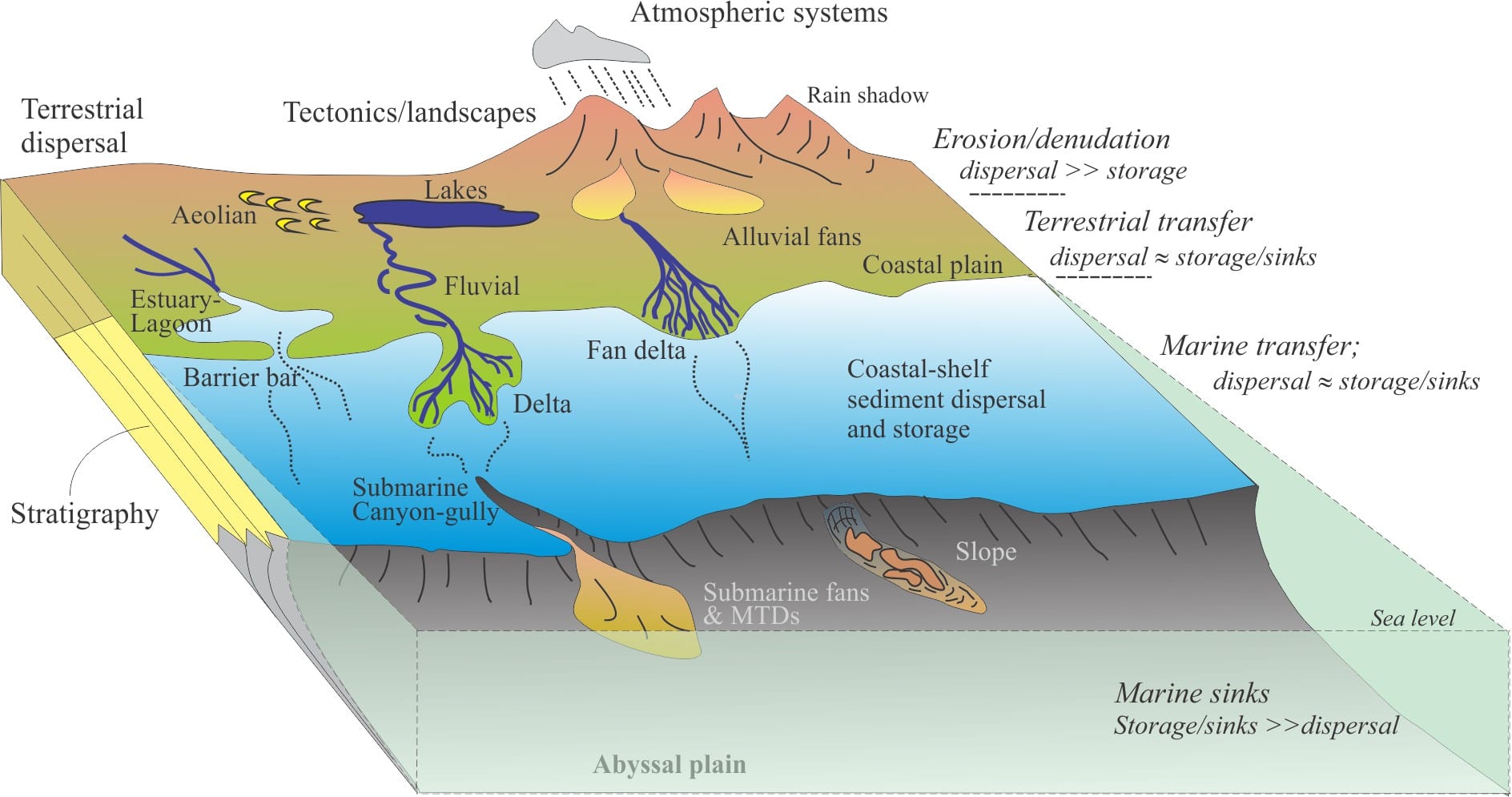
Let's get this straight right out of the gate. Deltas form where a river meets a standing body of water. That could be an ocean, a lake, or even a reservoir. The key point? The water that stops the sediment is relatively quiet. It's a collision between moving fluid and stationary fluid. Alluvial fans, on the other hand, form where a confined channel (usually in a mountain or highland area) suddenly opens onto a flat plain. There is no lake waiting. There is just a dramatic drop in gradient.
This is not a minor footnote. This is the entire story. The primary difference between a delta and an alluvial fan is the depositional environment. One is subaqueous (underwater, at least partially), and the other is almost entirely subaerial (on dry land). Think about the implications for a second. Water buoyancy affects how grains settle. Air does not. Seriously, try dropping a handful of sand into a swimming pool versus dropping it off a balcony. The behavior is radically different. That's the core physics at play here.
A lot of junior geologists get hung up on the shape. Yes, both can look like a fan from above. But the processes that create that shape could not be more different. An alluvial fan is built by catastrophic, high-energy events—flash floods, debris flows, muddy slurries that carry boulders the size of small cars. A delta is built by the persistent, day-in and day-out work of channelized flow, tweaked by tides and waves. One is a brute. The other is a craftsman.
Alluvial Fans: The Mountain Messengers
These things are built for speed and violence. When I look at an alluvial fan, I am looking at a system that is screaming "gravity!" from the top of its lungs. The sediment source is usually right behind it—a steep canyon in a tectonically active mountain range. The flow exits that canyon, loses confinement, and spreads out instantly. The drop in velocity is so sudden that the largest boulders drop right at the apex. This is why you see a classic fining-upward sequence from the apex to the toe.
But here is the kicker: alluvial fans are not fed by a single, permanent river, typically. They are fed by ephemeral streams or catastrophic debris flows. You might get water running down that canyon for three days out of the year. The rest of the time, it is a dry, chaotic pile of rocks. The stratigraphy is a nightmare of poor sorting, matrix-supported conglomerates, and these chaotic, inverse-graded beds that tell you something violent happened.
The most important word for an alluvial fan is "unconfined." The flow is allowed to spread radially because there is no topographic barrier and no body of standing water to stop it. It just piles up until the slope reaches a critical angle, and then it shifts to a new lobe. This process, called "avulsion," happens constantly. It makes for a very complex and heterogeneous sedimentary package. It's the kind of deposit that makes reservoir engineers cry, honestly.
Deltas: The Coastal Architects
Now flip the script. A delta is a coastal feature, and that means base level is the ruler of everything. Base level (sea level or lake level) sets the stage. The river cannot just keep piling sediment higher and higher like a fan can. Once the deposit reaches the water surface, the river has to build out, not up. This creates the classic progradational sequence—topset, foreset, and bottomset beds—that every geology student learns.
The sediment deposition in a delta is heavily influenced by the properties of the receiving basin. Is the basin salty? Fresh? Is it tidal? Is it dominated by waves? A wave-dominated delta, like the Nile, gets its shoreline straightened out. A tide-dominated delta, like the Ganges-Brahmaputra, gets these crazy tidal ridges that stick out perpendicular to the coast. A river-dominated delta, like the Mississippi, gets those beautiful bird's-foot lobes.
Compared to an alluvial fan, a delta is a much more organized system. The sediment is sorted by water. The sand is cleaner. The clays are carried far offshore. You get these beautiful, coarsening-upward parasequences that are predictable and mappable. It's not chaos. It's a well-choreographed dance between the river input and the basin energy. Seriously, look at a core from a delta front versus a core from an alluvial fan. The delta core will have ripples, cross-bedding, and bioturbation. The fan core will look like a blast site.
Energy and Gradient: The Physics of Deposition
If you want to boil the geological differences between deltas and alluvial fans down to a single number, look at the slope. Alluvial fans are steep. We are talking gradients of 1 to 10 degrees, sometimes even steeper at the apex. That steep gradient means the flow is supercritical, turbulent, and carrying a huge sediment load. When that flow hits the flat plain, it dumps its load almost instantly. It's like slamming on the brakes in a truck full of gravel.
Deltas, by contrast, form on what is effectively a flat surface. The gradient of a delta plain is measured in fractions of a degree. The river is moving slowly, meandering across its own deposits. The energy drop is not a sudden crash; it is a gentle deceleration as the freshwater plume mixes with the denser saline water. This mixing process—hypopycnal flow—is critical. It allows fine silt and clay to flocculate and settle out slowly, building those massive bottomset beds that can extend for miles offshore.
This difference in energy creates a massive difference in sediment texture. I cannot stress this enough. Go pick up a pebble from an alluvial fan. It will be angular. It might even have fresh impact scars from bouncing down the canyon. Pick up a sand grain from a delta. It is rounded, polished, and sorted. The delta grain has traveled hundreds of miles. The fan grain traveled maybe a mile. The transport distance and the energy of the system are literally written into the shape of every single grain.
Flow Regimes: Bedload versus Suspension
Alluvial fans are dominated by bedload transport and debris flows. The flow is so thick and viscous that it often behaves like a plastic mass, not a fluid. You get these deposits called "debris flow diamictites" which are essentially a muddy, sandy mess with outsized clasts floating in the middle. There is no stratification. There is no sorting. It is a "dump and run" deposit. The physics of a Bingham plastic are at play here—it requires a certain yield stress to get the flow moving, and once it stops, it stops hard.
Deltas, on the other hand, are dominated by suspension load transport. The river carries fine sand, silt, and clay in suspension. As it enters the basin, the flow decelerates and the sediment settles out according to settling velocity. This is classic Stokes' Law physics. The coarsest sand drops out first at the river mouth (the delta front), while the finest clay drifts out into the prodelta. You get incredible sorting. You get laminations. You get clean, porous sandstone bodies that make fantastic hydrocarbon reservoirs.
Look—if you see a deposit with boulders and cobbles, you are probably looking at an alluvial fan or a very proximal fluvial system. If you see clean, well-sorted sand and silt with marine trace fossils, you are in a delta. That is the 10-second rule. It works 90% of the time.
Shape, Stratigraphy, and Sediment: Building Blocks of a System
Let's talk about the geometry of these things because it is a major clue. An alluvial fan has a distinct radial shape that is roughly fan-shaped when viewed from above. The apex is at the canyon mouth, and the toe spreads out across the plain. In cross-section, it is a wedge that is thickest at the apex and thins rapidly outward. The internal stratigraphy is a mess of lenticular, discontinuous, and often chaotic units.
A delta is also fan-shaped, but the shape is controlled by the basin. The delta grows outward into the water, creating a lobate or cuspate shape. In cross-section, it is not a simple wedge. It is a sigmoid—a classic S-shape. You have the flat-lying topset beds (the delta plain), the steeply dipping foreset beds (the delta front), and the gently dipping bottomset beds (the prodelta). This "Gilbert-type" delta morphology is the textbook example, though most modern deltas are far more complex due to waves and tides.
The sedimentary structures are your best friend here. I always tell my students: "Don't tell me what you think it is. Tell me what you see." In an alluvial fan, you will see massive, structureless beds, inverse grading in debris flows, and crude horizontal bedding in sheetflood deposits. You will not see bioturbation. You will not see trace fossils. Life was not hanging out there during a flash flood.
Fossils and Ichnology: The Smoking Gun
This is where the geological differences between deltas and alluvial fans become absolutely undeniable. An alluvial fan is a terrestrial environment. The only fossils you might find are root traces from plants that grew during the long dry periods, or maybe a rare bone fragment of something that got caught in the flood. Even those are scarce. It is a hostile environment.
A delta is a brackish to marine environment. Even a freshwater lake delta will have a specific assemblage of organisms. Marine deltas are teeming with life. You will see Skolithos, Planolites, and Thalassinoides burrows in the delta front sands. You will see Crassostrea (oyster) bioherms on the delta plain. You will see a transition from marine fossils in the prodelta to brackish and freshwater fossils in the upper delta plain. That biological signature is the smoking gun.
I can't tell you how many times I have seen someone point to a conglomerate and call it a deltaic deposit. Then I walk over, find a single Skolithos burrow, and prove it is a tidal channel deposit in a estuarine setting. Or I see a massive, unstratified deposit and call it an alluvial fan, only to have someone argue it's a debris flow in a delta slope. The context matters. The associated facies matter. You have to look at the whole package.
- Alluvial Fan Key Traits: High gradient, terrestrial, chaotic bedding, angular clasts, debris flows, ephemeral flow, no marine fossils.
- Delta Key Traits: Low gradient, coastal, organized bedding (topset/foreset/bottomset), rounded grains, tractive currents, abundant bioturbation and marine trace fossils.
Common Misconceptions (And How to Avoid Them)
The biggest mistake I see in the field is the "it looks like a fan, so it must be a fan" fallacy. There are sedimentary bodies called "deep-sea fans" that look like alluvial fans but are actually submarine deposits formed by turbidity currents. This is a different beast entirely. Don't confuse a submarine fan with an alluvial fan. Submarine fans are deposited at the base of the continental slope by sediment gravity flows under thousands of meters of water. They share the chaotic texture of alluvial fans, but the context is completely different.
Another common error is confusing a delta top with an alluvial fan. The delta plain is dominated by floodplains, swamps, and distributary channels. It is a low-energy environment. An alluvial fan is a high-energy environment. If you see a channel filled with conglomerate in a delta plain setting, it is likely a distributary channel or a tidal channel, not an alluvial fan. The scale is wrong. The geometry is wrong.
To really get a handle on the difference between a delta and an alluvial fan, you need to map the full system. Trace the sediment source. Identify the basin boundary. Measure the paleocurrents. Is the transport direction radial or unidirectional? Are the beds climbing or aggrading? These are the questions that separate a good geologist from a great one. Honestly, it comes down to experience. You need to stick your nose in a few hundred outcrops before the pattern recognition clicks.
- Check the gradient. Steep slope = fan. Flat slope = delta.
- Look at the clasts. Angular and poorly sorted = fan. Rounded and well sorted = delta.
- Find the fossils. Marine trace fossils = delta. Root traces only = fan.
- Examine the bedding. Massive and chaotic = fan. Sigmoidal and organized = delta.
- Understand the energy. Catastrophic and ephemeral = fan. Steady and persistent = delta.
Common Questions About Geological Differences Between Deltas and Alluvial Fans
Can an alluvial fan turn into a delta over time?
Absolutely. It is called a "fan delta." This happens when an alluvial fan builds out directly into a standing body of water, like the sea or a lake. The subaerial part of the deposit retains the character of an alluvial fan (steep gradient, debris flows), but the subaqueous part develops classic delta characteristics (foresets, marine fossils). It is a hybrid, and it is surprisingly common along tectonically active coastlines like those in the Mediterranean or the Basin and Range.
What is the most obvious field indicator to tell them apart?
Grain size and sorting, without a doubt. Walk to the deposit and pick up the coarsest clast you can find. If it is a boulder sitting in a muddy matrix with no sign of current structures, you are on an alluvial fan. If the coarsest material is pebble-sized or smaller, well-sorted, and shows cross-bedding or ripple marks, you are looking at a delta. The sheer energy required to move a boulder is rarely sustained in a deltaic setting.
Why are deltas more important for oil and gas exploration than alluvial fans?
Porosity and connectivity. Deltas produce clean, well-sorted sand bodies with excellent primary porosity. These sand bodies are extensive and laterally continuous, making them fantastic reservoirs. Alluvial fans are typically too poorly sorted to have good porosity. The sand is mixed with mud and clay, which plugs the pore spaces. While some ancient alluvial fan deposits can be fractured or altered to hold hydrocarbons, they are generally considered secondary targets compared to deltaic reservoirs.
How does climate affect the formation of alluvial fans versus deltas?
Climate is a huge control. Alluvial fans thrive in arid to semi-arid environments where vegetation is sparse and flash flooding is common. The lack of plant roots allows for massive sediment transport during brief, intense storms. Deltas can form in any climate, but their character changes drastically. A humid climate delta will have lush vegetation, thick swamp deposits (coal), and a high proportion of fine sediment. An arid climate delta might be more sand-rich and have less organic matter. Climate dictates the style of sediment supply and the preservation potential.
Can you confuse an alluvial fan with a glacial outwash plain?
You can, and it happens more often than you think. Both are high-energy, poorly sorted deposits. However, glacial outwash (sandur) deposits are typically composed of more rounded clasts (due to glacial grinding and meltwater transport) and often contain diagnostic features like striated clasts or dropstones if deposited into a lake. Alluvial fans are also typically more steeply sloping and have a distinct fan shape with a single apex, while outwash plains are generally broader and flatter with a network of braided channels. Debris flow deposits are also far more common on alluvial fans than on glacial outwash plains.