
How Humidity Levels Affect Electrostatic Discharge (ESD)
I once walked across a synthetic carpet in a Phoenix hotel in December, reached for a metal doorknob, and saw a blue arc jump nearly an inch to my fingertip. That zap wasn’t just a funny story (though it did wake me up). It was a perfect, painful demonstration of what happens when humidity levels drop. For the last twelve years, I’ve been deep inside the world of Electrostatic Discharge (ESD) control, designing facilities, auditing labs, and watching people accidentally fry multi-thousand-dollar boards. And if there’s one variable that sneaks up on more engineers than any other, it’s the moisture hanging in the air.
So let’s cut through the fluff. Humidity levels aren’t just about comfort or static cling on your laundry. They are the single most influential environmental factor governing how often you get zapped and how bad that zap is. Seriously—if you understand the relationship between water vapor and charge dissipation, you can predict failures before they happen.
The Physics of a Dry Room and a Charged Body
Here’s the core mechanism: Electrostatic discharge (ESD) is basically a lightning bolt in miniature. It happens when two objects with different electrical potentials get close enough for the air between them to break down. The air acts as an insulator, but every insulator has a limit. When that limit is breached, zap. Humidity mediates this process in two distinct ways, and most people only ever grasp the first one.
The first mechanism is surface conductivity. Water molecules adhere to virtually every surface in a room—your skin, the workbench, the circuit board. When humidity levels are high (say, above 60% relative humidity), that microscopic film of water becomes conductive enough to bleed charge away slowly. You literally cannot build up a high voltage on your body because the moisture on your skin is creating a tiny leakage path to the ground. It’s a constant, gentle drain.
The second mechanism is air conductivity. Pure dry air is an excellent insulator. Add water vapor, and you start to introduce polar molecules that can be ionized more easily. The higher the humidity, the more charge carriers exist in the air itself. This makes the air slightly more conductive and lowers the threshold voltage needed for a spark to jump. Counterintuitive, right? More humidity actually makes the spark easier to happen, but it also makes it harder to accumulate the charge in the first place. It’s a classic trade-off.
Look—this is where most textbook explanations stop. They tell you “keep humidity above 40% and you’re safe.” That’s not wrong, but it’s dangerously incomplete. If you’re working with extremely sensitive components (think MOSFET gates or RF amplifiers), the difference between 40% and 20% can be the difference between a working prototype and a pile of silent, dead silicon. Honest truth.
Why Low Relative Humidity is the Enemy of Electronics
Let me paint you a picture of a typical factory floor in a northern winter. The outdoor air is at 20°F and bone dry. The building’s heating system cranks that air up to 72°F without adding any moisture. The relative humidity inside plummets to under 15%. I’ve seen it hit 8% in server rooms that forgot their humidifiers. This is a disaster zone for ESD control.
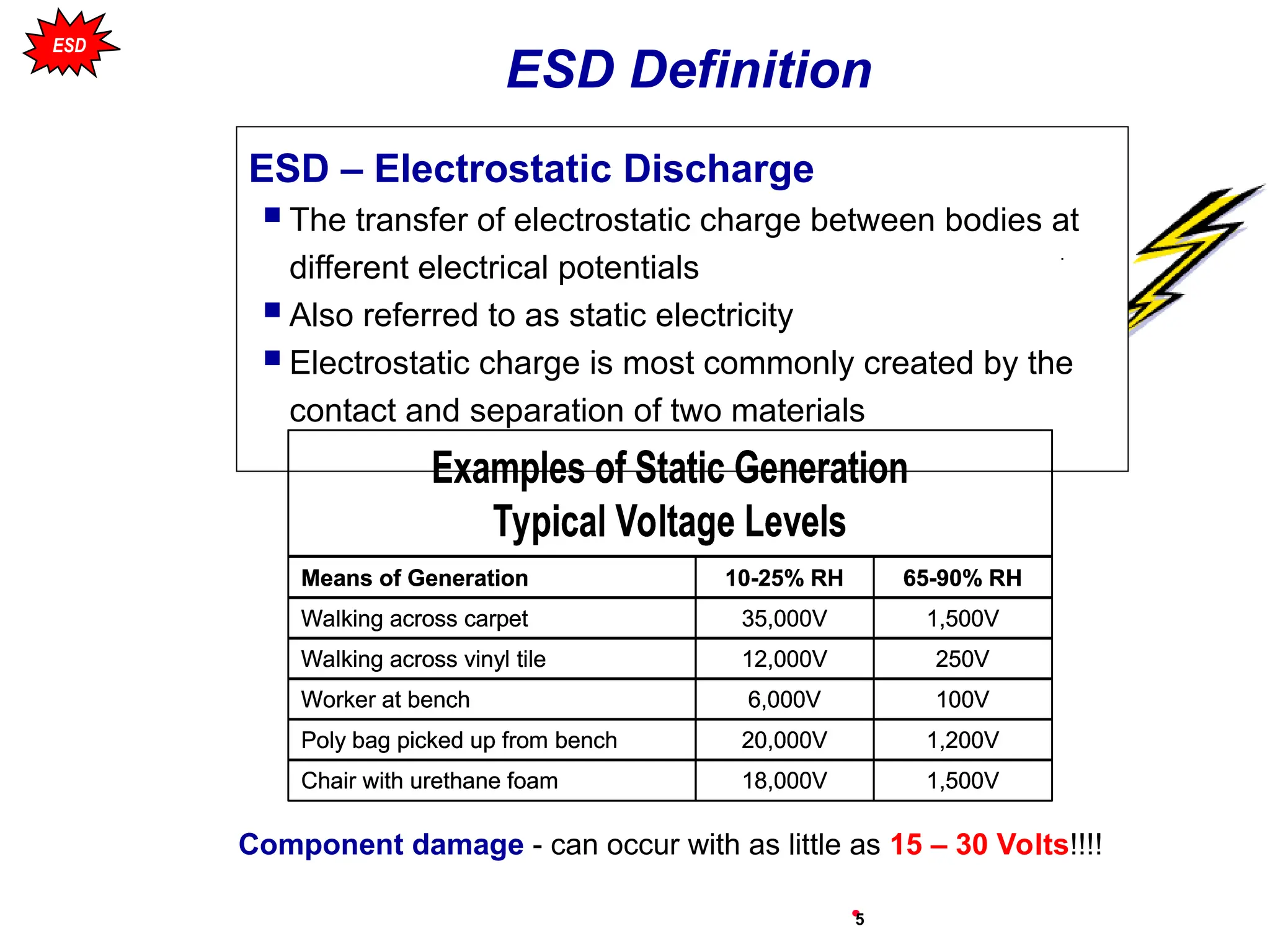
At these low levels, static charges can build up to staggering voltages. A person walking across a vinyl floor can generate 5,000 to 15,000 volts. Picking up a plastic bag from a workbench can create 20,000 volts. And here’s the kicker—the human body can feel a discharge starting around 3,000 volts. Most sensitive electronics start taking damage at around 100 volts. You won’t even feel the zap that kills your device.
The practical consequences are brutal:
- Increased failure rates during assembly and testing. - Latent defects that pass initial testing but fail weeks later in the field. - False alarms from ESD event detectors (they go off constantly, so people ignore them). - Operator frustration, leading to poor handling practices.
I’ve audited facilities where the engineers swore they had perfect ESD programs—wrist straps, mats, grounding cords, the whole nine yards. Yet their failure rates were through the roof. Every single time, the culprit was low humidity negating half their protective measures. You can’t ground your way out of physics. If the air is too dry, charge will find a way.
The Specific Thresholds You Need to Know
So where are the actual danger zones? Based on industry standards (ANSI/ESD S20.20 and IEC 61340-5-1) and my own field data, here’s the real breakdown:
- Below 20% RH: Extreme danger zone. Expect triboelectric charging (friction-based static) to be rampant. Most standard ESD protective packaging becomes less effective. You need aggressive ionizers and humidification, or you’re gambling. - 20% to 40% RH: High risk. Charge generation is significant. Wrist straps and mats still function, but you have to verify compliance constantly. This is where conductive flooring becomes critical. - 40% to 60% RH: The sweet spot. Charge decay times are acceptably fast. Most people won’t generate enough charge to damage Class 0 devices (those sensitive to under 250 volts). This is your target. - Above 60% RH: Reduced ESD risk, but now you’re inviting corrosion and material handling issues. Paper jams in printers, labels that won’t stick, and metal components that start to tarnish. You’re trading one problem for another.
Honestly, the 40% to 60% band is the Goldilocks zone. Stay there, and you cut your ESD incidents by roughly 80% compared to working at 20% RH. I’ve seen the numbers from a dozen facilities—it’s not theoretical.
Can You Have Too Much of a Good Thing? High Humidity Risks
Now, let’s flip the script. I live in the southeastern U.S. during the summer—and if you’ve ever walked outside in July in Atlanta, you know what humidity feels like. But inside a cleanroom or an electronics lab, pushing humidity levels too high creates a different suite of headaches.
First, there’s the obvious one: corrosion. Silver, copper, and tin all oxidize faster in moist environments. Solder joints can become brittle over time. Connector pins develop a film of tarnish that increases contact resistance. I’ve seen entire batches of high-end test equipment fail prematurely because the facility had been running at 70% RH for three months straight.
Second, there’s condensation. If your room is at 65% RH and the temperature fluctuates, you might get invisible micro-condensation on circuit boards during a cold transport or a power-down cycle. Water + electricity = short circuits. Even without a power-on event, the ionic contaminants in condensed water can create electrochemical migration—literally growing metal dendrites between traces. I had a client whose boards were failing because copper was growing across the PCB surface like tiny metal fingers.
Third, process issues. In assembly, high moisture can cause solder balls to stick where they shouldn’t. In semiconductor fabs, photoresist adhesion goes bad. In warehouses, corrugated cardboard loses its strength. It’s a cascade of secondary problems that are often misattributed to something else.
So the answer isn’t “crank the humidity as high as possible.” That’s a rookie mistake. The answer is precise control, within that 40% to 60% band, with monitoring and alarms.
Practical Strategies for Controlling Humidity in ESD-Sensitive Areas
After a decade of installing and troubleshooting these systems, here’s what actually works on the ground:
- Direct steam injection humidifiers are the most reliable for ESD areas. They introduce pure steam, not mist, so there’s no bacterial growth or mineral dust. - Evaporative humidifiers (wetted media) work in dry climates but can spread particulate contamination. Use them only with HEPA filtration downstream. - Desiccant dehumidifiers are essential for wet climates or when you need to drop humidity quickly. They’re energy hogs, but they work. - Place sensors at work height, not ceiling height. This is maddeningly common—facilities mount sensors on the roof and wonder why the readings don’t match the workbench conditions. Air stratifies. Measure where the hands are.
Also, never forget the seasonal variation. I’ve seen facilities that were fine all summer and then hit a wall of failures every November because nobody adjusted the humidifier settings for the winter dry spell. It’s the same building, same process, same people. The only difference is the weather outside.
Common Questions About How Humidity Levels Affect Electrostatic Discharge (ESD)
Does humidity actually prevent ESD, or just reduce the voltage?
It reduces the charge buildup and speeds up the charge decay, which in turn reduces the voltage available for a discharge. It does not entirely prevent ESD—you can still get a spark in a humid room if the charge is generated fast enough (think, rubbing a balloon with wool). But the vast majority of everyday static events simply don’t happen above 40% RH.What is the ideal humidity for an ESD-safe workspace?
The consensus standard is 40% to 60% relative humidity, controlled within ±5% if possible. For Class 0 sensitive devices (under 250 volts), I push for a tighter band of 45% to 55%. Stay inside those numbers and check your sensors monthly.Can I rely solely on humidifiers to control ESD?
No. That would be like relying solely on a fire extinguisher and never smoking. Humidification is a critical layer, but you still need grounding, static-dissipative materials, ionization, and proper handling procedures. It’s a system, not a single fix.Why do I sometimes get shocked even when the humidity is high?
Two reasons. First, if the humidity is high but the surface you touch is non-conductive (like plastic), the charge may still sit on your body’s insulated parts. Second, you might be generating charge at a rate faster than the surface moisture can bleed it away—like dragging your feet on a synthetic carpet while wearing rubber-soled shoes. High humidity reduces risk; it doesn’t eliminate it.Does outdoor humidity affect indoor ESD risk?
Absolutely. If your HVAC system brings in outside air (which it must for ventilation), the outdoor relative humidity directly influences the indoor levels. In dry climates or winter, the outdoor air has very low absolute moisture content, and heating it without adding water creates the desert conditions that fuel ESD. That’s why dedicated humidification is non-negotiable in any year-round ESD program.