
So you’ve built a circuit, the transistor looks happy on the datasheet, and then you power it up. The output is distorted, the transistor gets hot enough to fry an egg, and your carefully calculated gain is nowhere to be found. I’ve been there. Honestly, it’s a rite of passage. The culprit is almost always a poorly chosen or unstable quiescent point—that little dot on the DC load line that decides whether your amplifier sings or screams. Let’s tear into how to actually nail a stable operating Q point so your BJT doesn't throw a thermal tantrum.
The reality is that a transistor doesn't care about your theoretical calculations. It cares about temperature, manufacturing tolerances, and the specific beta (β) of the particular device you grabbed out of the bin. If you just pick resistor values based on a textbook formula and hope for the best, you’re designing for failure. We need a stable biasing network that laughs in the face of a 50% beta variation. This isn’t just about finding a point—it’s about making sure that point doesn’t move when things heat up.
Look—I’ve seen hobbyists spend hours debugging a circuit only to discover their collector current doubled because the ambient temperature went up by 10 degrees. That’s the difference between a working design and a smoke show. So let’s get into the practical math, the design choices that actually matter, and the quick sanity checks that separate pros from beginners.
Why Your Q Point Isn't Just a Point on a Graph
The DC quiescent point (Q-point) defines the DC voltage and current at the collector and emitter when no AC signal is applied. It’s the foundation. If that foundation shifts, your AC signal will clip, distort, or flat-out disappear. But here’s the kicker: a Q-point that looks perfect on paper can drift horribly in real life. Why? Because transistors are not ideal components.
First, beta (β) is a dirty liar. You buy ten transistors of the same part number, and you’ll get ten different beta values. Seriously. I once measured a batch of 2N3904s that ranged from β=150 to β=350. If your biasing network is dependent on beta, your Q-point will be all over the map. Second, V_BE (base-emitter voltage) changes with temperature—roughly -2 mV per degree Celsius. That’s a subtle shift, but it multiplies through a high-gain circuit.
A stable operating Q point is one that resists these changes. It’s designed using feedback and negative thermal compensation. The classic approach? Use a voltage divider bias with an emitter resistor. This configuration sacrifices a tiny bit of voltage headroom to gain massive stability. It’s the industry standard for a reason. Let’s walk through the exact steps to calculate it, without skipping the ugly parts.
Understanding Thermal Runaway Before You Touch a Resistor
Thermal runaway is the nightmare scenario. As the transistor heats up, collector current (I_C) increases. More current means more power dissipation, which means more heat, which means even more current. It's a positive feedback loop that ends with a dead transistor and a burnt finger.
The temperature coefficient of V_BE is your enemy here. A 1°C temperature rise lowers V_BE by about 2 mV. In a simple fixed-bias circuit (two resistors, one to base, one to collector), that 2 mV drop can increase base current, which then increases I_C dramatically. The result? Your Q-point slides up the load line until it hits saturation, or worse, the transistor fails open.
To combat this, you need a biasing network that provides negative feedback. The emitter resistor (R_E) does exactly that. If I_C tries to increase, the voltage drop across R_E increases, which raises the emitter voltage. This reduces the V_BE voltage (since V_BE = V_B - V_E), which then reduces base current, which reduces I_C. It’s a beautiful, self-correcting loop. Without it, your circuit is a ticking time bomb.
The Role of the DC Load Line in Predicting Behavior
The DC load line is your visual map. It plots all possible combinations of I_C and V_CE for a given collector resistor (R_C) and supply voltage (V_CC). The Q-point is a specific dot on that line. If your Q-point is too high (near saturation), the output waveform will clip on the low side. Too low (near cutoff), and it clips on the high side.
Ideally, you want the Q-point centered for maximum swing. But 'centered' is a moving target if the point drifts. So your stability calculations aren’t just about picking a nice spot—they’re about ensuring the dot doesn’t migrate more than a few percent even when the transistor heats up or you swap in a different unit. I often aim for a Q-point that is slightly lower than the exact midpoint, sacrificing a bit of theoretical swing for rock-solid real-world performance. It’s a trade-off worth making.
The Math Behind the Magic: Calculating the Stable Operating Q Point
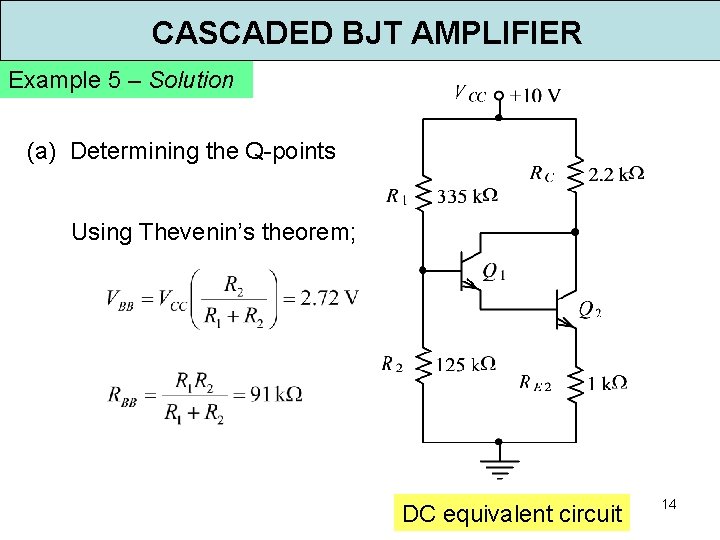
Alright, let’s get into the numbers. I’m going to assume you have a supply voltage (V_CC) and a desired collector current (I_C). Let’s use a common target: V_CC = 12V, I_C = 2 mA. We’ll use a voltage divider bias with an emitter resistor. This is the gold standard for stability because it makes the base voltage essentially independent of beta.
First rule of thumb: make the voltage divider 'stiff.' That means the current through the voltage divider (I_div) should be at least 10 times the base current (I_B). Since I_B = I_C / β, and we don’t trust β, we calculate for the worst case (lowest β you expect). If β_min = 100, then I_B_max = 2 mA / 100 = 20 μA. So I_div should be at least 200 μA. I usually go for 10 times to be safe—so 200 μA. That means the total resistance of the divider (R1 + R2) should be roughly V_CC / I_div = 12V / 200 μA = 60 kΩ.
Next, choose R_E. A common rule is to set the voltage at the emitter (V_E) to about 10-20% of V_CC. Let’s go with 10%: V_E = 1.2V. Then R_E = V_E / I_C = 1.2V / 2 mA = 600 Ω. That’s a standard value (use 620 Ω). Now, V_B = V_E + V_BE. Assume V_BE ≈ 0.7V, so V_B = 1.2V + 0.7V = 1.9V.
Now you pick R2 to set the base voltage. In a stiff divider, V_B = (R2 / (R1 + R2)) V_CC. You already know R1 + R2 = 60 kΩ. So 1.9V = (R2 / 60 kΩ) 12V. Solve for R2: R2 = (1.9 / 12) * 60 kΩ ≈ 9.5 kΩ. Use 9.1 kΩ or 10 kΩ. Then R1 = 60 kΩ - 9.5 kΩ ≈ 50.5 kΩ (use 51 kΩ).
Finally, choose R_C to set V_CE. For a centered swing, V_CE should be about V_CC / 2 = 6V. But we have V_E = 1.2V, so V_RC = V_CC - V_CE - V_E = 12V - 6V - 1.2V = 4.8V. Then R_C = V_RC / I_C = 4.8V / 2 mA = 2.4 kΩ. Use 2.2 kΩ or 2.7 kΩ.
That’s the stable Q-point. Now let’s prove it’s stable.
Checking Stability with Beta Variation
The magic of this voltage divider bias is that the base voltage is fixed by the resistors, not by beta. So if you swap in a transistor with β=300, the base current drops (since V_B is constant and R_E is fixed), but the collector current only changes slightly. Let’s test it.
For the circuit above, I_B = (V_B - V_BE) / (R_E * (β+1)) is the exact formula, but a quick approximation is I_C ≈ (V_B - V_BE) / R_E. Plug in: (1.9V - 0.7V) / 620 Ω = 1.2V / 620 Ω = 1.94 mA. That’s very close to our target of 2 mA. If β=300, the exact I_C calculates to about 1.96 mA. If β=100, it’s about 1.92 mA. That’s a change of only 2% over a 3x beta range. That’s stability.
Compare this to a fixed-bias circuit: a beta change from 100 to 300 would cause a 300% change in I_C. So the stable operating Q point is achieved by desensitizing the circuit to beta. It’s a little more math upfront, but it saves you from debugging later. Seriously, this is the difference between a professional design and a toy.
Real-World Adjustments for Temperature Drift
Temperature affects V_BE directly. At 25°C, V_BE might be 0.7V. At 85°C, it could drop to 0.58V. That 0.12V change looks small, but in our circuit, it would shift V_E and change I_C. Let’s calculate the drift: new I_C = (V_B - 0.58V) / R_E = (1.9V - 0.58V) / 620 Ω = 1.32V / 620 Ω = 2.13 mA. That’s a 6.5% increase over the 2 mA target. Acceptable? For most audio circuits, yes. For precision instrumentation, maybe not.
To improve further, you make the voltage divider even stiffer (higher divider current) or you add a diode in series with R_E to compensate for V_BE drift. But for 90% of designs, the simple voltage divider bias with an emitter resistor is enough. The key is to check the worst-case drift and decide if it’s within your tolerance. I always calculate for the maximum operating temperature and the lowest expected beta. That’s your safety margin.
Real-World Tools and Tricks to Verify Your Bias Point
You can do all the math in the world, but nothing beats a quick measurement. When you build the circuit, always measure V_CE and the voltage across R_E. If V_CE is within 10% of your target (say, around 6V for a 12V supply), you’re golden. If it’s way off, don’t panic. Just remeasure the resistor values and the actual V_BE. I’ve found plenty of mistakes where I used a 10 kΩ resistor instead of a 100 kΩ because the color bands blurred.
Another trick: vary the supply voltage by 5% and see if the Q-point moves. It shouldn’t move much. If it does, your divider isn’t stiff enough. Increase I_div to 20 times I_B. This is a classic stability test that reveals weak designs instantly.
Finally, simulate before you solder. Use a free tool like LTSpice or a quick online simulator. Sweep the temperature from 0°C to 70°C and watch the collector current. If it changes less than 10%, your DC quiescent point is rock solid. If it swings wildly, go back and increase R_E (which means you need to adjust V_B higher to maintain the same I_C). There’s always a trade-off between stability and voltage headroom. Learn to balance it.
Simulation vs. Breadboard: Trust but Verify
Simulation is great for catching math errors, but it assumes perfect components. The real world has resistor tolerances (5% or 1%), solder joint resistance, and board parasitics. I’ve seen a simulation predict a perfect 2.00 mA, only to measure 2.20 mA on the breadboard because the actual resistor values were on the high side.
Always do a reality check: measure the actual collector current by putting your multimeter in series with the collector lead, or measure the voltage across R_C and divide by R_C. If it’s off by more than 10%, check the beta of your specific transistor (measure it with a simple tester). Then adjust R1 or R2 slightly to dial in the exact Q-point. Remember, the formulas are guidelines. The multimeter is the final authority.
The Temperature Coefficient Test
This is a pro-level check. Heat up the transistor with a heat gun (or even just a soldering iron held nearby for a few seconds—carefully). Watch the collector current on a scope or meter. If it jumps up and stays high, your biasing network is too weak. If it jumps up but slowly settles back down, that’s the negative feedback working. That settling proves your circuit has good stability.
I usually aim for a temperature coefficient of less than 0.5% per degree Celsius. Anything more, and the design needs rethinking. This test is especially critical for power amplifiers where the transistor is already hot from dissipation. If the Q-point drifts significantly under self-heating, you’ll get crossover distortion or thermal runaway. Don’t skip this test.
Common Questions About How to Calculate the Stable Operating Q Point for a BJT
What happens if I ignore the emitter resistor entirely?
You’ll get a circuit that is highly dependent on beta and temperature. The Q-point will drift wildly, and thermal runaway is almost guaranteed with any significant power dissipation. The emitter resistor is the cheapest insurance you can buy. Always use one unless you have a very specific reason not to (like a very low supply voltage where every millivolt matters).
Can I use a current mirror for better stability?
Absolutely. A current mirror (like the basic Widlar or Wilson mirror) gives you a Q-point that is nearly independent of beta and temperature, as long as the transistors are matched. It’s overkill for most simple amplifiers but essential for differential pairs and integrated circuits. If you need extreme stability, a current mirror is the way to go.
How do I choose the right resistor values for the voltage divider?
Make the divider current at least 10 times the base current. Then set the base voltage to V_E + V_BE. Use standard resistor values and recalculate. If the calculated V_CE is too low (below 2V), increase R_E or decrease I_C. If V_CE is too high (over 90% of V_CC), decrease R_E. It’s an iterative process, but you’ll get a feel for it after two or three designs.
What if my desired I_C is very high (say, 100 mA)?
Then the emitter resistor will have a large voltage drop and dissipate significant power. You’ll need a resistor rated for the power (P = I²R). Also, the voltage divider might need to be very low resistance to keep the divider current high, which wastes power. In that case, consider a different bias topology, like a constant current source using a second transistor. But the same principles apply—stability over beta and temperature.
Does the Q-point have to be exactly at the center of the load line?
No. For maximum undistorted AC swing, yes, center is ideal. But if your load is a speaker or a low-impedance load, you might need a lower Q-point to avoid saturation. If the input signal is small, you can shift the Q-point higher to get more gain (since gain is roughly R_C / R_E). Stability is the primary goal; centering is secondary. Always prioritize a stable point over a perfectly centered one.