
The Difference Between an Alluvial Fan and an Alluvial Delta
You're driving through the desert in Nevada, and you see it. A massive, sweeping cone of gravel spilling out of a canyon onto the flat valley floor. It looks like a giant's spilled a truckload of rocks. Then, a week later, you're flying into New Orleans, and you see the Mississippi stretching into the Gulf like a tangled, muddy tree root. Both are sediment deposits. Both are created by moving water. But calling a fan a delta is like calling a cheeseburger a salad. They share ingredients, but they are not the same thing. Let me break down the difference between an alluvial fan and an alluvial delta, because understanding this is the key to reading the landscape.
The Hard Line: Water is the Judge
Look—the most fundamental split between these two landforms is brutally simple. It all comes down to where the water ends. An alluvial fan forms where a river exits a mountainous canyon and hits a dry (or much drier) plain. The water spreads out, loses its punch, and drops its load. It's a collision with the ground. An alluvial delta, on the other hand, forms where a river hits a standing body of water. A lake. An ocean. A reservoir. It's a collision with more water. That difference in fluid density changes everything.
Seriously, this is the hill I will die on. If there is no lake or sea involved, it cannot be a delta. It's a fan. Full stop. The shape might look similar from a satellite view, but the mechanics are completely different. A fan is built by a sudden drop in slope and flow confinement. A delta is built by the river hitting a bathtub of water that slows it down and clogs its system with salt or sediment flocculation. The environmental setting is the boss here.
What an Alluvial Fan Really Is (A Debris Spread)
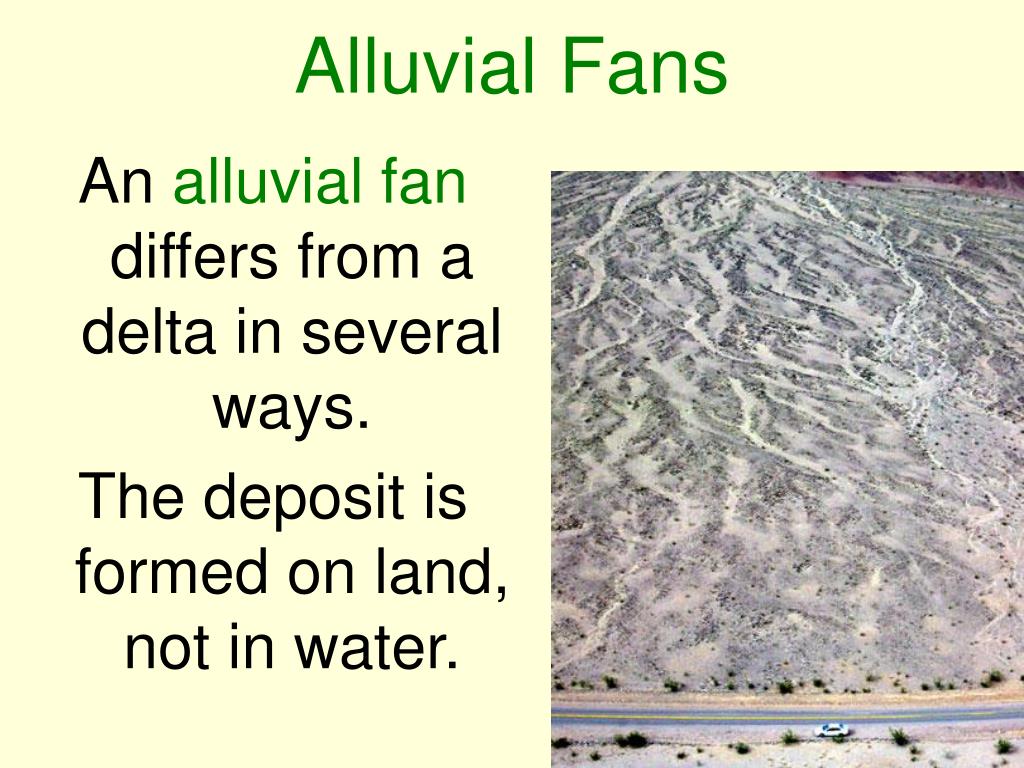
Alluvial fans are the drama queens of the geomorphology world. They form in high-energy environments, usually in arid or semi-arid regions, but also in wetter climates at the base of steep mountains. Imagine a flash flood roaring down a narrow canyon. It's carrying boulders, sand, and mud. The moment it spills out of that canyon mouth, it loses its confinement. The water spreads out laterally like a pancake on a hot griddle. It loses depth, loses velocity, and suddenly can't carry that big rock anymore. The alluvial fan is the pile of debris left behind.
Here's the kicker: fans are often poorly sorted. You'll find a house-sized boulder sitting right next to fine silt. Why? Because the flow is chaotic and decelerates rapidly. It's not a gentle, steady process. It's a pulse of energy that dumps everything at once. The surface of a fan is usually steep (compared to a delta) and marked by braided channels that shift and change every time it rains. It's a mess. A beautiful, violent mess.
- Debris flows are common here, not just water flows.
- Fans are typically found on land, entirely subaerial.
- The gradient is relatively steep, often 1 to 10 degrees.
Honestly? If you see a fan, you are looking at a place where gravity and water had a shouting match. The mountain lost.
What an Alluvial Delta Really Is (A Sediment Dump)
Alluvial deltas are the patient, organized cousins. They form when a river enters a quiet body of water. The river slows down, but it doesn't stop. It fans out into distributaries—think of the Mississippi's bird-foot shape or the Nile's smooth arc. The sediment is deposited in three distinct layers: topset (the flat top), foreset (the sloping front), and bottomset (the fine muds far out). It's a much more layered and sorted deposit than a fan.
The key here is buoyancy. Fresh river water is less dense than salty ocean water (or even cold lake water). So the river water floats on top initially, spreading out as a plume. The sediment settles out slowly, with the heaviest grains dropping first. That's why deltas have that classic layered structure. They aren't just piles of rubble; they are carefully stacked strata. An alluvial delta is a sign of a patient river, a stable base level, and a lot of time.
- River-dominated deltas (like the Mississippi) push fingers of sediment out into the basin.
- Wave-dominated deltas (like the Nile) are smoothed and shaped by ocean waves.
- Tide-dominated deltas (like the Ganges-Brahmaputra) have funnel-shaped mouths and strong tidal channels.
It's a big deal. The shape of the delta tells you exactly what kind of energy is fighting the river.
Energy, Sorting, and the Shape of Things
Now we get to the juicy part. How do you actually tell them apart when you are standing in the field? It's not just about whether you see water or not. It's about the story the sediment tells you. The difference between an alluvial fan and an alluvial delta is written in the grain size, the sorting, and the geometry of the deposit.
A fan screams violence. A delta whispers persistence. Let me explain exactly what I mean.
The Energy Collapse vs. The Buoyancy Factor
On a fan, the energy collapse is instantaneous. The water goes from confined to unconfined in the space of a few meters. The result? A steep, cone-shaped pile of sediment where the largest rocks are at the apex (the canyon mouth) and get smaller as you move outward. But even that sorting is terrible. You can find cobbles mixed with clay. The flow is often non-Newtonian—think wet concrete, not clear water. An alluvial fan is a debris dump.
In a delta, the energy drop is gradual. The river enters a large basin and the flow slows over kilometers, not meters. The sediment sorting is excellent. You get coarse sand near the river mouth, then silt, then clay far out in the basin. The river water spreads out laterally because it's floating, not because it hit a wall. That buoyancy creates a complex circulation pattern that distributes sediment in a predictable, layered way. It's physics, not chaos.
Here is a practical way to think about it:
- Fan: The water loses power because the slope disappears.
- Delta: The water loses power because it hits another fluid.
These are fundamentally different mechanisms. Don't let a similar shape fool you.
Why One Looks Like a Pie Slice and the Other Like a Bird's Foot
The geometry is a dead giveaway once you know what to look for. Alluvial fans are usually segments of a cone—like a slice of pie if you look from above. They have a single apex point at the canyon mouth and a radial drainage pattern on the surface. The fan surface is convex upward in cross-section, meaning it bulges in the middle. This is because the biggest sediment piles up near the apex.
Alluvial deltas, on the other hand, have a flat top (the delta plain) and a steep front (the delta front). They are concave upward in cross-section. The classic shape is that of a Greek letter delta (Δ), which is where the name comes from. Herodotus noticed this over 2,000 years ago. The distributaries split and rejoin, creating a network that resembles a tree or a foot. The Mississippi delta looks like a bird's foot because the river is pushing sediment out through narrow channels, building "fingers" of land.
Pro tip: Look at the map. If the deposit is at the mouth of a canyon and spreads onto a plain, it's a fan. If it's at the mouth of a river and extends into a lake or ocean, it's a delta. The context is everything.
It's that simple. And that complex. Because sometimes, a fan can be submerged by a rising sea level, and then we call it a "delta" in the rock record even if it started as a fan. Geology loves to mess with you.
Common Questions About the Difference Between an Alluvial Fan and an Alluvial Delta
Can an alluvial fan turn into an alluvial delta?
Technically yes, but only if the base level changes. If a lake forms at the foot of a fan or if sea level rises and floods the fan toe, the upper part remains a fan while the lower part becomes a deltaic deposit. In the rock record, we see these stacked sequences all the time. It's called a "fan-delta" and it's a hybrid that confuses everyone. But in the strict sense of active deposition, a fan is a fan until water covers it.
Which one is more dangerous for building on?
Without a doubt, an alluvial fan is more dangerous. They are prone to flash flooding, debris flows, and sudden channel avulsion. You can build a house on a fan today, and a mudflow could bury it next summer. Deltas are also dangerous (subsidence, flooding, liquefaction), but a fan's hazard is acute and violent. I have seen entire neighborhoods wiped out by a single storm event on a fan in California. Don't build on a fan unless you really understand the risk.
How can you tell them apart on a satellite image?
Look at the source. If the deposit is directly attached to a mountain front with a distinct apex and radial pattern, it's a fan. If it is at the end of a long river system and surrounded by water or marshland, it's a delta. Also check the color—fans often have lighter, coarser sediment near the apex. Deltas show a lot of vegetation and fine, dark sediment on the delta plain. And look for distributaries. Fans have braided channels. Deltas have distributary channels that split and stay active.
Are alluvial fans only found in deserts?
No, but that's a common misconception. They are most common in arid environments because there is less vegetation to stabilize slopes and more flash flooding. However, you can find excellent fans in humid regions too, like the Himalayas or the Canadian Rockies. The key requirement is a steep mountain front and a basin to receive sediment. I have mapped beautiful fans in the Pacific Northwest, where it rains constantly. They just look more vegetated and less dramatic.
Why does it matter which one it is?
It matters for groundwater. Fans are excellent aquifers because they are coarse and porous—water flows right through them. Deltas have complex layering with clay beds that trap water and create artesian conditions. It matters for oil and gas exploration. Fossilized fan deposits can hold hydrocarbons, but ancient deltas are some of the best reservoirs on Earth. And it matters for land use planning. You wouldn't build a dam on a delta (it would sink), and you wouldn't build a city on a fan without flood control. Knowing the difference between an alluvial fan and an alluvial delta saves lives and money.
That is, it is something that is not the same about two things. Use our desktop app for private, offline diffs. Compare text, files, and code (e.g. Is an online diff tool that can find the difference between two text documents. See examples of difference used in a sentence. The way in which two or more things which you are comparing are not the same: Definition of difference noun in oxford advanced learner's dictionary. For this calculator, the order of the numbers does not matter as. Percentage difference is usually calculated when you want to know the difference in percentage between two numbers. A difference is something that two or more things do not have in common.