
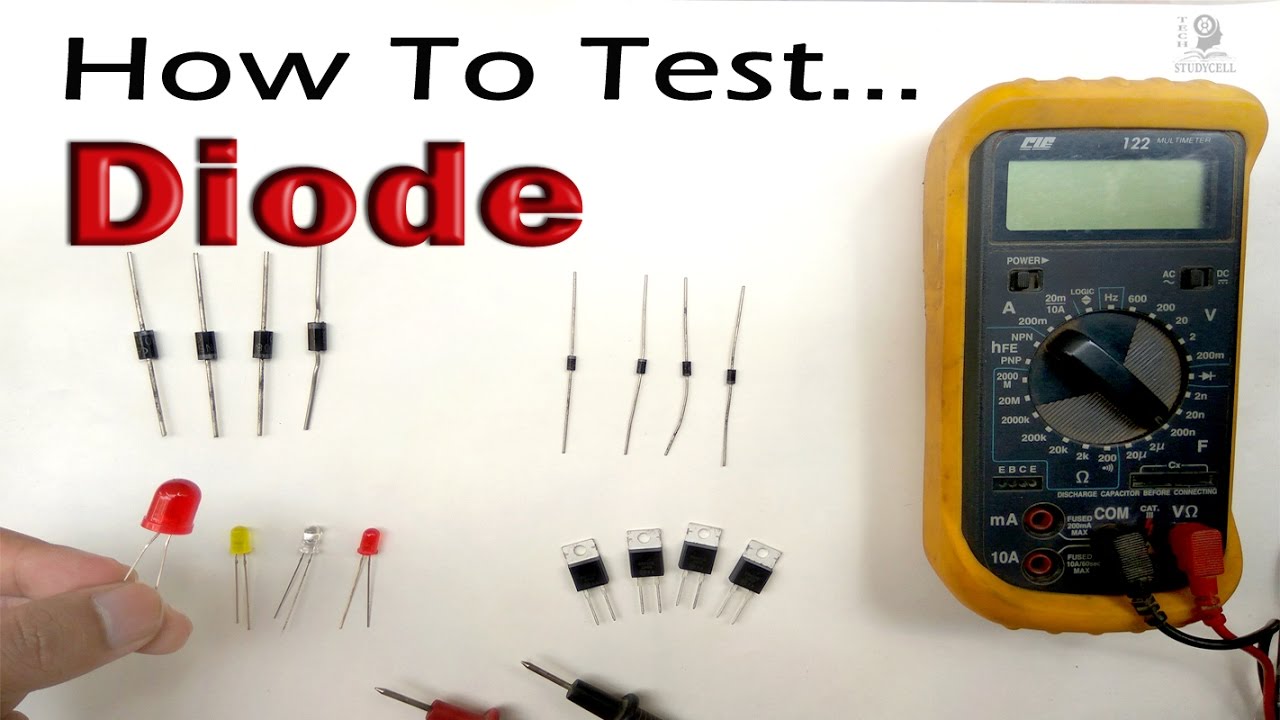
Using a Multimeter to Diagnose Diode Failure
I’ll never forget the first time a switching power supply just… quit. No smoke, no bang—just silence. The client was furious, and I was staring at a board that looked perfect. That’s when an old-timer slapped a multimeter in my hand and said, “Check the diodes.” Honestly? That single lesson probably saved my career a dozen times over. If you’re knee-deep in troubleshooting gear that’s gone belly-up, nine times out of ten a bad diode is the culprit. Using a multimeter to diagnose diode failure isn’t just a skill—it’s a survival tactic for anyone who works with electronics.
Look, I’ve seen engineers overcomplicate this. They grab oscilloscopes, run simulations, burn hours chasing ghosts. But the simplest, fastest route to a solid answer is still that humble multimeter in your drawer. Whether you're fixing a vintage amplifier or a modern EV charger, the technique is the same. You don't need a lab. You need a meter, a little patience, and the knowledge of what you're actually looking for.
Let’s get one thing straight: a diode is a one-way valve for electricity. Its job is to let current flow in one direction and block it in the other. When it fails, it either becomes a permanent open circuit (blocking everything) or a short circuit (letting everything through, usually with dramatic results). Diagnosing diode failure with a multimeter is about verifying that one-way street still exists. It’s deceptively simple, but the devil is in the details—especially when you’re testing in-circuit or dealing with weird semiconductor quirks.
So grab your meter, set it to the diode test mode (that little symbol that looks like an arrow hitting a wall), and let’s walk through this together. I promise you’ll walk away feeling like a legit detective.
Why Your Multimeter Is the Best Tool for the Job
You might be thinking, “Can’t I just use a continuity tester and call it a day?” Sure, you could—if you enjoy guessing games. A continuity beeper only tells you if there’s a low-resistance path. It can’t tell you if your diode is still rectifying properly. It’s a big deal. Using a multimeter to diagnose diode failure gives you two critical pieces of data: the forward voltage drop and the reverse blocking capability. Without those numbers, you’re flying blind.
The Magic of the Silicon Junction
A healthy silicon diode will show a forward voltage drop somewhere between 0.5V and 0.8V. Germanium diodes? Lower—around 0.2V to 0.4V. Schottky diodes sit in the 0.15V to 0.45V range. That specific voltage is the key. If you see 0.000V in forward bias (with a proper meter), the diode is likely shorted. If you see “OL” or an open reading in both directions, it’s toast—open circuit. Seriously, memorize those numbers. They’ll never let you down.
Now, here’s where most people trip up. They test a diode in-circuit without considering what else is attached to it. Resistors, capacitors, or other semiconductors can give you false readings. Your multimeter might show a forward drop that looks normal, but it’s actually the rest of the circuit pretending to be a diode. That’s why I always recommend starting with an out-of-circuit test if you can. Desolder one leg. It takes two minutes and saves you from chasing a phantom problem for hours.
But let’s be real—sometimes you can’t pull the part. In those cases, you need to interpret the readings with a skeptical eye. A shorted reading in-circuit almost always means a bad diode. An open reading is also reliable. But a normal-looking forward drop? That’s where you need to double-check with a voltage drop comparison against a known good part on the same board. It’s a lifesaver.
Setting Up Your Meter Correctly
Look—this sounds obvious, but I’ve watched professionals fumble with the selector dial for a solid minute. Make sure your meter is set to the diode test symbol. Not resistance. Not continuity. The diode test mode usually outputs a small current (around 1mA) and measures the voltage across the junction. If you accidentally use the resistance mode (ohms), you’ll get confusing readings because the meter applies a different voltage and current. Trust me, the results won’t make any sense.
Also, check your leads. A broken lead with a hairline fracture can give you intermittent readings that look like a flaky diode. I’ve been burned by that more than once. Touch the two probes together before you start. The meter should show 0.000V (or close to it) in diode mode. If it doesn’t, replace the probes or the batteries. It’s a quick sanity check that separates rookies from pros.
Finally, know your meter’s limits. Cheap multimeters sometimes can’t handle a diode that’s in a high-voltage circuit. They might give you a random reading or just show “OL” even on a good part. If you’re working on power electronics, invest in a decent meter with a proper diode test function. It doesn’t have to be a Fluke—but it shouldn’t be a $5 special from the gas station either.
The Step-by-Step Diagnosis Process
Alright, let’s get down to brass tacks. You’ve got a suspect diode in your hand (or at least identified on the board). Here’s exactly how I’ve done this thousands of times, from tiny signal diodes to massive rectifiers in industrial drives. Follow these steps, and you’ll diagnose the failure in under a minute.
Step 1: The Forward Bias Test
Identify the anode and cathode. Most diodes have a stripe on the cathode side. Place the red probe on the anode and the black probe on the cathode. For a silicon diode, you should see a reading between 0.5V and 0.8V. Write it down. Now, here’s the kicker—that number should be stable. If it’s drifting, jumping around, or showing 1.2V (which is possible for LEDs or Zener diodes), note that too. Using a multimeter to diagnose diode failure means looking for consistency as much as specific values.
What if you get 0.000V? That’s a short circuit. The diode is dead. Replace it. What if you get “OL” or an over-limit reading? That’s an open circuit. Also dead. Simple, right? But wait—if you’re testing a Zener diode (those used for voltage regulation), the forward drop looks just like a regular diode. The real test is in reverse bias, but we’ll get there.
One caveat: if the diode is in-circuit with a low-resistance parallel path, the forward reading might be artificially low. I’ve seen a perfectly good diode show 0.2V just because it was shunted by a transformer winding. That’s why isolating the component is always the gold standard. You can’t argue with a clean reading.
Step 2: The Reverse Bias Test
Swap your probes: red on cathode, black on anode. A healthy diode should show “OL” or a very high resistance reading (some meters display a voltage drop that goes into the volt range, indicating the meter can’t make it conduct). This is the blocking direction. If you see a low voltage drop here (like 0.3V or 0.5V), your diode is leaking—or it’s outright shorted. Either way, it’s failed.
Now, I need to be honest with you. Some cheap meters will show a small voltage in reverse bias (like 1.5V or 2V) because they’re applying enough voltage to partially break down the junction. That’s not necessarily a failure. But if the reading is consistently below 1V, you’ve got a problem. Leaky diodes are sneaky—they’ll pass a little current in reverse, which causes overheating and eventual catastrophic failure. I’ve traced dozens of intermittent faults to diodes that were only marginally leaky. Don’t ignore a borderline reading.
Also, watch out for thermal drift. Heat up the diode with a heat gun (or just let it run in-circuit for a few minutes). If the reverse leakage increases significantly as it warms up, it’s a ticking time bomb. Replace it. This is a pro-level trick that will save you from repeat failures. Seriously.
Common Failure Modes and What They Look Like
Over a decade in the field, I’ve seen three primary ways diodes die. Each leaves a distinct signature on your multimeter. Once you recognize these patterns, you’ll diagnose failures without even thinking about it.
- Short Circuit (Dead Short): Your meter reads 0.000V (or near zero) in both directions. The diode is now a piece of wire. Usually caused by overcurrent or surge events. This is the most common failure in power supplies.
- Open Circuit (Fused Junction): Your meter shows “OL” in both directions. The internal connection is broken. This often happens after prolonged overheating or a high-voltage spike that literally vaporizes the bond wire.
- Leaky Junction (Soft Failure): Forward voltage drop looks normal (e.g., 0.6V), but reverse bias shows a low reading like 0.2V or 0.3V. These are the hardest to catch because the circuit might still sort-of work—until it doesn’t. Thermal stress or manufacturing defects cause this.
There’s also a fourth, rarer failure called “thermal runaway” where the diode conducts properly when cold but fails as it heats up. You’ll catch this if you test your diode under load. A multimeter cold test might show a perfect part. Always test after the device has been running for a few minutes if you suspect an intermittent issue.
I once spent two days debugging a motor controller that would work for 10 minutes then shut down. Turned out one of the six rectifier diodes was perfectly fine at room temperature but leaked like a sieve at 60°C. Lesson learned: always combine your diode failure diagnosis with temperature awareness. It’s not just about the numbers—it’s about the context.
Advanced Tips for Tricky Situations
You’re going to run into scenarios that make you question your meter. Using a multimeter to diagnose diode failure isn’t always textbook. Here are a few battle-tested tactics for those moments.
Testing Diodes in Parallel or With Transformers
Parallel diodes (common in high-current rectifiers) can mask a single failure. If you test across the pair, you might still see a normal forward drop because the good diode is carrying the test current. The trick is to lift one leg of each diode and test individually. Yes, it’s annoying. Yes, it’s necessary. Alternatively, use a low-current ohmmeter setting (like 200 ohms) and check for a difference in resistance between the two diodes. A failed short circuit will read near zero ohms, but an open circuit might still be hidden. Lifting the leg is the only sure bet.
Transformers also create headaches. The low-resistance primary winding can make a shorted diode look like a good part in forward bias. I’ve seen technicians replace entire power supply boards only to realize the diode was bad all along. Always isolate the diode from transformer windings before testing. It’s five extra minutes that can save you hours of misdiagnosis.
Using the Voltage Drop Comparison Method
Here’s a trick that works wonders in-circuit without desoldering. Find a diode that you’re confident is good (maybe on a different part of the board, or a new component of the same type). Measure its forward voltage drop. Then measure the suspect diode under the exact same conditions—same meter, same temperature, same probe pressure. If there’s more than a 10% difference, that suspect is likely failing. This method relies on relative comparison rather than absolute values, which compensates for in-circuit loading effects. I’ve used this to spot failing diodes that still showed technically valid readings but were clearly degraded.
It’s not perfect—you need a reference point—but when you’re dealing with a diode failure that’s borderline, comparative testing is your best friend. Keep a small notebook with known good readings for common diode types. Trust me, future you will thank present you.
Common Questions About Using a Multimeter to Diagnose Diode Failure
Can I test a diode without removing it from the circuit?
Yes, but results are not always reliable. If the diode reads shorted or open, it’s definitely bad. But a normal reading doesn’t guarantee it’s good—other components can influence the measurement. For a definitive answer, lift one leg and retest.
My multimeter doesn't have a dedicated diode test mode. Can I still test a diode?
You can use the resistance (ohms) mode on a high range, like 200k or 2M. A good diode will show low resistance in one direction and high in the other. But this method is less precise. I strongly recommend getting a meter with a diode test function—it’s worth the $20 upgrade.
What does it mean if a diode shows a forward voltage drop of 0.2V instead of 0.6V?
It could be a Schottky diode (which is normal), or it could be a shorted silicon diode if the reading is unstable. Check the part number. If it’s a 1N4007 and you see 0.2V, it’s likely failed. Compare with a known good part of the same type.
Why would a diode fail intermittently?
Thermal stress is the #1 cause. A crack in the silicon die or a broken bond wire can make contact when cold but open up as the part heats and expands. Test the diode both cold and hot (using a heat gun or hair dryer) to catch this type of failure.
Can a multimeter test a Zener diode for its breakdown voltage?
No, most standard multimeters only test forward voltage drop and basic reverse leakage. To measure Zener breakdown voltage, you’ll need a variable power supply and a resistor, or a dedicated component tester. The diode test on a meter will just show “OL” in reverse if the Zener voltage is higher than the meter’s internal voltage.